
Co-Extruded Rubber Seals Factory | Material Science Data
By Zhouxin Sealing Engineering Team · · 4 views
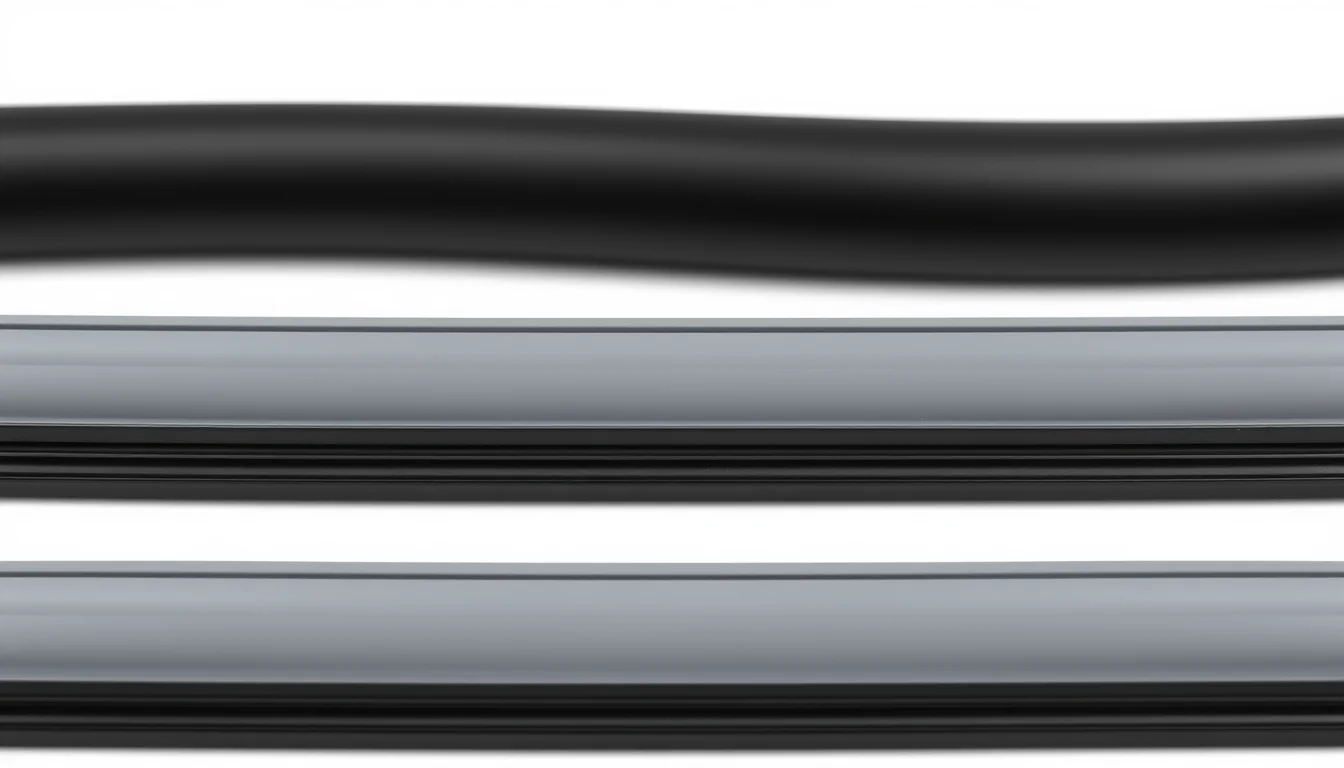
A co-extruded rubber seals factory supplies dual-durometer profiles where a hard carrier and soft sealing bulb are vulcanized in one pass, delivering tensile strength from 7 to 15 MPa, compression set below 25% per ASTM D395, and thermal aging verified to ASTM D573. This datasheet compares polymer matrices for overseas OEM and wholesale specifiers. All figures below are production-verified at our Changde, Hunan facility.
Material Science Comparison: Co-Extruded Elastomer Systems
Co-extrusion bonds two or more elastomer streams at the die head before vulcanization. The polymer matrix of each stream dictates tensile strength, compression set, and chemical resistance. The table below presents typical values for the grades we run in continuous production.
| Elastomer System | Hardness (Shore A) | Tensile Strength (MPa) | Compression Set % (70h @ 100°C) | Thermal Aging (ASTM D573, hrs @ 100°C) | Oil Resistance (IRM 903, 70h @ 100°C) | Acid/Alkali Resistance | Ozone Resistance | Temp Range (°C) |
|---|---|---|---|---|---|---|---|---|
| EPDM / EPDM | 50–80 | 8–12 | 18–25 | 1000+ | Poor (swell >100%) | Good | Excellent | -50 to +150 |
| EPDM / TPE | 60–85 | 7–10 | 20–28 | 700 | Poor | Good | Excellent | -40 to +120 |
| Silicone / Silicone | 40–70 | 6–10 | 15–22 | 1000+ | Fair | Good | Excellent | -60 to +200 |
| NBR / PVC | 55–85 | 9–14 | 20–30 | 500 | Excellent (swell <15%) | Fair | Fair | -30 to +120 |
| TPE / TPE | 55–90 | 8–15 | 25–35 | 400 | Good | Fair | Good | -40 to +110 |
| Neoprene / EPDM | 50–75 | 8–13 | 20–28 | 800 | Good | Good | Good | -40 to +120 |
Tensile strength is measured per ASTM D412 on die-cut specimens from the finished extrusion. Compression set follows ASTM D395 Method B. Aging hours are extrapolated from Arrhenius plots of tensile retention at 70°C, 100°C, and 125°C.
Why Co-Extrusion Changes the Spec Sheet
A single-durometer profile forces a compromise: soft enough to seal, hard enough to clip. Co-extrusion removes that constraint. The hard leg (typically 70–90 Shore A) carries the insertion force; the soft bulb (40–60 Shore A) deforms at low compression. The interface between the two streams is a chemical bond formed during vulcanization, not an adhesive joint. Peel strength at the interface typically exceeds 4 N/mm, which is higher than the tear strength of the softer compound.
Compression Set and Long-Term Sealing Force
Compression set is the single best predictor of seal life. A profile with 20% set at 70h/100°C will retain roughly 80% of its initial sealing force after that exposure. For a door sealing strip cycling 20 times per day, this translates to a service window of 8–12 years in temperate climates. Silicone co-extrusions achieve 15–22% set, which is why they dominate high-temperature oven and cabinet seal applications.
Chemical and Environmental Resistance Data
Oil, Acid, and Alkali Exposure
Per ISO 1817, volume swell after 70h immersion at 100°C:
| Medium | EPDM | Silicone | NBR | TPE |
|---|---|---|---|---|
| IRM 903 oil | >100% | 40–60% | 10–15% | 25–40% |
| 10% H₂SO₄ | <5% | 5–10% | 15–25% | 10–20% |
| 10% NaOH | <5% | <5% | 10–20% | 8–15% |
| Deionized water | <3% | <3% | <5% | <3% |
EPDM is the default for outdoor and water-contact profiles. NBR is specified when oil mist or hydraulic fluid is present. Silicone is chosen when the temperature exceeds 150°C or when the profile must remain flexible below -50°C.
Ozone and UV Aging
Ozone resistance is tested per ASTM D1149 at 50 pphm, 40°C, 20% strain. EPDM and silicone show no cracking after 1000 hours. NBR and TPE require antiozonant packages and are rated to 200–400 hours. For exterior architectural profiles, we recommend EPDM or a silicone co-extrusion. WPC profiles with co-extruded EPDM seals are common in decking and cladding systems.
Flame Retardancy
UL 94 V-0 is achievable in silicone and TPE co-extrusions with halogen-free additives. EPDM can reach V-1 with hydrated mineral fillers, but tensile strength drops 15–20%. For silicone series profiles used in electrical enclosures, we run a V-0 compound with 6–8 MPa tensile and 18% compression set.
Extrusion Tolerance and Dimensional Control
Co-extruded profiles are measured on a vision system at 100% inspection. Standard extrusion tolerance follows ISO 3302-1 Class E2 for dense rubber:
| Dimension Range (mm) | Tolerance (±mm) |
|---|---|
| 0–4 | 0.10 |
| 4–10 | 0.15 |
| 10–25 | 0.25 |
| 25–63 | 0.40 |
| 63–100 | 0.60 |
Tighter tolerances (±0.05 mm) are available on the sealing bulb for automotive and medical enclosure programs. Cut-length tolerance is ±0.5 mm on automatic cutting lines.
In our Hunan factory experience, a European OEM specified a co-extruded EPDM/TPE cabinet seal at 65 Shore A bulb and 85 Shore A carrier. The first article ran 0.22 mm over on the bulb height due to die swell after 48 hours of continuous extrusion. We corrected by adjusting the die land length and puller speed, then held ±0.12 mm across a 20,000-meter run. The lesson: co-extrusion tolerance drifts with die temperature, so we log die-head temperature every 15 minutes and recalibrate the vision system each shift.
Vulcanization and Bond Integrity
Co-extrusion requires the two compounds to reach peak cure at the same time. If the hard leg cures faster, the interface traps unreacted curatives and peel strength drops below 2 N/mm. We formulate cure systems with matched scorch times (t5 within 15 seconds) and run a moving-die rheometer on every batch. Salt-bath or hot-air vulcanization lines run 8–12 minutes at 180–220°C, depending on profile cross-section. Post-cure is applied to silicone profiles to remove volatiles and stabilize compression set.
Frequently Asked Questions
What is the MOQ for co-extruded rubber seals?
MOQ is 500 meters per profile for standard compounds and 2,000 meters for custom color or flame-retardant formulations. Tooling amortization is waived above 10,000 meters. We accept mixed-container orders combining two or three profiles to reach the MOQ.
What is the lead time?
Sample and first-article lead time is 10–15 days after drawing approval. Production lead time is 20–25 days for 5,000–20,000 meters, plus 3–5 days for sea freight from Shanghai or Shenzhen. Expedited 10-day production is available on silicone and EPDM profiles.
What extrusion tolerance can you hold?
Standard tolerance is ISO 3302-1 Class E2, typically ±0.10 mm on dimensions under 4 mm and ±0.25 mm on dimensions 10–25 mm. We hold ±0.05 mm on sealing bulbs for automotive programs. Cut length is ±0.5 mm.
How are co-extruded seals packed?
Profiles are coiled in 50–200 meter rolls, wrapped in PE film, then packed in cartons on pallets. Cut-to-length pieces are packed in polybags with desiccant. We offer neutral packing or custom-printed cartons for wholesale buyers.
What is the sample policy?
Free samples up to 1 meter per profile are provided for evaluation. Buyer pays courier only. Custom-compound samples require a 50-meter minimum and 7–10 days. Sample cost is credited against the first production order.
Specification Summary
| Parameter | Standard Range | Tight Tolerance Option |
|---|---|---|
| Hardness | 40–90 Shore A | ±3 Shore A |
| Tensile strength | 6–15 MPa | per ASTM D412 |
| Compression set | 15–35% | <20% available |
| Thermal aging | 400–1000+ hrs | per ASTM D573 |
| Ozone resistance | 200–1000+ hrs | per ASTM D1149 |
| Flame retardancy | UL 94 V-1 to V-0 | halogen-free |
| Extrusion tolerance | ISO 3302-1 E2 | ±0.05 mm |
| Cut length | ±0.5 mm | ±0.3 mm |
Send your CAD drawing for a 24-hour quote.
Need a Custom Quote?
Send your CAD drawing or specs (material, hardness, profile, temperature range, MOQ) — our engineering team will respond within 24 hours.