
Aluminum Window Sealing Strips | B2B Manufacturer & OEM
By Zhouxin Sealing Engineering Team · · 4 views
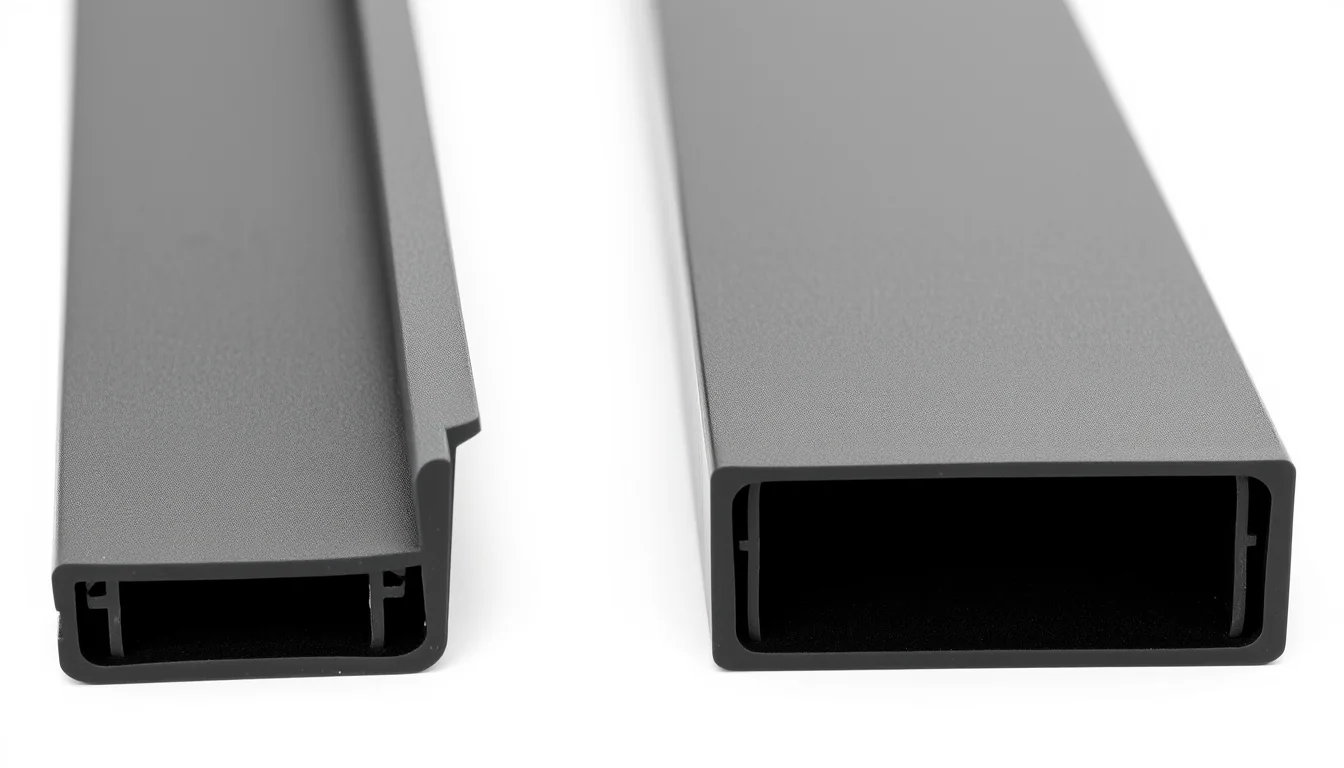
For aluminum window sealing strips, the material choice dictates a 10–25 year service life: EPDM offers the best cost-to-aging balance (tensile 10–15 MPa, compression set <25% after 70h at 100°C), silicone excels at temperature extremes (-60 to 200°C), and TPE provides co-extrusion compatibility with aluminum profiles. This datasheet-grade comparison gives overseas B2B specifiers the numbers needed to select an elastomer for fenestration projects.
Material Property Benchmark: EPDM vs. Silicone vs. TPE vs. Neoprene
The following table consolidates typical values from production batches and ASTM D412 / D573 testing. All compounds are sulfur- or peroxide-cured, with carbon black or mineral fillers in the polymer matrix.
| Property | EPDM | Silicone (VMQ) | TPE (SEBS) | Neoprene (CR) |
|---|---|---|---|---|
| Hardness (Shore A) | 60–80 | 40–70 | 50–75 | 55–75 |
| Tensile strength (MPa) | 10–15 | 6–10 | 5–9 | 8–12 |
| Elongation at break (%) | 300–500 | 250–450 | 400–600 | 300–500 |
| Compression set (%, 70h @ 100°C) | 15–25 | 10–20 | 30–45 | 20–30 |
| Thermal aging (hours @ 120°C, retention ≥80%) | 1000+ | 2000+ | 500–700 | 700–1000 |
| Ozone resistance (ASTM D1149, 50 pphm) | Excellent | Excellent | Good | Good |
| Oil resistance (ASTM #1 oil, 70h @ 100°C) | Poor (swell >100%) | Fair (swell 20–40%) | Poor | Good (swell <30%) |
| Acid/alkali resistance (pH 3–11) | Good | Good | Fair | Fair |
| Service temperature range (°C) | -50 to 150 | -60 to 200 | -40 to 100 | -40 to 120 |
| Flame retardancy (UL 94) | HB (FR grades V-0) | V-0 available | HB | V-0 available |
| Relative cost index | 1.0 | 2.5–3.5 | 1.2–1.5 | 1.3–1.6 |
Tensile Strength and Durometer Selection
For aluminum window sealing strips, a tensile strength below 8 MPa indicates excessive filler loading and predicts premature tearing at mitered corners. Specify 10–12 MPa for EPDM glazing gaskets and 60±5 Shore A for compression seals; weatherseals that contact sliding sashes should run 65–70 Shore A to resist abrasion. Durometer tolerance should be held to ±3 points per ASTM D2240.
Compression Set and Long-Term Seal Integrity
Compression set is the single most predictive metric for window seal longevity. A seal with 25% set at 70h/100°C (ASTM D395 Method B) retains adequate rebound force after 10+ years of diurnal cycling. Silicone's 10–20% set justifies its cost in high-rise curtain walls; TPE's 30–45% set limits it to interior or low-cycle applications.
Thermal Aging and Ozone Resistance Data
ASTM D573 thermal aging at 120°C for 1000 hours shows EPDM retaining 85–90% tensile strength and 80% elongation; silicone retains >90% at 2000 hours. Ozone resistance per ASTM D1149 is critical for coastal projects: EPDM and silicone show no cracking at 50 pphm after 200 hours, while TPE requires anti-ozonant additives.
In our Hunan factory experience, a Middle East curtain-wall project specified EPDM strips for a 50°C ambient site; after 18 months of accelerated testing at 90°C, compression set measured 22% versus the 25% specification limit, while a competitor's TPE sample exceeded 40% and was rejected at incoming inspection.
Chemical Resistance for Aluminum Window Sealing Strips
Aluminum window frames are exposed to acidic rain (pH 4–5), alkaline detergents (pH 10–11), and occasional solvent contact. EPDM swells >100% in ASTM #1 oil and is unsuitable for oil-contaminated facades; Neoprene swells <30% and suits industrial environments. Silicone offers the broadest acid/alkali resistance (pH 2–12) but has poor hydrocarbon resistance. For coastal salt-spray (ASTM B117), EPDM and silicone both exceed 1000 hours without degradation.
Flame Retardancy and Building Code Compliance
For high-rise fenestration, UL 94 V-0 flame retardancy is achievable in silicone and Neoprene compounds; EPDM requires halogenated or intumescent additives that may reduce aging performance. Verify UL 94 rating with the compound supplier's file number.
Extrusion Tolerance and Vulcanization Control
Extrusion tolerance for aluminum window sealing strips should be ±0.3 mm on critical sealing lips and ±0.5 mm on overall dimensions, per ISO 3302-1 Class E2. Vulcanization temperature (160–180°C for EPDM, 170–190°C for silicone) and line speed control crosslink density; undercured strips exhibit high compression set and poor ozone resistance. Our lines run continuous vulcanization with in-line laser gauging.
| Parameter | Specification | Test Method |
|---|---|---|
| Hardness tolerance | ±3 Shore A | ASTM D2240 |
| Tensile strength | ≥10 MPa (EPDM) | ASTM D412 |
| Compression set | ≤25% (70h @ 100°C) | ASTM D395 B |
| Thermal aging | 1000h @ 120°C, ≥80% retention | ASTM D573 |
| Ozone resistance | No crack, 50 pphm, 200h | ASTM D1149 |
| Extrusion tolerance | ±0.3 mm | ISO 3302-1 E2 |
| Color fastness | ΔE ≤3 after 500h QUV | ASTM D4329 |
For complementary profiles, review our door sealing strips and silicone series; cabinet and enclosure applications may use cabinet seals, while decorative trims pair with WPC profiles.
Frequently Asked Questions
What is the MOQ for aluminum window sealing strips?
MOQ is 500 kg per compound and profile, or 1,000 meters for standard sections. Custom extrusion dies require a one-time tooling fee and 1,500-meter minimum. OEM/ODM buyers can combine profiles within the same compound to reach MOQ.
What is the lead time?
Standard profiles ship in 15–20 days after drawing approval; custom compounds and new dies require 25–35 days. Air freight samples dispatch in 5–7 days. Peak season (Q3) adds 5 days.
What extrusion tolerance do you hold?
±0.3 mm on sealing lips and ±0.5 mm on overall dimensions per ISO 3302-1 Class E2. Tighter ±0.2 mm is available on request for automated glazing lines.
How are strips packed for export?
Coils in PE film, 100–200 m per coil, packed in cartons or wooden crates with desiccant. Coil diameter and labeling follow buyer specification; palletized loads suit container shipment.
What is your sample policy?
Free 1–2 meter samples of standard profiles ship within 3 days; buyer pays freight. Custom compound samples require a 7–10 day lead time and a nominal fee, credited against the first order.
| Profile Type | Material | Hardness (Shore A) | Tensile (MPa) | Compression Set | Temp Range |
|---|---|---|---|---|---|
| Glazing gasket | EPDM | 65 ±3 | ≥12 | ≤20% | -50 to 150°C |
| Weatherseal | Silicone | 60 ±3 | ≥8 | ≤15% | -60 to 200°C |
| Sliding sash seal | TPE | 70 ±3 | ≥6 | ≤35% | -40 to 100°C |
| Industrial trim | Neoprene | 65 ±3 | ≥10 | ≤25% | -40 to 120°C |
Send your CAD drawing for a 24-hour quote.
Need a Custom Quote?
Send your CAD drawing or specs (material, hardness, profile, temperature range, MOQ) — our engineering team will respond within 24 hours.