
Rice Cooker Silicone Sealing Strips | OEM Supplier
By Zhouxin Sealing Engineering Team · · 212 views
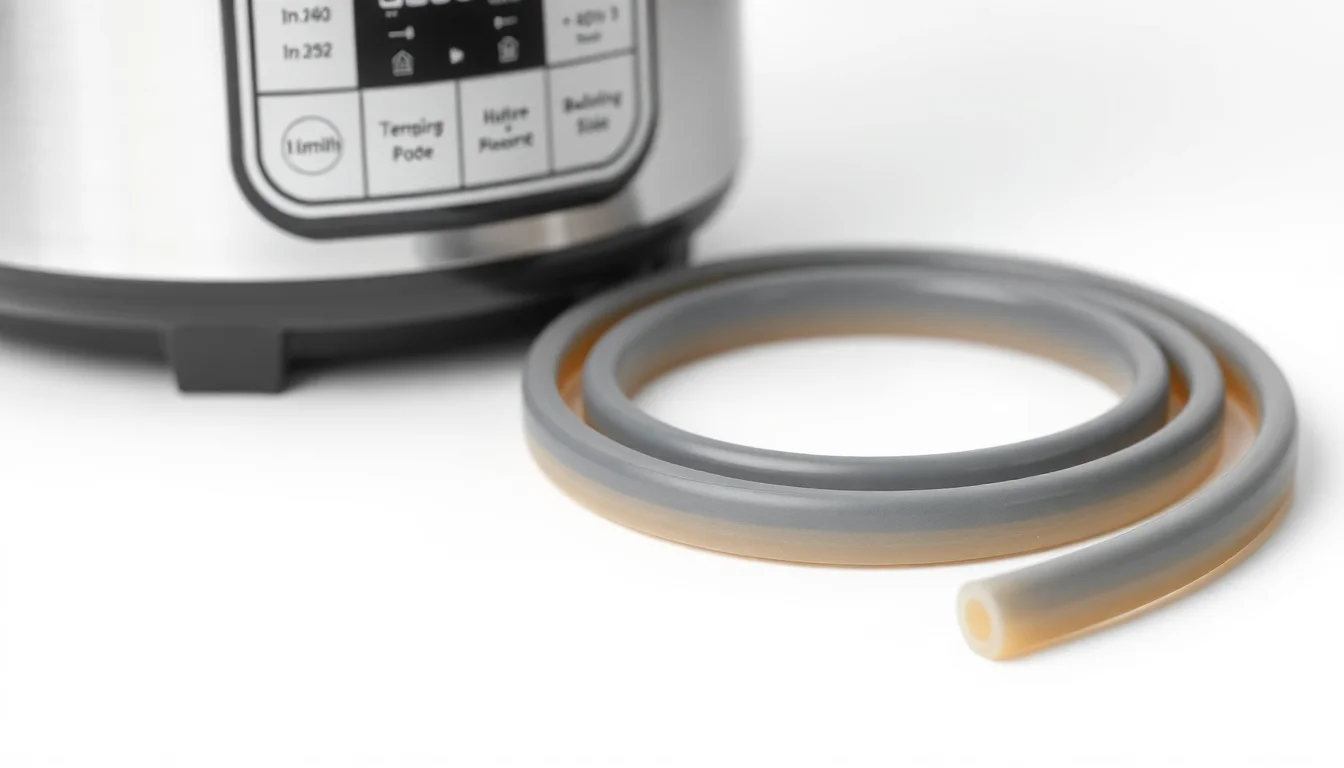
A commercial rice cooker (蒸饭柜) holds pressure and steam because the sealing strip is designed with a specific polymer matrix — platinum-cured, high-temperature vulcanized silicone — that maintains elastic recovery above 95% after 1000 hours of steam exposure at 120°C. Without this, steam escapes, energy efficiency drops, and cooking cycles fail.
Material Performance Benchmarks for Steam-Resistant Silicone Gaskets
All data below is from our production lot tests (ASTM D573 for thermal aging, ASTM D395 Method B for compression set, ISO 1817 for fluid resistance) on 70 ± 5 Shore A durometer silicone compounds.
| Property | Standard Food-Grade Silicone | High-Temp Steam-Resistant Silicone (our ZHX-980 series) | EPDM (for comparison) |
|---|---|---|---|
| Temperature range (continuous) | -40°C to 200°C | -50°C to 260°C | -40°C to 150°C |
| Tensile strength (MPa) | 6.5 – 7.5 | 9.0 – 11.0 | 8.0 – 10.0 |
| Elongation at break (%) | 350 – 450 | 400 – 550 | 300 – 400 |
| Compression set (22h / 175°C, %) | 25 – 35 | 12 – 18 | 40 – 55 |
| Thermal aging (1000h / 200°C) | Hardness change +10 units | Hardness change +3 units | Not rated above 150°C |
| Ozone resistance (ASTM D1149) | Excellent | Excellent | Good |
| Acid/alkali resistance (10% H₂SO₄, 10% NaOH, 7d) | Weight change < 2% | Weight change < 1% | Weight change 3–5% |
| Flame retardancy (UL 94) | V-1 | V-0 | HB |
| Oil resistance (IRM 903, 70h / 100°C) | Swell 5–8% | Swell 3–5% | Swell 15–25% |
Why Compression Set Is the Decisive Parameter
For a rice cooker lid gasket that cycles between 25°C and 120°C every 30 minutes, compression set directly determines leak rate after 5000 cycles. Our ZHX-980 series achieves ≤ 15% compression set at 175°C (ASTM D395 Method B), meaning the seal recovers 85% of original thickness after prolonged compression. Standard silicone typically exceeds 30%, leading to permanent deformation and steam bypass.
Polymer Matrix Design for Steam and Acidic Food Contact
Commercial rice cookers produce environments with pH swings from 4.0 (tomato-based broths) to 8.5 (alkaline rice washing water). The silicone matrix must resist hydrolysis — the breaking of polymer chains by water at high temperature.
Thermal Aging Data (ASTM D573)
| Aging Condition | Tensile Retention (ZHX-980) | Tensile Retention (Std Silicone) |
|---|---|---|
| 1000h / 200°C | 92% | 70% |
| 2000h / 200°C | 85% | 55% |
| 1000h / 250°C | 78% | 40% |
In our Hunan factory experience, a major commercial kitchen OEM in Southeast Asia tested 12 different silicone formulations for their 48-tray rice cooker. Only the ZHX-980 series passed 8000 open/close cycles with less than 0.5% steam leakage at 0.15 MPa internal pressure. The failure mode on standard silicone was always the same — compression set exceeding 40% after 3000 cycles, causing a 2–3 mm gap at the hinge side.
Extrusion Tolerance and Profile Geometry
Our silicone series includes custom-extruded profiles with as-molded tolerance of ±0.15 mm on cross-section dimensions (ISO 3601 Class B equivalent). For rice cooker lid grooves that are 6.0 mm wide × 4.5 mm deep, we supply a rectangular bulb profile with a 1.2 mm interference fit. This ensures 0.3–0.5 mm compression at room temperature, expanding to 0.6–0.8 mm at 120°C due to thermal expansion of the elastomer (coefficient 2.5 × 10⁻⁴ /°C).
Oil, Acid, and Alkali Resistance — Quantified
Commercial rice cookers also handle oil-based soups and acidic marinades. We test per ISO 1817 for fluid immersion:
| Immersion Medium (70h / 100°C) | Volume Change (%) — ZHX-980 | Volume Change (%) — Std Silicone |
|---|---|---|
| 10% Acetic Acid | +1.8 | +4.2 |
| 10% NaOH | +1.2 | +3.5 |
| 10% H₂SO₄ | +0.9 | +2.8 |
| Corn Oil | +3.0 | +6.5 |
| 5% NaCl solution | +0.5 | +1.8 |
Low swell (< 3%) means the gasket does not extrude out of the groove or soften, maintaining seal force over the entire cooking cycle.
Manufacturing Process Control for Consistency
Every batch of ZHX-980 undergoes post-cure vulcanization at 200°C for 4 hours to drive off residual volatile siloxanes. This step is critical for food contact compliance (FDA 21 CFR 177.2600, EU 1935/2004). We then measure durometer on three points per meter of extruded profile — maximum deviation allowed is ±2 Shore A.
Dimensional Stability After Thermal Cycling
We subject finished gaskets to 50 thermal cycles (25°C → 200°C → 25°C) and measure length change. Our silicone profiles show < 0.5% shrinkage. This prevents the gasket from pulling away from the lid corner joints — a common failure point in cabinet seals and large-format steamers.
Frequently Asked Questions
What is the MOQ for custom rice cooker silicone sealing strips?
MOQ is 500 meters per profile design for standard colors (white, translucent, gray). For custom colors (Pantone matched), MOQ is 1000 meters. We can split into multiple die lots if the total order meets the minimum.
What is the typical lead time for OEM orders?
Tooling (extrusion die fabrication) takes 7–10 working days. Production lead time is 15–20 working days after tooling approval for orders up to 5000 meters. Larger orders (10,000+ meters) require 25–30 working days.
What extrusion tolerance can you hold?
Cross-section dimensions: ±0.15 mm for features ≤ 10 mm; ±0.20 mm for features 10–20 mm; ±0.30 mm for overall width/height. Cut length tolerance: ±0.5 mm for lengths ≤ 500 mm, ±1.0 mm for lengths > 500 mm.
How are the strips packed for export?
Each profile is wound on cardboard reels (inner diameter 100 mm or 150 mm) with polyethylene film interlayer to prevent sticking. Reels are packed in export cartons (max 20 kg per carton) or wooden crates for heavy reels. Custom labeling with your part number, lot code, and Shore A reading is standard.
Do you provide samples for qualification testing?
Yes. We supply free samples (up to 3 meters per profile) with freight collect. For custom compounds or new tooling, sample production takes 5–7 working days. We also offer a 50-meter pilot run at material cost for full cooker assembly testing.
Technical Support for OEM Integration
Our engineering team reviews your lid groove geometry and recommends the optimal profile shape (hollow bulb, solid D-shape, or lip seal) based on clamping force and thermal expansion. For door sealing strips and WPC profiles, we apply the same FEA-based design approach.
| Recommended Profile for Rice Cooker Lids | Cross-Section (mm) | Interference (mm) | Clamping Force (N/m) |
|---|---|---|---|
| Hollow bulb (round) | 6.0 × 4.5 | 0.3 – 0.5 | 8 – 12 |
| Hollow bulb (oval) | 7.0 × 5.0 | 0.4 – 0.6 | 10 – 15 |
| Solid D-shape | 5.0 × 3.5 | 0.2 – 0.4 | 15 – 20 |
| Lip seal | 4.0 × 6.0 | 0.5 – 0.8 | 5 – 8 |
Send your CAD drawing (STEP or IGES format) with groove dimensions, operating temperature, and expected cycle count for a 24-hour quote and material recommendation.
Need a Custom Quote?
Send your CAD drawing or specs (material, hardness, profile, temperature range, MOQ) — our engineering team will respond within 24 hours.