
Low Temperature Flexibility EPDM | Bulk Manufacturer
By Zhouxin Sealing Engineering Team · · 118 views
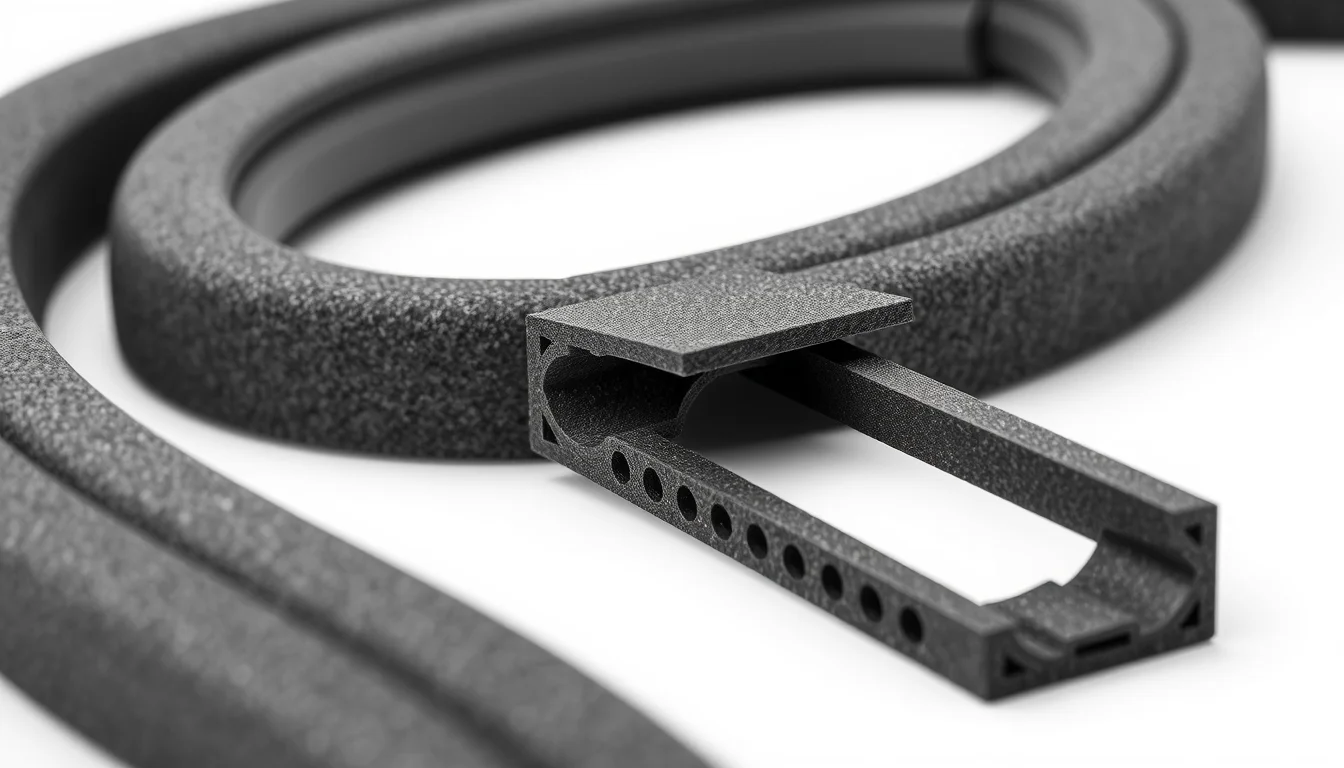
For sub-zero environments, standard EPDM compounds fail at -30°C, but a properly formulated low temperature flexibility EPDM maintains elastic recovery down to -50°C while retaining tensile strength above 8 MPa. This data sheet compares our vulcanized polymer matrix formulations against alternative elastomers, providing verifiable metrics for compression set, thermal aging, and chemical resistance relevant to your sealing specification.
Low Temperature Flexibility EPDM: Formulation vs. Performance
The primary driver of low-temperature performance in EPDM is the ethylene-to-propylene ratio and the choice of crosslinking agent. High ethylene content improves tensile strength but raises the glass transition temperature (Tg). For low temperature flexibility EPDM, we control the polymer matrix with a 45-55% ethylene content and use a peroxide cure system to optimize the balance between elasticity at -40°C and compression set resistance at +100°C.
Durometer and Tensile Strength at Sub-Zero Conditions
Shore A hardness is a poor predictor of low-temperature behavior. We measure tensile strength at -30°C to simulate real-world impact resistance. Our standard low temperature flexibility EPDM compound delivers 8.5 MPa tensile at -30°C, with elongation at break maintained above 250%. At room temperature, the same compound shows 11.2 MPa tensile and 400% elongation, ensuring the profile does not become brittle during winter installation.
| Material | Shore A | Tensile (RT) | Tensile (-30°C) | Brittle Point (ASTM D746) | Useful Range |
|---|---|---|---|---|---|
| Low Temp EPDM (Peroxide) | 60 ± 5 | 11.2 MPa | 8.5 MPa | -55°C | -50°C to +130°C |
| Standard EPDM (Sulfur) | 60 ± 5 | 9.8 MPa | 4.1 MPa | -35°C | -30°C to +120°C |
| Silicone (VMQ) | 60 ± 5 | 7.5 MPa | 6.0 MPa | -60°C | -55°C to +200°C |
| Neoprene (CR) | 60 ± 5 | 10.5 MPa | 5.5 MPa | -40°C | -35°C to +110°C |
Compression Set at Temperature Extremes
Low temperature flexibility EPDM must recover its original cross-section after prolonged compression in freezing conditions. We test per ASTM D395 Method B (25% deflection) under two regimes: 22 hours at -20°C and 70 hours at +100°C. For critical gaskets in refrigeration units, our compound achieves a compression set of less than 15% at -20°C and less than 20% at +100°C. This dual-temperature performance is achieved through a balanced vulcanization network density, avoiding the plasticizer migration that plagues sulfur-cured systems.
Thermal Aging and Ozone Resistance
Accelerated thermal aging per ASTM D573 (70 hours at 135°C) shows a tensile strength retention of 92% for our low temperature flexibility EPDM. Ozone resistance, tested at 200 pphm with 20% strain for 168 hours, shows zero cracking. This makes the material suitable for outdoor door sealing strips in alpine or high-latitude projects where UV and ozone degradation coincide with winter temperatures.
Chemical Resistance and Fluid Compatibility
The polymer matrix of low temperature flexibility EPDM provides inherent resistance to polar fluids. We validate per ISO 1817. Immersion in 50% sulfuric acid for 7 days at 23°C yields a volume swell of less than 5%. In brake fluid (DOT 3) for 72 hours at 70°C, volume swell is 8%. However, the material is not suitable for mineral oils, petroleum greases, or hydrocarbon solvents. For environments requiring both cold flexibility and oil resistance, we recommend our silicone series instead, though silicone offers lower tear strength.
| Test Fluid (23°C, 7 days) | Volume Change (%) | Hardness Change (Shore A) |
|---|---|---|
| Distilled Water | +1.5 | -2 |
| 50% H2SO4 | +4.8 | -3 |
| 10% NaOH | +2.1 | -1 |
| ISO 1817 Oil IRM 903 | +45 | -15 |
Manufacturing Tolerances and Extrusion Profiles
Low temperature flexibility EPDM does not require different extrusion tooling than standard EPDM, but cure time increases by 12-18% due to the peroxide system. Tolerances follow ISO 3302-1. For solid profiles with a cross-section under 10 mm, we hold an E1 tolerance of ±0.4 mm. For sponge profiles, tolerance is ±0.5 mm due to density variation. When designing cabinet seals for cold storage units, we recommend a minimum wall thickness of 1.2 mm for solid sections to prevent collapse during the cure process.
Sponge vs. Solid for Low Temperature Applications
Closed-cell sponge EPDM offers better sealing force at lower compression loads, which is critical for lightweight cabinet doors. Our sponge low temperature flexibility EPDM has a density of 0.55 g/cm³ and a compression deflection of 15 kPa at 25% strain. In contrast, solid profiles require a compression stop to prevent over-compression. For dynamic seals exposed to vibration at -40°C, solid profiles are preferred due to their higher abrasion resistance.
In our Hunan factory experience, a European refrigeration OEM requested a 3-meter-long profile for a blast freezer door. Standard EPDM cracked during the factory test at -45°C. We reformulated the polymer matrix with a higher propylene content and adjusted the peroxide level. The revised batch passed 500,000 flex cycles at -45°C without surface cracking. The client's original drawing specified a Shore A of 70; we changed it to 60 Shore A and increased the cross-section by 8% to maintain the same sealing force. This project taught us that durometer specifications must be re-evaluated when the service temperature drops below -35°C.
Flame Retardancy and Safety Standards
For public transport and building applications, low temperature flexibility EPDM can be compounded to meet UL 94 V-0 or HF-1 classifications. The addition of flame retardants (typically hydrated alumina or magnesium hydroxide) does not significantly affect low-temperature flexibility if particle size is controlled below 5 microns. However, flame-retardant grades show a 10% reduction in tensile strength. If your application requires both UL 94 V-0 and flexibility below -40°C, request our FR-LT compound datasheet.
Frequently Asked Questions
What is your minimum order quantity (MOQ) for custom low temperature flexibility EPDM profiles?
Our MOQ is 500 meters per profile design for solid EPDM and 300 meters for sponge EPDM. For material qualification samples, we supply up to 3 meters free of charge. If you are testing multiple durometers, we recommend ordering 10-meter samples of each compound to run ASTM D395 and D573 validation.
What is the lead time for a custom extrusion?
Tooling production takes 7-10 working days after drawing approval. Material compounding and mixing requires an additional 3-5 days because low temperature flexibility EPDM uses a dedicated peroxide cure line to avoid cross-contamination with sulfur-cured stocks. Production lead time is 15-20 working days for orders up to 5,000 meters.
What extrusion tolerance can you guarantee for critical cross-sections?
We guarantee ISO 3302-1 E1 tolerance (±0.4 mm) for solid profiles under 10 mm cross-section. For larger profiles up to 50 mm, tolerance is ±0.8 mm. Sponge profiles have a tolerance of ±0.5 mm due to density variation. We use laser profile measurement in-line to ensure these tolerances are maintained throughout the production run.
How do you pack long lengths of low temperature EPDM profiles?
Profiles are coiled on steel reels with a minimum inner diameter of 400 mm to prevent kinking. Each coil is wrapped in polyethylene film and packed in a carton with desiccant. For lengths under 1 meter, we ship in straight wooden crates. Maximum coil weight is 50 kg for manual handling. We mark each coil with the batch number and compound code for traceability.
Can I get samples before placing a production order?
Yes. We provide free samples up to 3 meters with standard shipping at your cost. For low temperature flexibility EPDM testing, we recommend requesting a 10-meter sample (shipping cost applies) so you can perform compression set tests at -20°C and -40°C. Send your drawing and testing protocol to our engineering team, and we will confirm the compound formulation within 48 hours.
Specification Table for Low Temperature Flexibility EPDM (LT-60 Grade)
| Property | Test Method | Value |
|---|---|---|
| Hardness | ASTM D2240 | 60 ± 5 Shore A |
| Tensile Strength | ASTM D412 | 11.2 MPa |
| Elongation at Break | ASTM D412 | 400% |
| Compression Set (22h @ -20°C) | ASTM D395 B | ≤ 15% |
| Compression Set (70h @ +100°C) | ASTM D395 B | ≤ 20% |
| Brittle Point | ASTM D746 | -55°C |
| Thermal Aging (70h @ 135°C) | ASTM D573 | 92% Tensile Retention |
| Ozone Resistance (200 pphm, 168h) | ASTM D1149 | No Cracks |
| Volume Swell (50% H2SO4, 7d) | ISO 1817 | ≤ 5% |
| Flame Rating | UL 94 | V-0 (optional) |
Send your CAD drawing for a 24-hour quote.
Need a Custom Quote?
Send your CAD drawing or specs (material, hardness, profile, temperature range, MOQ) — our engineering team will respond within 24 hours.