
High Tensile Strength Rubber Profile | OEM Factory Supply
By Zhouxin Sealing Engineering Team · · 5 views
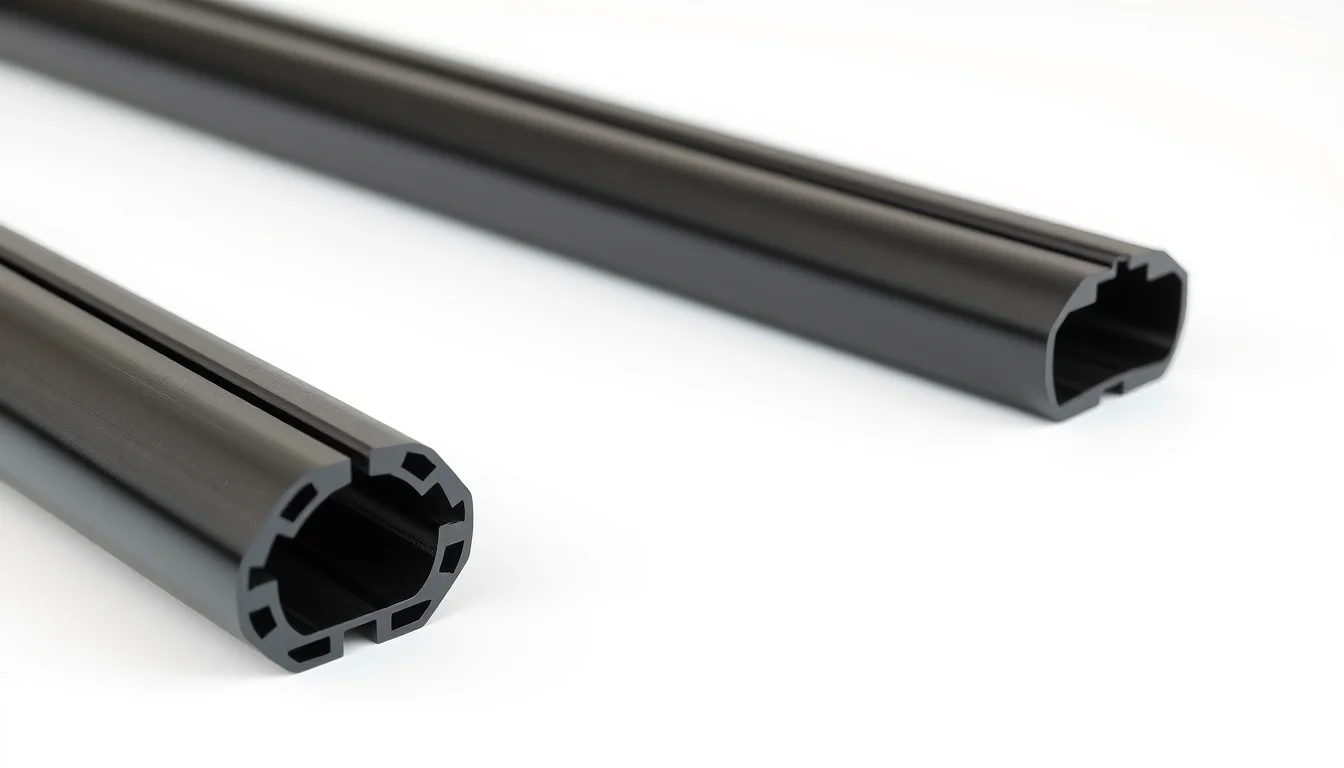
A high tensile strength rubber profile is specified when the seal must resist pull-out, tear, and permanent deformation under load — typically ≥10 MPa tensile per ASTM D412, with compression set below 25% after 70 h at 100°C. For overseas buyers holding active POs, the real question is not the number on a datasheet but whether your supplier can hold that number across 50,000 meters, three colors, and a ±0.15 mm extrusion tolerance. This guide walks through factory capability comparison, tooling economics, and the CAD handoff that separates a clean project from three months of back-and-forth.
What "High Tensile Strength" Actually Means in a Rubber Profile
Tensile strength in an extruded profile is a system property, not a compound spec. The polymer matrix, filler loading, cure state, and die design all interact. A dense EPDM at 12 MPa in a lab plaque can drop to 8 MPa in a thin-walled profile if the extrusion line runs too hot or the vulcanization tunnel is short.
Material Benchmarks Buyers Should Verify
| Material | Tensile (MPa) | Shore A | Temp Range | Compression Set (70h/100°C) | Cost Index |
|---|---|---|---|---|---|
| EPDM (dense) | 10–15 | 60–80 | -40 to 150°C | 15–25% | $$ |
| Silicone (VMQ) | 7–10 | 40–70 | -60 to 200°C | 20–35% | $$$ |
| Nitrile (NBR) | 10–14 | 60–80 | -30 to 120°C | 12–20% | $$ |
| Neoprene (CR) | 10–14 | 50–75 | -40 to 120°C | 18–28% | $$$ |
| TPE/TPV | 6–10 | 60–85 | -40 to 125°C | 25–40% | $ |
Numbers above are typical ranges for production extrusion, not best-case lab values. Ask for 10-day thermal aging data per ASTM D573 — a compound that loses more than 20% tensile after 70 h at 100°C will not survive a decade on a rooftop or under a hood.
Where High Tensile Matters Most
- door sealing strips that see repeated compression and pull-out stress
- cabinet seals with mechanical retention barbs
- WPC profiles co-extruded with a rubber sealing lip
- silicone series for high-temp or food-contact applications
Factory Capability Comparison: What to Check Before You Issue a PO
Not all extrusion houses are equal. A trader with a single 65 mm line cannot hold ±0.15 mm on a 40 mm profile. Here is the checklist we use when benchmarking competitors for our own customers.
Equipment and Process
| Capability | Entry-Level Supplier | Mid-Tier | Export-Grade Factory |
|---|---|---|---|
| Extrusion lines | 1–2 | 3–5 | 6+ with inline vulcanization |
| Tolerance (dense profile) | ±0.30 mm | ±0.20 mm | ±0.10–0.15 mm |
| Inline splicing | Manual | Semi-auto | Auto with vision check |
| Cure control | Batch | Batch + timer | Continuous tunnel, PLC-logged |
| Lab testing | Outsourced | Basic tensile | Full ASTM D412/D573/D395 |
| Tooling shop | Outsourced | Partial | In-house CNC + EDM |
Certifications and Compliance
For export POs, confirm ISO 9001, RoHS, REACH SVHC, and — for electronics or appliance seals — UL 94 flame retardancy where required. For automotive-adjacent projects, IATF 16949 is a hard filter. Ask for the certificate number and verify it; PDFs are easy to fake.
In our Hunan factory experience, a German buyer sent a 12 MPa EPDM profile spec for a cold-storage door seal. The first trial batch failed compression set at 32% because the compound used reclaimed filler to hit cost. We reformulated with virgin EPDM and a peroxide cure, held 18% set after 70 h at 100°C, and the project moved to 40,000 m/month. The lesson: tensile strength alone does not predict sealing life — compression set and ozone resistance do.
The Real Custom Extrusion Process, Step by Step
1. Drawing Review and DFM Feedback
We review your CAD for wall thickness, undercuts, and tolerance stack. A 0.8 mm wall in EPDM is achievable; in 70 Shore A silicone it is risky. We return a DFM note within 48 hours.
2. Tooling Design and Fabrication
Extrusion dies are cut on CNC and finished by EDM. Typical tooling cost for a dense profile: USD 400–1,200 depending on cross-section complexity. Lead time: 7–12 working days. Co-extrusion (rubber + rigid PVC or aluminum carrier) doubles tooling cost.
3. Compound Development
We start from a proven base and adjust filler, plasticizer, and cure system to hit your tensile, durometer, and thermal aging targets. First-article compound samples: 5–7 days.
4. Trial Extrusion and Sample Approval
We run 50–100 m of trial profile, measure cross-section on an optical comparator, and send 3–5 m samples with a dimensional report. You approve or request adjustments. Expect 2–3 iterations on complex profiles.
5. Mass Production and QC
Production runs on PLC-controlled lines with inline laser measurement. We pull 1 sample per 500 m for tensile and durometer per ASTM D2240. Compression set per ASTM D395 is run per batch.
6. Packing and Export
Coils, straight lengths, or cut-to-size. Standard export packing: inner PE bag, outer woven bag or carton, palletized and shrink-wrapped. We provide HS code, packing list, and dimensional weight for your freight forwarder.
How to Send CAD Drawings That Eliminate Back-and-Forth
Most delays come from incomplete drawings, not slow factories. Send the following in one package:
- DXF or DWG of the cross-section, drawn at 1:1, with the profile axis aligned to X
- Tolerance table — which dimensions are critical (sealing lip, mounting groove) and which are cosmetic
- Material callout — polymer, Shore A, color, and any compliance (UL 94, FDA, REACH)
- Length and packaging — coil ID/OD, straight length, cut tolerance
- Annual volume and first-order quantity — this drives tooling amortization and pricing tier
- Application notes — temperature, media contact, compression ratio, UV exposure
If you only have a photo or a sample, send it. We reverse-engineer the cross-section and return a drawing for your approval before cutting tooling. This adds 3–5 days but avoids a wrong die.
MOQ, Tooling, and Cost Structure
| Item | Typical Range | Notes |
|---|---|---|
| MOQ (standard profile) | 500–1,000 m | Lower for repeat orders |
| MOQ (custom compound) | 2,000–5,000 m | Compound development amortized |
| Tooling (dense profile) | USD 400–1,200 | One-time, customer-owned |
| Tooling (co-extrusion) | USD 900–2,500 | Includes carrier die |
| Sample lead time | 7–15 days | After drawing approval |
| Production lead time | 15–25 days | After sample approval |
| Sample cost | Free for standard, paid for custom | Credited against first PO |
Prices are FOB Shanghai or Shenzhen. We quote EXW, FOB, or CIF depending on your freight setup.
Frequently Asked Questions
What is your MOQ for a custom high tensile strength rubber profile?
For a standard EPDM or silicone profile with an existing die, MOQ is 500–1,000 m. For a new compound or a co-extruded profile, MOQ is 2,000–5,000 m to cover compound development and tooling amortization. We accept trial orders below MOQ at a higher unit price for first-article validation.
What is the lead time from drawing to shipment?
Tooling takes 7–12 working days. First-article samples ship 5–7 days after tooling. After sample approval, mass production is 15–25 days depending on volume and compound complexity. Total from CAD to container: 35–50 days for a new custom profile.
What extrusion tolerance can you hold?
For dense EPDM and silicone profiles, we hold ±0.10–0.15 mm on critical dimensions and ±0.25 mm on non-critical dimensions. Sponge and co-extruded profiles run ±0.20–0.30 mm. Tolerance capability depends on cross-section wall thickness and compound shrinkage; we confirm in the DFM note.
How do you pack and export rubber profiles?
Standard export packing is inner PE bag, outer woven bag or carton, palletized and shrink-wrapped. Coils, straight lengths, and cut-to-size are all available. We provide HS code, packing list, and dimensional weight. For sea freight, we add desiccant and UV-resistant wrap for long transit.
Do you provide free samples?
Yes — free 3–5 m samples for standard profiles, with freight collect. For custom compounds or new tooling, we charge a sample fee of USD 100–300, credited against your first production PO. Samples ship with a dimensional report and material datasheet.
Send your CAD drawing for a 24-hour quote.
Need a Custom Quote?
Send your CAD drawing or specs (material, hardness, profile, temperature range, MOQ) — our engineering team will respond within 24 hours.