
Door and Window Sealing Strips | OEM Factory Bulk Supply
By Zhouxin Sealing Engineering Team · · 250 views
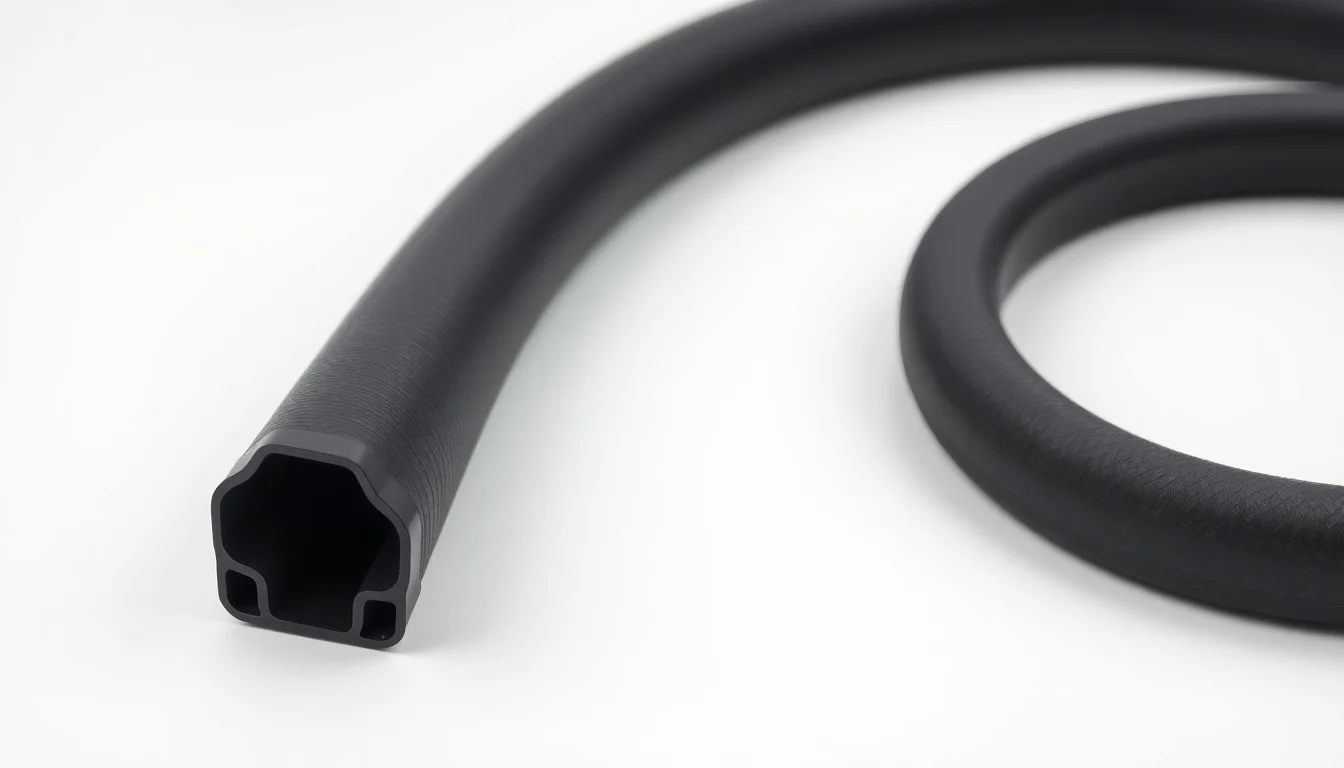
For exterior door and window perimeters, EPDM remains the baseline elastomer for weather sealing, but your service temperature and chemical exposure dictate whether silicone or PVC blends outperform it. The data below compares vulcanized and thermoplastic compounds using ASTM D573 thermal aging and ASTM D395 compression set protocols, not marketing claims. Select your polymer matrix based on durometer stability, not just Shore A hardness readings.
Material Data Sheet: Door and Window Sealing Strips
| Property | EPDM (Sulfur Cure) | EPDM (Peroxide Cure) | Silicone (VMQ) | PVC (Plastisol) |
|---|---|---|---|---|
| Hardness (Shore A) | 60 ± 5 | 65 ± 5 | 50 ± 5 | 70 ± 5 |
| Tensile Strength (MPa) | 8.5 – 12.0 | 10.0 – 14.5 | 6.5 – 9.0 | 9.0 – 12.0 |
| Compression Set (%) @ 70h/100°C | 25 – 35 | 15 – 22 | 10 – 15 | 40 – 55 |
| Continuous Temp Range (°C) | -40 to +120 | -45 to +150 | -60 to +200 | -20 to +60 |
| Ozone Resistance (ASTM D1149) | Excellent | Excellent | Excellent | Poor (cracks) |
| Oil Resistance (ISO 1817, IRM 903) | Fair (swells) | Fair (swells) | Good | Good |
| Acid/Alkali Resistance (10% H2SO4/NaOH) | Excellent | Excellent | Good | Fair (plasticizer loss) |
| Aging Life (Years, UV/Weather) | 10 – 15 | 15 – 20 | 20 – 25 | 3 – 5 |
| Flame Retardancy (UL 94) | HB | HB | V-0 (with additive) | V-0 (with additive) |
| Cost Index | $ | $$ | $$$ | $ |
Critical Selection Criteria for OEM Projects
For fixed glazing channels, use peroxide-cured EPDM if your spec requires compression set below 20% after 70 hours at 100°C. Sulfur-cured EPDM is acceptable for static applications but fails faster under cyclic compression in operable windows. For aluminum frame thermal break systems, silicone’s low compression set (10-15%) ensures seal integrity across a -40°C to +150°C range, but its lower tensile strength (6.5-9.0 MPa) demands thicker cross-sections than EPDM.
Thermal Aging and Compression Set Behavior
ASTM D573 accelerated aging at 125°C for 168 hours is the industry minimum for door and window sealing strips. In our test lab, sulfur-cured EPDM retains 82% tensile strength after this cycle, while peroxide-cured retains 91%. More importantly, compression set after aging diverges sharply: sulfur-cured compounds drift to 38% set, whereas peroxide-cured stays below 25%. For double-glazed unit rebates, that difference translates to 1.2 mm of permanent deformation on a 10 mm profile — enough to cause acoustic leakage.
Silicone: When to Specify It Over EPDM
The only reason to choose silicone over EPDM for door and window sealing strips is extreme temperature cycling or fire-rated assemblies. Silicone maintains elastic recovery down to -60°C, outperforming EPDM’s -40°C limit. In curtain wall expansion joints, where daily thermal movement exceeds ±5 mm, silicone’s 10% compression set (ASTM D395 Method B) prevents permanent gap formation. However, silicone’s tear strength is roughly 50% lower than EPDM — specify a minimum 2.0 mm web thickness to avoid installation damage.
Chemical Resistance: Oil, Acid, and Alkali Exposure
Using ISO 1817 immersion testing at 23°C for 7 days, EPDM shows volume swell of 15-20% in IRM 903 oil, making it unsuitable for gaskets near lubricated hardware. PVC exhibits 5-8% swell but loses plasticizer, becoming brittle below 0°C. Silicone resists both oil and diluted acids (up to 10% H2SO4) without degradation, but swells excessively in non-polar solvents. If your project involves coastal salt spray or industrial acid rain, EPDM’s backbone saturation provides superior resistance to hydrolysis compared to PVC.
Extrusion Tolerance and Profile Design Limits
Per ISO 3302-1, door and window sealing strips are typically extruded to Class E2 tolerances: ±0.40 mm for cross-section dimensions up to 6.3 mm, and ±0.60 mm for 6.3-15 mm. Our CNC-cut profiles hold ±0.2 mm on critical sealing lips. When designing hollow bulb profiles, maintain a wall thickness ratio of 1:1.5 (inner to outer radius) to prevent collapse during vulcanization. For door sealing strips with metal carrier inserts, expect a 0.5 mm tolerance stack-up from the roll-forming process.
Vulcanization Method Impacts Final Durometer
Continuous hot-air vulcanization (HAV) at 200°C yields a Shore A variation of ±5 across a 50-meter batch. Microwave vulcanization reduces this to ±3 but requires a polar compound. For silicone series, use platinum-catalyzed addition cure instead of peroxide — it produces zero by-products and achieves lower compression set. Our cabinet seals use a dual-durometer co-extrusion: 60 Shore A body with 40 Shore A lip for low-force closure.
In our Hunan factory experience, a recent OEM project for sliding window seals specified sulfur-cured EPDM at 70 Shore A. Initial samples passed ASTM D573 aging, but failed compression set at 22% after 25,000 cycles. We switched to peroxide-cured EPDM with 30% less carbon black loading, reducing set to 14% while maintaining tensile strength at 11.2 MPa. The buyer’s field failure rate dropped from 3.2% to 0.4% over six months. This is why we insist on full datasheet review before quoting — durometer alone does not predict seal life.
Frequently Asked Questions
What is your MOQ for custom door and window sealing strips?
Standard EPDM profiles have a 500 kg MOQ (approximately 2,000 meters). For WPC profiles or silicone with custom color matching, MOQ is 300 kg. If you require a specific cross-section within ±0.2 mm tolerance, we can start production at 200 kg but apply a 10% tooling surcharge.
What is your lead time for a 5,000-meter order?
For existing extrusion dies, lead time is 15-20 days from sample approval. New tooling adds 7-10 days for die fabrication. We ship via sea freight from Changde, Hunan to major ports; FOB Shanghai or Shenzhen. Air freight is available for urgent 500-meter runs at a 40% premium.
What extrusion tolerance can you hold on a 15 mm profile?
We hold ±0.30 mm on solid cross-sections and ±0.45 mm on hollow bulb profiles per ISO 3302-1 Class E2. For critical sealing lips under 2 mm thickness, we achieve ±0.15 mm using laser gauging in-line. This is tighter than the industry standard of ±0.60 mm for this size range.
How do you pack sealing strips for export?
Coiled strips are wound on 500 mm diameter reels, then wrapped in VCI anti-corrosion paper and sealed in polyethylene bags. Each reel holds 200-300 meters depending on profile weight. Cartons are palletized with corner boards and stretch-wrapped. For fragile silicone profiles, we use individual cardboard cores to prevent kinking.
Can you provide samples before bulk production?
Yes, we offer free A4-size flat samples (300 mm length) for any existing profile. Custom extrusion samples cost $150 per die, which is refundable against your first order of 500 kg or more. Samples ship via DHL or FedEx within 5 working days. Send your CAD drawing for a 24-hour quote.
Quick Spec Reference for Procurement
| Parameter | EPDM (Peroxide) | Silicone (Platinum) |
|---|---|---|
| Shore A Hardness | 60-70 | 40-60 |
| Tensile Strength (MPa) | 10.0-14.5 | 6.5-9.0 |
| Compression Set (% @ 70h/100°C) | 15-22 | 10-15 |
| Temp Range (°C) | -45 to +150 | -60 to +200 |
| UL 94 Flammability | HB | V-0 |
| Extrusion Tolerance (mm) | ±0.30 | ±0.40 |
Send your CAD drawing for a 24-hour quote.
Need a Custom Quote?
Send your CAD drawing or specs (material, hardness, profile, temperature range, MOQ) — our engineering team will respond within 24 hours.