
How Wooden Door Factories Select Sealing Strips | OEM Supplier
By Zhouxin Sealing Engineering Team · · 6 views
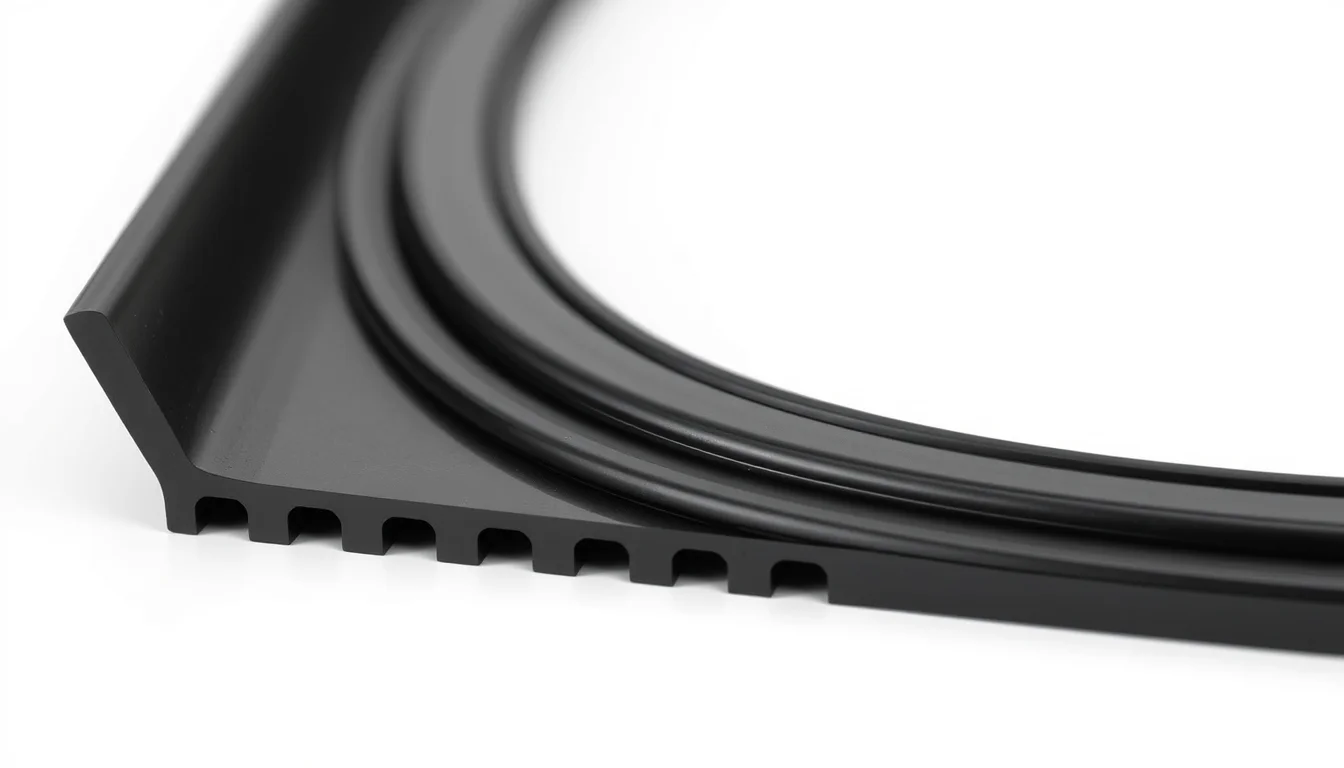
Wooden door factories should select sealing strips by matching polymer performance data — tensile strength, compression set, thermal aging, and chemical resistance — to the door's service environment, then locking extrusion tolerances and flame ratings into the purchase spec. The comparison below gives OEM buyers a direct material-selection matrix for TPE, PVC, and PU profiles plus door bottom seal devices.
Material Performance Matrix for Door Sealing Strips
| Property | TPE | PVC (flexible) | PU (polyurethane) | Test Method |
|---|---|---|---|---|
| Shore A hardness range | 55–80 | 60–85 | 70–90 | ASTM D2240 |
| Tensile strength (MPa) | 8–14 | 10–18 | 25–45 | ASTM D412 |
| Elongation at break (%) | 350–550 | 200–350 | 400–600 | ASTM D412 |
| Compression set, 22 h @ 70°C (%) | 20–30 | 30–45 | 15–25 | ASTM D395 Method B |
| Thermal aging, 168 h @ 100°C, tensile retention (%) | ≥80 | 60–75 | ≥85 | ASTM D573 |
| Service temperature range (°C) | -40 to +90 | -20 to +60 | -40 to +100 | — |
| Ozone resistance, 50 pphm, 40°C, 72 h | No cracking | Surface crazing | No cracking | ASTM D1149 |
| Oil / acid / alkali resistance | Moderate | Good (dilute acids) | Excellent (oils, fuels) | ISO 1817 |
| Flame retardancy option | UL 94 V-0 available | UL 94 V-0 available | UL 94 HB–V-0 | UL 94 |
| Density (g/cm³) | 1.05–1.20 | 1.25–1.45 | 1.10–1.25 | ISO 1183 |
| Typical extrusion tolerance (mm) | ±0.3 | ±0.3 | ±0.3 | ISO 3302-1 Class E2 |
Data above reflects production-validated ranges for Hunan Zhouxin door profiles; exact values are confirmed on the material datasheet per compound batch.
Matching Polymer to Door Service Environment
TPE sealing strips — interior and semi-exterior doors
Thermoplastic elastomer (TPE) delivers a compression set of 20–30% after 22 h at 70°C, which keeps the seal in contact with the door frame across seasonal humidity swings. Tensile strength of 8–14 MPa supports thin-wall bulb and fin profiles without tearing during installation. TPE is fully recyclable, so factory scrap from extrusion trimming can be reground at up to 20% loading without dropping tensile retention below 80% after 168 h at 100°C (ASTM D573). For interior wooden doors, this is the default specification.
PVC sealing strips — cost-sensitive volume lines
Flexible PVC offers tensile strength of 10–18 MPa at a lower compound cost than TPE, but compression set runs 30–45%, meaning the profile takes a permanent set faster under sustained door-closing pressure. Service temperature tops out near +60°C, so PVC is unsuitable for doors exposed to direct sun or near heat sources. Specify PVC where the door is interior, the closing force is light, and annual volume justifies a dedicated extrusion die.
PU sealing strips — exterior and heavy-duty doors
Polyurethane posts tensile strength of 25–45 MPa and compression set of 15–25%, the best recovery in this group. Resistance to oils, fuels, and dilute acids per ISO 1817 makes PU the choice for exterior wooden doors, garage doors, and doors in workshops or commercial kitchens. Thermal aging at 100°C for 168 h retains ≥85% tensile strength. The trade-off is compound cost and a narrower hardness window (70–90 Shore A) that limits very soft bulb profiles.
Door bottom seal devices — the mechanical layer
Door bottom seals combine an elastomer blade or bulb with a rigid carrier and an automatic drop mechanism. Specify the blade in TPE or PU depending on floor abrasion; the carrier in rigid PVC or aluminum. Compression set of the blade governs how long the seal maintains floor contact — target ≤25% per ASTM D395 to avoid light-gap failures within the first year of service.
Specification Checklist for OEM Purchase Orders
| Parameter | Recommended spec | Why it matters |
|---|---|---|
| Durometer | 55–80 Shore A (TPE); 70–90 (PU) | Balances closing force vs. sealing contact |
| Tensile strength | ≥8 MPa (TPE); ≥25 MPa (PU) | Prevents tear-out at fastener points |
| Compression set | ≤30% (TPE); ≤25% (PU) | Long-term seal recovery |
| Thermal aging | ≥80% tensile retention, 168 h @ 100°C | Predicts 5–8 year service life |
| Extrusion tolerance | ±0.3 mm, ISO 3302-1 E2 | Ensures press-fit into door groove |
| Flame rating | UL 94 V-0 where code requires | Fire door compliance |
| Color fastness | ΔE ≤3 after 300 h QUV | Matches door finish over time |
In our Hunan factory experience, a European OEM door line switching from PVC to TPE on interior profiles reduced field complaints about light gaps by roughly 40% over two heating seasons, because the TPE compression set held the fin in contact through the dry winter months. The change required a new extrusion die but no modification to the door groove.
Extrusion Tolerance and Vulcanization Control
Extrusion tolerance is the variable most often under-specified by door factories. A ±0.3 mm band per ISO 3302-1 Class E2 is achievable on TPE and PVC profiles with in-line laser gauging; tighter bands drive scrap rates up and should be reserved for critical sealing faces. For PU, post-extrusion vulcanization and annealing stabilize the polymer matrix and lock dimensional drift to under 0.2 mm over 24 h. Request the compound's vulcanization curve and a first-article inspection report with each new die.
Ozone resistance matters for exterior doors: TPE and PU compounds formulated with anti-ozonants show no cracking at 50 pphm for 72 h per ASTM D1149, while standard PVC may craze. Flame retardancy to UL 94 V-0 is available in TPE and PVC for fire-rated door assemblies; confirm the rating on the compound certificate, not the profile drawing.
Sourcing Workflow: From Drawing to Production Line
- Send the door groove cross-section drawing and target durometer.
- Receive material recommendation (TPE, PVC, or PU) with datasheet values for tensile strength, compression set, and aging.
- Approve a 300 mm sample length against the groove.
- Confirm extrusion tolerance class and flame rating on the PO.
- First-article inspection, then volume release.
Review the full door sealing strips range for profile geometry options, and pair door bottom seals with WPC profiles where the door leaf uses composite framing. For high-temperature or specialty door variants, the silicone series extends the service window beyond 150°C; cabinet and furniture lines can reference cabinet seals for matching edge profiles.
Frequently Asked Questions
What is the MOQ for custom TPE or PVC door sealing strips?
MOQ is 500 kg per profile for existing dies and 1,000 kg for a new extrusion die, reflecting setup and vulcanization stabilization costs. Trial orders below MOQ can be quoted as sample runs at a per-meter premium. Confirm MOQ against your annual door output before finalizing the die drawing.
What lead time should a wooden door factory plan for?
Standard profiles ship in 15–20 days after PO confirmation; new dies add 10–15 days for fabrication and first-article approval. Repeat orders with approved compound and die run in 12–15 days. Book capacity two weeks ahead of your production line changeover date.
What extrusion tolerance can you hold on door sealing profiles?
Standard production holds ±0.3 mm per ISO 3302-1 Class E2 on critical sealing faces. Tighter ±0.2 mm is available on TPE and PU with in-line gauging, subject to profile geometry review. Tolerance class is stated on the inspection report for every batch.
How are sealing strips packed for export?
Profiles are coiled in 50–100 m rolls, wrapped in PE film, and packed in export cartons or wooden crates with desiccant. Roll length and coil diameter are set to your unloading equipment. Carton labeling includes batch number, compound code, and tolerance class for traceability.
What is the sample policy for OEM evaluation?
Free 300 mm cut samples of standard profiles ship within 3 days; custom compound samples require a small tooling charge credited against the first volume order. Samples include the material datasheet with tensile strength, compression set, and aging data. Send your CAD drawing for a 24-hour quote.
Need a Custom Quote?
Send your CAD drawing or specs (material, hardness, profile, temperature range, MOQ) — our engineering team will respond within 24 hours.