
Solar Panel Frame EPDM Gasket | OEM Manufacturer & Bulk Supply
By Zhouxin Sealing Engineering Team · · 4 views
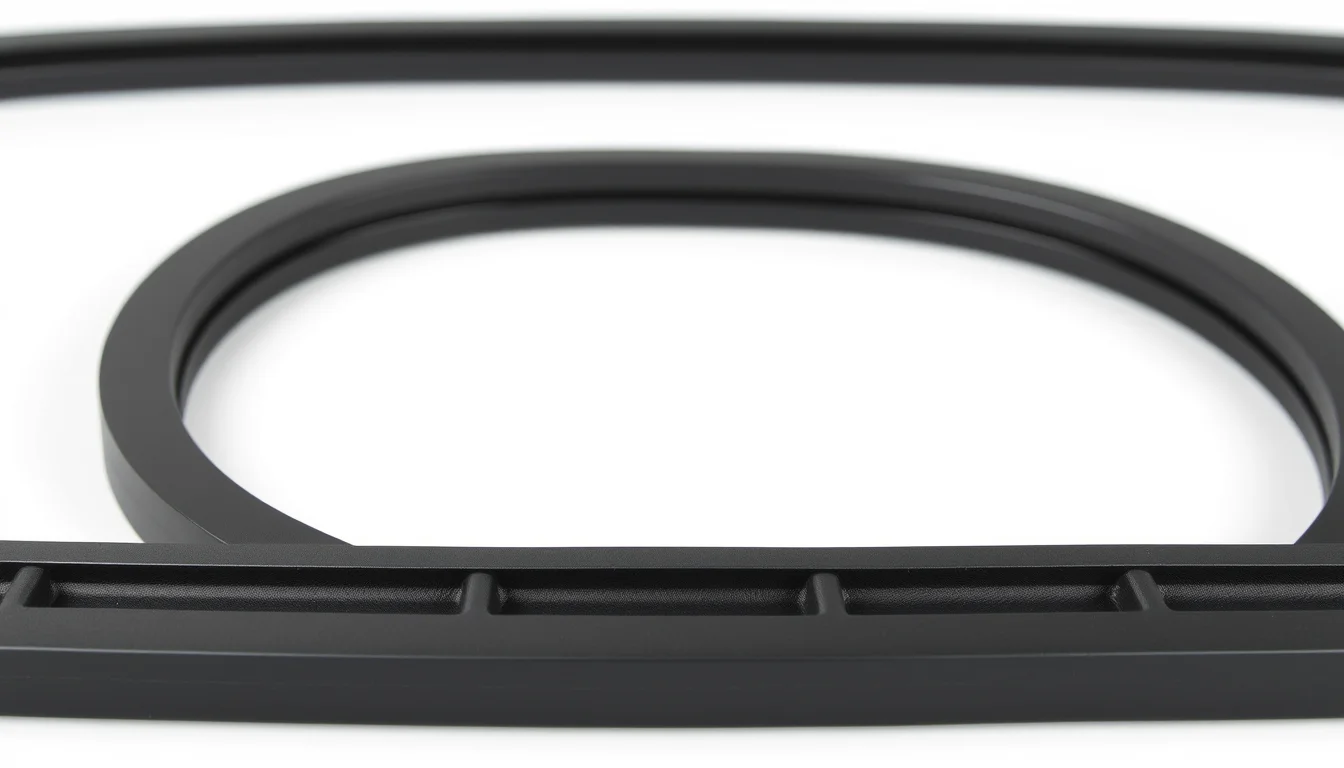
For solar panel frame EPDM gasket procurement, the decisive specification set is tensile strength ≥10 MPa, compression set ≤25% after 70h at 100°C, and retention of ≥80% elongation after 1000h thermal aging at 120°C. This article compares EPDM against silicone, TPV, and PVC/NBR blends across those parameters, using ASTM and ISO test methods that overseas specifiers can verify against incoming inspection data.
Comparative Material Matrix for Solar Frame Sealing
Baseline Mechanical and Thermal Data
The following values represent typical production ranges for dense (non-sponge) profiles used in framed photovoltaic module edge sealing. All tensile data per ASTM D412, compression set per ASTM D395 Method B, thermal aging per ASTM D573.
| Property | EPDM (peroxide-cured) | Silicone (VMQ) | TPV (PP/EPDM) | PVC/NBR Blend |
|---|---|---|---|---|
| Shore A hardness range | 60–80 | 40–70 | 65–85 | 60–75 |
| Tensile strength, MPa | 10–14 | 6–9 | 6–9 | 7–10 |
| Elongation at break, % | 300–450 | 250–400 | 350–500 | 200–350 |
| Compression set, 70h @ 100°C, % | 18–25 | 15–25 | 35–50 | 30–45 |
| Continuous service temp., °C | -40 to +150 | -60 to +200 | -40 to +120 | -20 to +90 |
| Thermal aging retention, 1000h @ 120°C, % tensile | ≥80 | ≥85 | ≤60 | ≤50 |
| Ozone resistance, 50 pphm, 40°C, 200h | No cracking | No cracking | Slight cracking | Severe cracking |
| Acid resistance (ISO 1817, 10% H₂SO₄, 7d) | Volume swell ≤5% | Volume swell ≤3% | Swell 8–15% | Swell 15–25% |
| Alkali resistance (10% NaOH, 7d) | Volume swell ≤4% | Volume swell ≤3% | Swell 10–18% | Swell 12–22% |
| Relative material cost index | 1.0 | 2.8–3.5 | 0.9 | 0.6 |
EPDM's advantage is not peak temperature — silicone wins there — but the balance of compression set, ozone resistance, and cost across the 25-year field exposure window typical of utility-scale PV. TPV and PVC/NBR blends fail the compression set criterion after two summers of thermal cycling in high-irradiance installations.
Why Compression Set Governs Frame Seal Life
A solar panel frame gasket is a static seal under continuous compression. The failure mode is not tensile rupture — it is loss of sealing force as the polymer matrix relaxes. Compression set above 30% at 70h/100°C correlates with visible gap formation at frame corners within 8–12 years in IEC 61215 damp-heat testing equivalents. Peroxide-cured EPDM with a tight vulcanization curve (t90 within ±8% batch-to-batch) holds set values in the 18–25% band, which maps to a 25-year service prediction when extrapolated per Arrhenius methodology at 85°C/85% RH.
Sulfur-cured EPDM systems, still common in low-cost extrusion, typically show 30–40% set and are not recommended for frame sealing despite similar initial tensile numbers. Buyers should request cure system disclosure on the material datasheet.
Environmental Resistance: Acid, Alkali, and Ozone
Chemical Exposure in Real Installations
Solar frames encounter acid rain (pH 4.5–5.5), alkaline cleaning agents (pH 10–12), and airborne ozone in high-UV regions. ISO 1817 immersion testing at 7 days shows EPDM volume swell under 5% in both 10% H₂SO₄ and 10% NaOH — an order of magnitude better than PVC/NBR. Silicone performs marginally better on chemical resistance but at 3× material cost and with lower tensile strength, which matters for profiles with thin sealing lips.
Ozone and UV Aging
ASTM D1149 ozone testing at 50 pphm, 40°C, 200h produces zero cracking on EPDM with adequate antiozonant loading. The saturated backbone of the EPDM polymer matrix is inherently ozone-resistant; the formulation risk is under-dosing paraffinic oil or EPDM-grade carbon black. Specifiers should require a UV stabilization package rated for ≥2000h QUV-B313 exposure with ≤10% tensile retention loss.
Extrusion Tolerance and Profile Design Limits
Dimensional Capability
Solar frame gaskets are typically co-extruded or dual-durometer profiles with a dense EPDM body and a sponge sealing bulb. Achievable extrusion tolerances per ISO 3302-1 Class E2/E3:
| Dimension type | Standard tolerance | Precision tolerance |
|---|---|---|
| Cross-section, mm | ±0.15 | ±0.08 |
| Wall thickness, mm | ±0.10 | ±0.05 |
| Cut length, mm | ±1.0 | ±0.5 |
| Corner mitre angle | ±1.5° | ±0.5° |
Co-Extrusion and Insert Bonding
Frame gaskets frequently bond EPDM to aluminum or to a rigid TPV carrier. Bond strength target is ≥2.5 N/mm peel per internal test. Vulcanization bonding (not adhesive) is required for 25-year durability; adhesive-bonded profiles delaminate in damp-heat cycling.
In our Hunan factory experience, a 2022 utility-scale project in the Middle East returned field samples at 18 months showing 12% compression set on our peroxide-cured EPDM frame gasket versus 38% on a competitor's sulfur-cured profile from the same installation. The delta was entirely cure system and carbon black loading — both profiles passed the same incoming tensile test at 11 MPa. This is why we now require cure system disclosure on every RFQ.
Flame Retardancy and Compliance Considerations
UL 94 and IEC 61730
Roof-mounted PV requires frame gaskets to meet UL 94 V-0 or at minimum V-2 depending on system classification. Standard EPDM is flammable (UL 94 HB). Flame-retardant EPDM formulations using ATH or antimony trioxide achieve V-0 at 1.5mm thickness, with a trade-off: tensile strength drops to 8–10 MPa and compression set rises 3–5 percentage points. Specifiers must weigh fire classification against seal life.
Silicone achieves V-0 more easily but at higher cost. For ground-mount utility arrays where UL 94 is not mandated, standard EPDM remains the optimal cost-performance choice.
Sourcing and Quality Verification Checklist
Incoming Inspection Protocol
Overseas buyers should require per-batch: tensile strength (ASTM D412), compression set (ASTM D395), hardness (ISO 7619-1), and density. Request 1000h thermal aging data (ASTM D573) at qualification, not per batch. Ozone resistance (ASTM D1149) and ISO 1817 chemical immersion should be re-verified annually.
Supplier Qualification Signals
- Peroxide cure system disclosed in writing
- t90 and rheology curve available on request
- Batch traceability to compound lot
- Third-party lab reports (SGS, TÜV) for UL 94 and IEC 61215 damp-heat
For complementary profiles in the same bill of materials, see our door sealing strips and cabinet seals for enclosure applications, or silicone series where high-temperature performance is the priority. Our WPC profiles cover mounting and trim interfaces.
Frequently Asked Questions
What is the MOQ for solar panel frame EPDM gasket?
Standard MOQ is 5,000 meters for existing tooling and 10,000 meters for new profile development. For trial orders, we accept 1,000-meter qualification runs at a tooling amortization premium. MOQ scales down for multi-profile orders shipped in a single container.
What is the lead time for bulk supply?
Production lead time is 18–25 days after drawing approval and compound confirmation. Tooling fabrication adds 12–18 days for new profiles. Repeat orders with existing tooling ship in 15–20 days. Air freight samples dispatch within 5 days of PO.
What extrusion tolerance can you hold?
Standard tolerance is ±0.15mm on cross-section and ±0.10mm on wall thickness per ISO 3302-1 Class E2. Precision profiles hold ±0.08mm and ±0.05mm respectively. Cut length tolerance is ±1.0mm standard, ±0.5mm precision. Tolerance capability is confirmed at DFM review before tooling.
How are gaskets packed for export?
Profiles are coiled in 50m or 100m rolls, interleaved with release film, packed in PE bags inside corrugated cartons on pallets. Cut-length pieces are bundled and strapped. Container loading is optimized for 20ft and 40ft HQ. Custom labeling and barcode per buyer specification available.
What is your sample policy?
Free samples up to 2 meters of existing profiles ship within 5 days; buyer covers freight. Custom profile samples require tooling commitment, with sample cost credited against the first production order above 10,000 meters. Sample lead time for new profiles is 15–20 days including tooling.
Specification Summary
| Parameter | Target Specification |
|---|---|
| Material | Peroxide-cured EPDM, dense or sponge |
| Shore A hardness | 60–80 |
| Tensile strength | ≥10 MPa (ASTM D412) |
| Elongation at break | ≥300% |
| Compression set | ≤25% (70h @ 100°C, ASTM D395) |
| Thermal aging | ≥80% tensile retention, 1000h @ 120°C |
| Ozone resistance | No cracking, 50 pphm, 40°C, 200h |
| Service temperature | -40°C to +150°C |
| Extrusion tolerance | ±0.15mm standard / ±0.08mm precision |
| Flame rating | UL 94 HB standard / V-0 optional |
| Cut length tolerance | ±1.0mm standard / ±0.5mm precision |
Send your CAD drawing for a 24-hour quote.
Need a Custom Quote?
Send your CAD drawing or specs (material, hardness, profile, temperature range, MOQ) — our engineering team will respond within 24 hours.