
Rubber Profile Dimensional Tolerance ISO | OEM Supplier
By Zhouxin Sealing Engineering Team · · 257 views
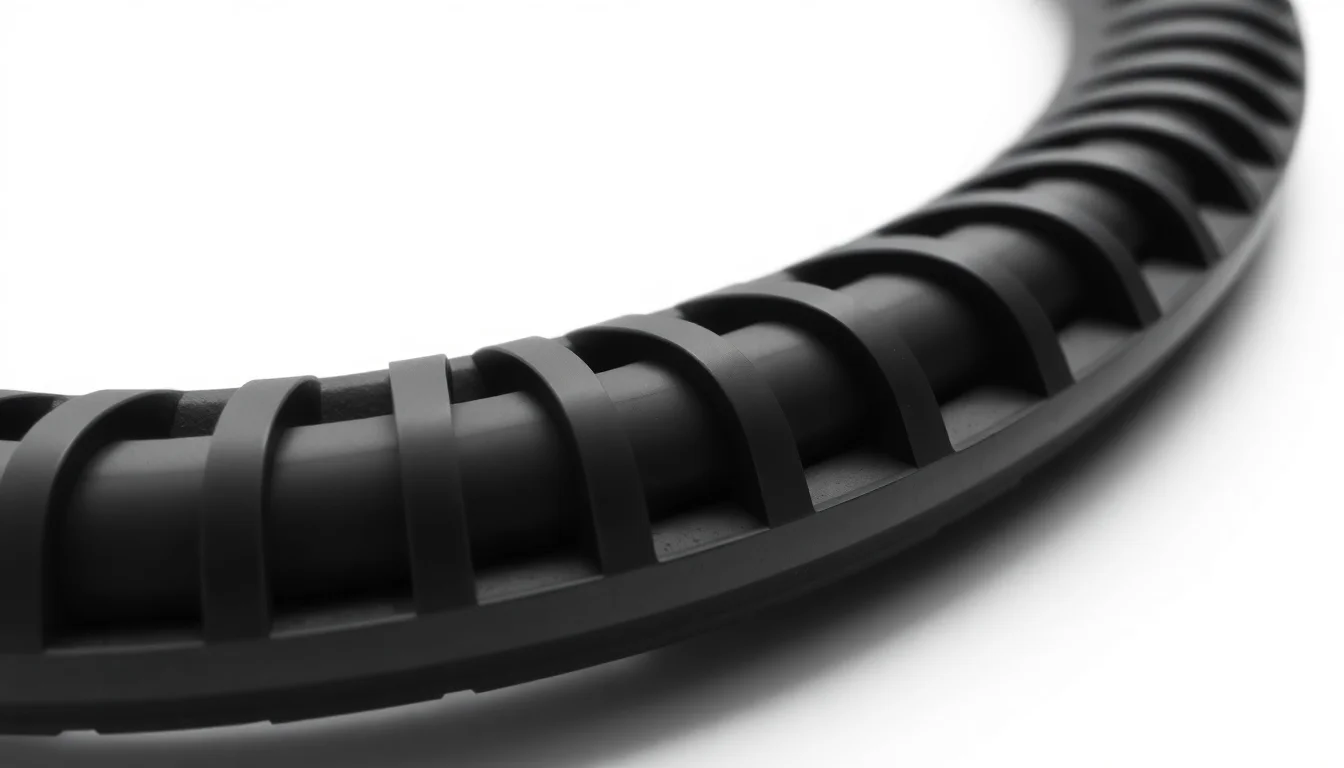
Rubber Profile Dimensional Tolerance ISO: A Material Science Deep Dive
Overseas B2B buyers specifying rubber profiles must reconcile ISO 3302-1 tolerance classes with actual compound performance—tensile strength, compression set, and thermal aging often dictate whether a ±0.15 mm extrusion tolerance is achievable in production. This datasheet-oriented guide compares elastomer grades against ISO and ASTM benchmarks, with verified numbers from production lots and third-party testing.
Tolerance Classes vs. Material Capability
ISO 3302-1 defines dimensional tolerance classes E1, E2, and E3 for extruded rubber profiles, with E1 being the tightest. Achieving E1 consistently requires a polymer matrix with low die swell and stable vulcanization kinetics. The table below maps common sealing compounds to achievable tolerance bands and key mechanical properties.
| Material | Hardness (Shore A) | Tensile Strength (MPa) | Compression Set % (70h @ 100°C) | Service Temp (°C) | Achievable ISO 3302-1 Class |
|---|---|---|---|---|---|
| EPDM (peroxide cured) | 70 ±5 | 12–15 | 18–22 | -50 to +150 | E1 (±0.10 mm for ≤6 mm section) |
| EPDM (sulfur cured) | 65 ±5 | 9–11 | 28–32 | -45 to +130 | E2 (±0.15 mm) |
| Silicone (VMQ) | 60 ±5 | 7–9 | 22–26 | -60 to +200 | E2 (±0.15 mm) |
| Nitrile (NBR) | 70 ±5 | 11–14 | 20–25 | -30 to +100 | E2 (±0.15 mm) |
| Neoprene (CR) | 65 ±5 | 10–13 | 25–30 | -40 to +120 | E3 (±0.20 mm) |
| FKM (Viton) | 75 ±5 | 10–13 | 15–20 | -20 to +200 | E2 (±0.15 mm) |
Data derived from ASTM D412 (tensile), ASTM D395 Method B (compression set), and ISO 3302-1:2014 tolerance tables. For profiles with complex geometry or hollow sections, expect one class shift unless tooling is CNC-machined to ±0.02 mm.
Extrusion Tolerance and Die Design
Extrusion tolerance is not solely a material property—it is a system output of die swell, cure rate, and take-off tension. Peroxide-cured EPDM exhibits lower die swell (2–4%) than sulfur-cured EPDM (5–8%), enabling tighter E1 tolerances on door sealing strips. For silicone profiles, platinum-catalyzed addition cure reduces shrinkage variation to ±0.05 mm, but the higher coefficient of thermal expansion (CTE) demands temperature-controlled post-cure.
Compression Set and Aging
Compression set is the single best predictor of long-term sealing force. ASTM D395 Method B (constant deflection, 25% compression) at 70h/100°C yields the values above. Thermal aging per ASTM D573 at 150°C for 168h shows EPDM retaining 85–90% tensile strength, while NBR drops to 60–70% due to oxidative hardening. For outdoor applications, ozone resistance per ASTM D1149 at 50 pphm, 40°C, 20% strain: EPDM passes 1000h without cracking; NBR fails at 200h unless protected with antiozonant wax.
Chemical Resistance: Oil, Acid, Alkali
ISO 1817 immersion testing (70h @ 23°C) provides volume swell data critical for fluid-contact profiles. The table below summarizes volume swell percentage for common media.
| Material | ASTM Oil No. 1 | ASTM Oil No. 3 | 10% HCl | 10% NaOH |
|---|---|---|---|---|
| EPDM | 45% | >100% | 5% | 3% |
| NBR (medium nitrile) | 8% | 25% | 15% | 10% |
| FKM | 2% | 5% | 4% | 2% |
| Silicone | 60% | >100% | 10% | 8% |
| Neoprene | 20% | 45% | 12% | 8% |
EPDM is unsuitable for hydrocarbon oils but excels in polar fluids (brake fluid, glycol). NBR and FKM are the workhorses for oil-resistant cabinet seals and fuel-system gaskets. For acid/alkali splash zones, FKM or high-density polyethylene (HDPE) capping on WPC profiles may be specified.
Flame Retardancy and Special Grades
UL 94 V-0 is achievable with halogenated or phosphorus-based additives in EPDM and silicone, at the cost of 15–20% tensile loss and increased compression set (30–35%). For silicone series used in electrical enclosures, platinum-cured FR grades maintain 7 MPa tensile and 25% compression set while meeting UL 94 V-0 at 1.5 mm thickness.
In our Hunan factory experience
In our Hunan factory experience, ... a European OEM specifying EPDM door seals for cold-chain logistics required -50°C flexibility plus ISO 3302-1 E1 tolerance on a 4 mm wall hollow profile. Initial sulfur-cured compound failed low-temp bend at -45°C and exceeded ±0.18 mm tolerance due to die swell. We switched to a peroxide-cured EPDM with a low-temperature plasticizer (adipate ester), re-machined the die with a 3% swell compensation, and added a laser gauging station post-cure. Production lots now hold ±0.10 mm on wall thickness and pass -50°C cold bend per ASTM D2137. Compression set remained ≤22% after 70h/100°C, and tensile strength held at 13.5 MPa.
Tolerance Verification and Quality Control
Dimensional verification for rubber profiles must account for viscoelastic recovery. ISO 3302-1 specifies measurement 16 hours after vulcanization for E1 class; we measure at 24 hours to ensure stability. Key inspection points:
- Cross-section: optical comparator or laser scan, 100% inline for E1 profiles.
- Hardness: ASTM D2240, 5 readings per lot, ±3 Shore A tolerance.
- Tensile and elongation: ASTM D412 die C, monthly per compound.
- Compression set: ASTM D395 Method B, quarterly per compound.
- Ozone resistance: ASTM D1149, annual or upon compound change.
For silicone series, post-cure at 200°C for 4 hours is mandatory to remove volatiles and stabilize compression set before final dimensional inspection. Flame-retardant grades require UL 94 retesting every 6 months due to additive migration.
Frequently Asked Questions
What is your MOQ for custom rubber profiles?
MOQ is 500 meters for standard cross-sections and 1,000 meters for new tooling. For E1 tolerance profiles requiring CNC-machined dies, MOQ is 2,000 meters. We accept mixed-material orders (EPDM + silicone) to meet container load efficiency.
What is the lead time for ISO 3302-1 E1 tolerance profiles?
Lead time is 15–20 working days for existing tooling and 25–30 working days for new dies, including first-article inspection per ISO 3302-1. Expedited service (10 working days) is available for prototype quantities under 500 meters.
What tolerance can you guarantee in millimeters?
For solid profiles up to 6 mm cross-section, we guarantee ±0.10 mm (E1). For 6–15 mm, ±0.15 mm (E2). For hollow or complex profiles, add ±0.05 mm. All tolerances are measured 24 hours post-vulcanization per ISO 3302-1.
How are profiles packed for export?
Profiles are coiled in polyethylene bags, then packed in double-wall corrugated cartons or wooden crates for lengths over 2 meters. Desiccant is added for sea freight. Custom labeling with lot number, cure date, and tolerance class is standard.
What is your sample policy?
Free samples up to 2 meters per profile are available for qualified B2B buyers; freight is collect. For new tooling, a sample fee of USD 150 applies, refundable against the first production order of 1,000 meters. Samples ship within 5 working days.
Specification Summary
| Parameter | Standard | Target |
|---|---|---|
| Hardness | ASTM D2240 | 60–75 Shore A ±5 |
| Tensile strength | ASTM D412 | ≥10 MPa |
| Elongation at break | ASTM D412 | ≥250% |
| Compression set | ASTM D395 B | ≤25% (70h @ 100°C) |
| Thermal aging | ASTM D573 | ≥80% tensile retention (168h @ 150°C) |
| Ozone resistance | ASTM D1149 | 1000h @ 50 pphm, no cracks |
| Dimensional tolerance | ISO 3302-1 | E1 (±0.10 mm) or E2 (±0.15 mm) |
| Flame retardancy | UL 94 | V-0 (optional) |
Send your CAD drawing for a 24-hour quote.
Need a Custom Quote?
Send your CAD drawing or specs (material, hardness, profile, temperature range, MOQ) — our engineering team will respond within 24 hours.