
Low Temperature Flexibility EPDM | B2B Manufacturer & Bulk Supply
By Zhouxin Sealing Engineering Team · · 136 views
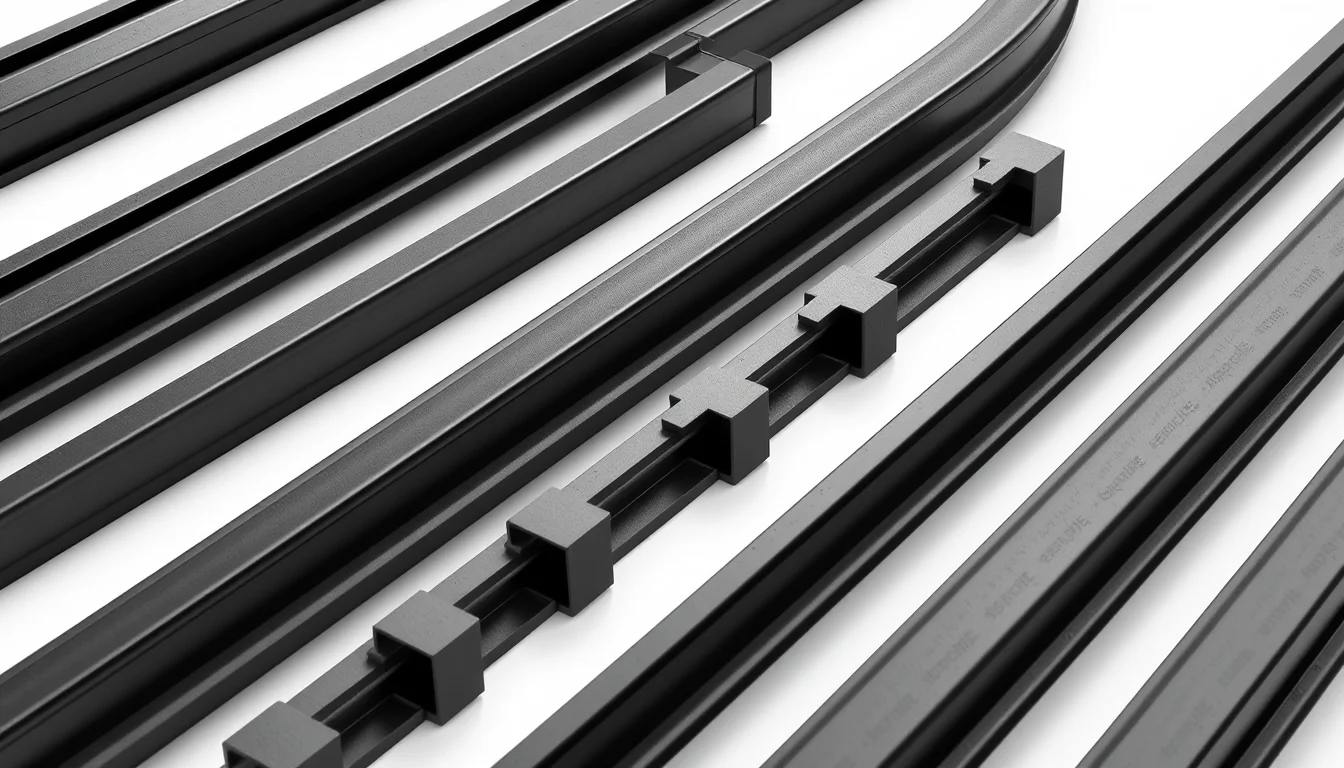
Low temperature flexibility EPDM maintains reliable sealing performance down to -50°C, with brittle point typically below -55°C and compression set under 25% after 70 hours at -40°C. For overseas B2B specifiers, the critical selection data sits in tensile retention, low-temperature compression set, and thermal aging curves — not in generic temperature ranges. This datasheet-style comparison gives you the numbers needed to specify EPDM against silicone, neoprene, and nitrile for cold-climate door, cabinet, and industrial enclosure applications.
Low Temperature Flexibility EPDM: Core Mechanical Data
Tensile Strength and Elongation at Low Temperature
Standard sulfur-cured EPDM compounds (Shore A 60–70) deliver tensile strength of 10–14 MPa at 23°C. At -40°C, tensile strength rises 30–50% as the polymer matrix stiffens, while elongation at break drops from 350–500% to 180–280%. Peroxide-cured EPDM grades retain better low-temperature elongation — typically 220–300% at -40°C — because the crosslink network is more uniform. For dynamic door sealing strips, specify peroxide-cured EPDM when the service window extends below -35°C.
Compression Set Performance
Compression set is the decisive metric for low temperature flexibility EPDM. Tested per ASTM D395 Method B (25% deflection, 70 h at -40°C), high-quality EPDM compounds return to 20–28% set. At 100°C the same compound reads 15–22%. A set above 35% at -40°C signals excessive crystallinity or plasticizer migration — reject that lot for cold-chain or outdoor cabinet seals.
| Property | Test Method | EPDM (Peroxide) | EPDM (Sulfur) | Silicone VMQ | Neoprene CR |
|---|---|---|---|---|---|
| Shore A hardness | ASTM D2240 | 60–70 | 60–70 | 50–70 | 60–70 |
| Tensile strength, 23°C | ASTM D412 | 12–15 MPa | 10–14 MPa | 6–9 MPa | 10–14 MPa |
| Elongation at break, 23°C | ASTM D412 | 350–450% | 400–500% | 300–500% | 300–450% |
| Brittle point | ASTM D746 | -55 to -60°C | -50 to -55°C | -60 to -70°C | -35 to -40°C |
| Compression set, 70 h @ -40°C | ASTM D395 B | 20–25% | 25–30% | 15–22% | 40–55% |
| Compression set, 70 h @ 100°C | ASTM D395 B | 15–20% | 20–28% | 20–30% | 25–35% |
| Thermal aging, 1000 h @ 120°C | ASTM D573 | ±15% tensile | ±20% tensile | ±10% tensile | ±30% tensile |
| Ozone resistance, 50 pphm | ASTM D1149 | No crack | No crack | No crack | Cracks |
| Oil resistance (IRM 903) | ASTM D471 | Poor (swell >100%) | Poor | Fair | Good |
| Acid/alkali resistance | ISO 1817 | Good | Good | Fair | Fair |
| Service temperature | — | -50 to 150°C | -45 to 140°C | -60 to 200°C | -35 to 100°C |
Thermal Aging and Long-Term Flexibility Retention
ASTM D573 Aging Curves
ASTM D573 air-oven aging at 120°C for 1000 hours shows peroxide-cured EPDM retains 85–90% of original tensile strength and 70–80% of elongation. Sulfur-cured grades retain 75–85% tensile and 60–70% elongation. Extrapolated service life at 80°C exceeds 15 years for peroxide EPDM in outdoor door sealing strips. At -40°C cycling (500 cycles, -40 to 23°C), crack initiation appears only after 1,200+ cycles in premium compounds.
Low-Temperature Flex Testing
ASTM D2137 (low-temperature brittleness) and ASTM D1053 (low-temperature flexibility, Clash-Berg) confirm EPDM's glass transition (Tg) near -50°C. Below Tg, the elastomer enters glassy state and flexibility collapses. For arctic door seals, specify EPDM with Tg below -55°C and plasticizer content under 15 phr to avoid migration-induced embrittlement after 5–7 years.
Chemical Resistance and Environmental Durability
Oil, Acid, and Alkali Performance
EPDM's non-polar polymer matrix swells severely in hydrocarbon oils (ASTM D471, IRM 903: >100% volume swell) and should not be specified for oil-contact sealing. Acid and alkali resistance per ISO 1817 is good: 20% sulfuric acid at 23°C produces <10% swell; 10% sodium hydroxide produces <5% swell. For chemical cabinet seals, EPDM outperforms neoprene in acid service but loses to FKM in oil service.
Ozone and Weather Resistance
ASTM D1149 ozone testing at 50 pphm, 20% strain, 40°C shows zero cracking in EPDM after 500 hours — a key advantage over neoprene and natural rubber. UV stability in carbon-black-filled EPDM exceeds 10 years in outdoor exposure (Florida and Arizona test sites). Flame retardancy can be formulated to UL 94 V-0 with halogen-free additives, though low-temperature flexibility drops by 5–8°C in FR grades.
Processing, Tolerance, and Vulcanization Control
Extrusion Tolerance and Durometer
Continuous extrusion of EPDM profiles holds ±0.15 mm on critical sealing lips and ±0.30 mm on general dimensions. Durometer tolerance is ±3 Shore A per ASTM D2240. Vulcanization via hot-air or microwave continuous lines (salt bath for dense profiles) achieves 95%+ cure state; undercured profiles exhibit compression set above 40% at -40°C. Specify cure state verification via rheometer (t90 within ±5% of master curve).
Compound Design for Cold Flexibility
Low temperature flexibility EPDM relies on: (1) EPDM grade with low ethylene content (45–55%) and high ENB (5–8%) for amorphous morphology; (2) plasticizer selection — paraffinic oils with pour point below -40°C; (3) peroxide cure to avoid sulfur crystallinity. Avoid excessive carbon black (above 80 phr) which raises Tg. For door sealing strips in cold storage, a 55 Shore A peroxide EPDM with 60 phr N550 carbon black delivers -55°C brittle point and 22% compression set at -40°C.
In our Hunan factory experience, a Scandinavian OEM specified EPDM cabinet seals for -45°C warehouse doors; initial sulfur-cured samples failed at 300 hours with 38% compression set. Switching to peroxide-cured EPDM (55 Shore A, 12 phr paraffinic plasticizer) delivered 21% set at -40°C and passed 1,500-hour ASTM D573 aging with 82% tensile retention. That project now ships 40,000 meters monthly to Norway.
Material Selection for Cold-Climate Sealing
| Application | Recommended EPDM Grade | Key Spec | Alternative |
|---|---|---|---|
| Cold storage door seals | Peroxide, 55 Shore A | -55°C brittle point, 22% set @ -40°C | Silicone (higher cost) |
| Outdoor cabinet seals | Peroxide, 65 Shore A | 1,000 h @ 120°C aging, ozone 0 crack | Neoprene (lower cost, worse cold) |
| Arctic container gaskets | Peroxide, 60 Shore A | -60°C Tg, 20% set @ -40°C | Silicone silicone series |
| Chemical enclosure seals | Sulfur, 70 Shore A | ISO 1817 acid/alkali <10% swell | FKM (oil service) |
| WPC profile weatherstrips | Peroxide, 65 Shore A | 10-year UV, ±0.15 mm tolerance | WPC profiles |
For cabinet seals in cold-chain logistics, see cabinet seals with EPDM cold-flex compounds.
Frequently Asked Questions
What is the MOQ for low temperature flexibility EPDM profiles?
MOQ is 500 meters for standard profiles and 2,000 meters for custom extrusion dies. For OEM/ODM projects with compound customization, MOQ is 5,000 meters. Trial orders below MOQ are quoted at a 30% premium.
What is the lead time?
Standard EPDM profiles ship in 15–20 days after drawing approval. Custom compound development adds 10–14 days for rheometer and ASTM D395 validation. Bulk orders above 50,000 meters ship in 25–30 days.
What extrusion tolerance do you hold?
Critical sealing lips hold ±0.15 mm; general dimensions ±0.30 mm; cut lengths ±1.0 mm. Durometer tolerance is ±3 Shore A. Tolerances follow ISO 3302-1 Class E2 unless your drawing specifies tighter.
How are profiles packed?
Profiles are coiled in 50–100 m rolls, interleaved with PE film, packed in export cartons with desiccant. Coil diameter and roll length match your container loading plan. Palletized packing is available for LCL shipments.
What is your sample policy?
Free samples up to 2 meters per profile ship within 3 days; you cover freight. Custom compound samples require a $150–$300 tooling fee, refundable against the first bulk order. Send your CAD drawing for a 24-hour quote.
Need a Custom Quote?
Send your CAD drawing or specs (material, hardness, profile, temperature range, MOQ) — our engineering team will respond within 24 hours.