
High & Low Temp Silicone Strips for Extreme Equipment | OEM
By Zhouxin Sealing Engineering Team · · 115 views
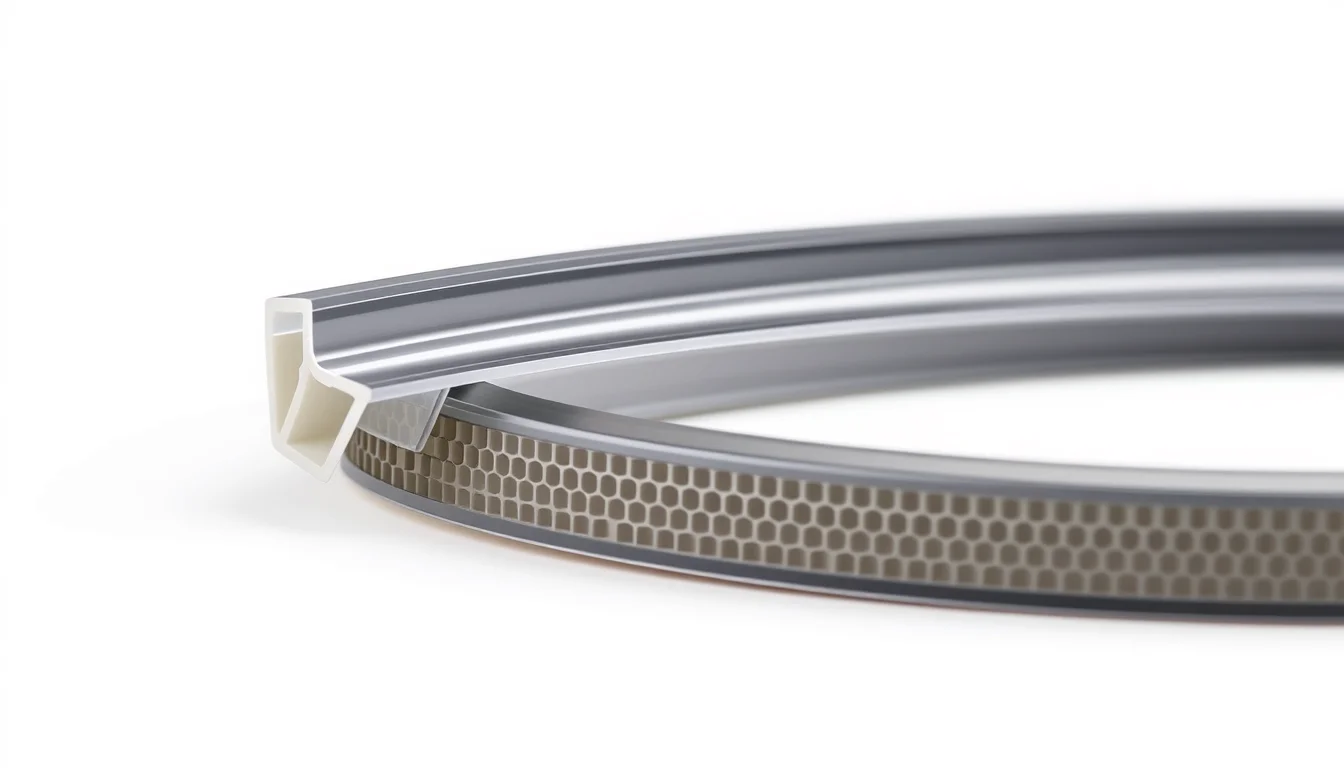
For sealing equipment that operates from -60°C to +300°C, you need platinum-cured silicone strips — not standard peroxide-cured profiles — because only the platinum system holds low compression set and tensile strength after long thermal aging. This guide gives OEM procurement teams the real specs, factory capability comparison, and custom extrusion workflow to place a production PO without surprises.
Why Silicone Is the Default Elastomer for -60 to +300°C Service
Silicone's polymer matrix (Si–O backbone) tolerates both temperature extremes better than EPDM, NBR, or neoprene. For an industrial equipment OEM, that translates into a seal that stays flexible at cold-soak and resists hardening at process heat. But "silicone" is not one material — the cure system and filler package decide whether your strip survives 1,000 hours at 250°C or fails at 400 hours.
Platinum-Cured vs. Peroxide-Cured Silicone
Platinum-cured (addition-cure) silicone delivers lower compression set, no peroxide by-products, and better batch-to-batch consistency. Peroxide-cured silicone costs less but can post-cure volatile by-products that fog optics and contaminate clean processes. For high-temp silicone strips used on extreme temperature equipment, specify platinum cure unless your cost model is extremely tight.
Temperature Range Reality Check
Standard VMQ silicone: -55°C to +200°C continuous. Low-temp phenyl silicone: -60°C to +175°C. High-temp grades with heat-stabilizers: +250°C continuous, +300°C short-term peaks. Always confirm the grade against your actual duty cycle — a 300°C rating on a datasheet usually means intermittent, not continuous.
Material & Spec Comparison for Extreme Temperature Sealing
| Property | Platinum-Cured Silicone (Std) | High-Temp Silicone (Stabilized) | Low-Temp Phenyl Silicone |
|---|---|---|---|
| Continuous service temp | -55 to +200°C | -50 to +250°C (300°C peak) | -60 to +175°C |
| Hardness (Shore A) | 40–70 | 50–70 | 40–60 |
| Tensile strength | 7–9 MPa | 6–8 MPa | 5–7 MPa |
| Elongation at break | 300–500% | 250–400% | 250–400% |
| Compression set (22h @ 175°C) | ≤ 20% | ≤ 25% | ≤ 30% |
| Thermal aging (ASTM D573, 72h @ 225°C) | Δ hardness ≤ +10 Shore A | Δ hardness ≤ +15 Shore A | Δ hardness ≤ +12 Shore A |
| Ozone resistance | Excellent | Excellent | Excellent |
| Flame retardancy option | UL 94 V-0 available | UL 94 V-0 available | UL 94 V-0 available |
All figures are typical values from production batches; request a certificate of conformance with your PO. Compression set is measured per ASTM D395 Method B.
Custom Extrusion: How the Process Actually Runs
Step 1 — Drawing Review and DFM Feedback
Send a 2D PDF plus a 3D STEP file. We review wall thickness, undercut, and corner radii against our extrusion tolerance capability (±0.10 mm on cross-section for profiles up to 30 mm). Expect DFM comments within 24–48 hours.
Step 2 — Tooling and Sample
Extrusion die cost for a custom silicone profile typically runs USD 350–900 depending on complexity and whether a secondary cut or splice is needed. Sample lead time is 7–10 working days after drawing approval and tooling payment. Samples ship free for qualified OEM projects; buyer covers courier.
Step 3 — Vulcanization and Post-Cure
Continuous vulcanization (hot air or salt bath) sets the profile; platinum-cured grades then post-cure to drive off residual volatiles. This step is what separates a strip that passes ASTM D573 thermal aging from one that embrittles at 200°C.
Step 4 — Cutting, Splicing, and Inspection
Strips cut to length ±1 mm, spliced corners for gasket frames, and 100% dimensional check on first article. Extrusion tolerance is verified with a profile projector against the drawing.
In our Hunan factory experience, the single biggest cause of back-and-forth on overseas custom rubber projects is a drawing that omits the sealing surface datum and the compression direction. When a European OEM sent us a 12-page drawing package with the compression axis clearly marked, we cut sample approval from three rounds to one — saving roughly three weeks on a 40,000-meter annual program.
Factory Capability, MOQ, and Export Packing
| Item | Standard Capability |
|---|---|
| Extrusion lines | 8 (silicone, EPDM, NBR, neoprene) |
| Profile size range | 3 mm to 120 mm cross-section |
| Extrusion tolerance | ±0.10 mm (≤30 mm profile), ±0.15 mm (>30 mm) |
| MOQ (custom) | 500 m per profile; 200 m for trial orders |
| MOQ (stock silicone strip) | 100 m |
| Tooling lead time | 5–7 working days |
| Sample lead time | 7–10 working days |
| Production lead time | 15–25 working days after sample approval |
| Packing | Coil in PE bag, carton, or wooden case for long lengths |
| Export terms | FOB Shanghai/Shenzhen, CIF, DDP available |
| Documentation | COC, RoHS, REACH, UL 94 report on request |
For OEM/ODM buyers running scheduled POs, we hold buffer stock of approved profiles so repeat orders ship in 10–15 days. Wholesalers ordering mixed containers can combine silicone strips with door sealing strips and cabinet seals to hit a full container load.
Sending CAD Drawings That Get Quoted in 24 Hours
A complete drawing package includes: (1) 2D PDF with all dimensions and tolerances, (2) 3D STEP file, (3) material callout (e.g., "platinum-cured VMQ, 60 Shore A, UL 94 V-0"), (4) compression direction and sealing surface marked, (5) operating temperature range and duty cycle, (6) annual volume and order frequency. With those six items, we return a firm quote — tooling, unit price, MOQ, lead time — within one business day. Missing items 3 and 4 are the usual culprits for delayed quotes.
Frequently Asked Questions
What is your MOQ for custom high-temp silicone strips?
500 meters per profile for custom extrusion, with a 200-meter trial order available for first-time buyers. Stock silicone strip profiles start at 100 meters. MOQ can be negotiated for multi-profile orders combined into one shipment.
What is the production lead time?
15–25 working days after sample approval for custom profiles, and 10–15 days for repeat orders where tooling already exists. Tooling adds 5–7 working days and samples add 7–10 working days before production begins.
What extrusion tolerance can you hold?
±0.10 mm on cross-section for profiles up to 30 mm, and ±0.15 mm above 30 mm. Cut length is ±1 mm. Tighter tolerances are possible on request but require a drawing review and may affect unit price.
How are strips packed for export?
Coiled in PE bags and cartoned, or wooden-cased for long lengths and heavy coils. We can print your label and barcode, and pack to your carton spec. Mixed SKUs per carton are accepted for wholesale orders.
What is your sample policy?
Samples are free for qualified OEM projects; the buyer covers courier. Custom samples require tooling payment, which is credited against the first production order of 1,000 meters or more.
Recommended Product Lines for Extreme Temperature Equipment
For -60 to +300°C service, specify from our silicone series: high-temp silicone strips (stabilized VMQ, 50–70 Shore A, +250°C continuous), low-temp silicone profiles (phenyl VMQ, -60°C), and platinum-cured silicone gaskets for cabinet and enclosure sealing. Where your equipment also uses decorative trim, WPC profiles can be quoted in the same shipment.
Send your CAD drawing for a 24-hour quote.
Need a Custom Quote?
Send your CAD drawing or specs (material, hardness, profile, temperature range, MOQ) — our engineering team will respond within 24 hours.