
Commercial Door Weatherstripping Bulk Supply | OEM Factory
By Zhouxin Sealing Engineering Team · · 235 views
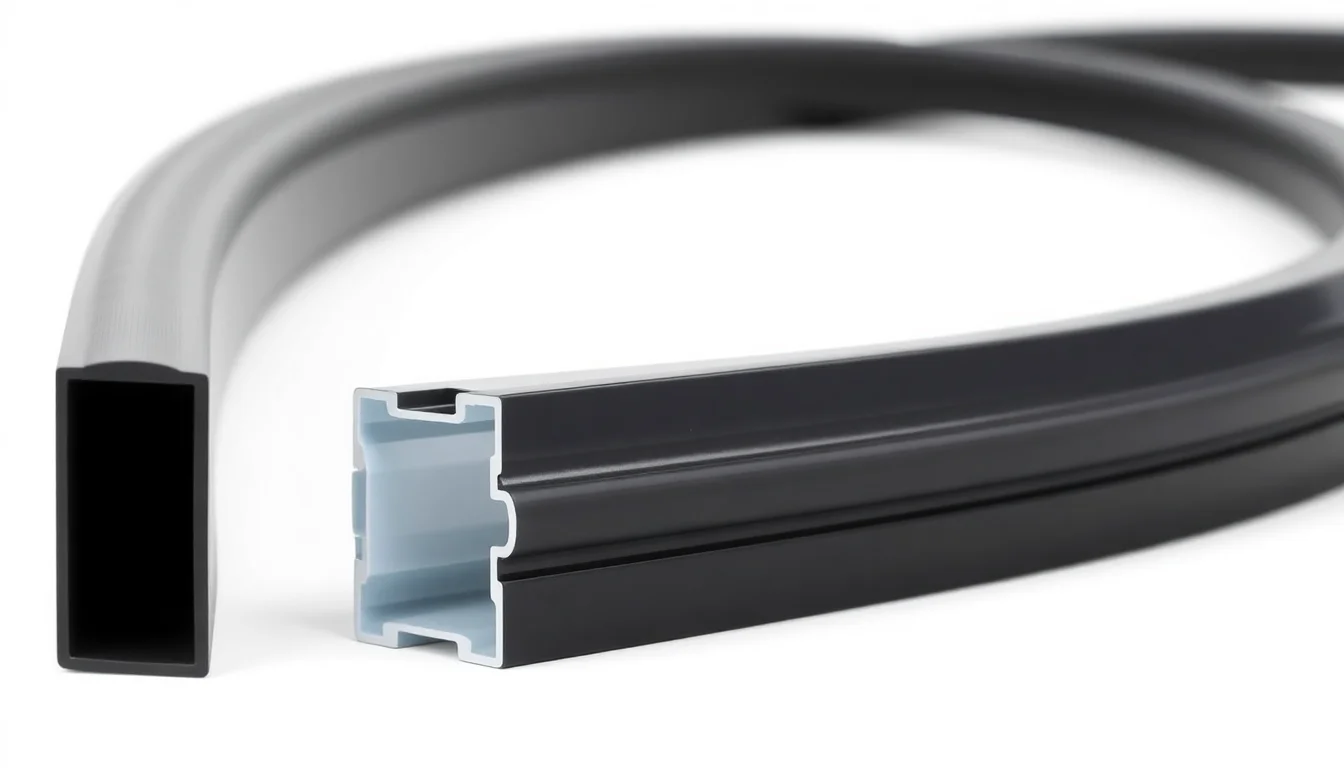
For overseas buyers holding active POs for commercial door weatherstripping, the critical differentiator is not material cost—it's extrusion tolerance consistency, compression set performance, and the factory's ability to hold ±0.15 mm on complex bulb profiles. Here is exactly how we evaluate, tool, and ship custom weatherstripping at Hunan Zhouxin Sealing Technology.
Factory Capability Comparison: What to Look For
When vetting suppliers for commercial door weatherstripping, most buyers focus on price per meter. That misses the real cost drivers: rework from out-of-tolerance extrusions, premature seal failure from poor compression set, and shipping delays from mold miscommunication. Use this benchmark table when comparing factories:
| Capability | Typical Low-Cost Factory | Our Standard (Changde, Hunan) |
|---|---|---|
| Extrusion tolerance | ±0.30 mm | ±0.10–0.15 mm (bulb profiles) |
| Compression set (ASTM D395, 22 h @ 70 °C) | >30% | ≤18% (EPDM 70A) |
| Tensile strength (ASTM D412) | 5–7 MPa | 9–12 MPa |
| Ozone resistance (50 pphm, 40 °C, 100 h) | Cracking after 48 h | No cracks after 100 h |
| Flame retardancy | None offered | UL 94 V-0 (silicone option) |
| Tooling cost (single cavity, 20 × 20 mm profile) | $800–1,200 | $600–900 (steel mold, 2-week lead) |
The Real Custom Extrusion Process (Step by Step)
Step 1: CAD Drawing Review
Send us your cross-section in .DXF, .DWG, or .STEP format. We check for:
- Draft angles on locking legs (minimum 1° for EPDM, 2° for silicone)
- Wall thickness consistency (avoid sudden jumps >1 mm)
- Bulb geometry (compression ratio target: 25–35% for door seals)
Step 2: Tooling Fabrication (10–14 Days)
We machine single- or multi-cavity extrusion dies from hardened tool steel. For complex profiles with hollow bulbs, we add a mandrel support bridge to prevent collapse during extrusion. Tooling cost includes one round of minor CAD adjustments.
Step 3: First-Article Sample (7–10 Days)
After die-mounting on a 65 mm single-screw extruder, we run 5 kg of compound and cut 3-meter samples. You receive:
- Cross-section microscope photo with ±0.01 mm overlay
- Shore A durometer reading (3 points along length)
- Visual inspection report (surface defects, porosity)
Step 4: Production & QC
Full production runs are sampled every 50 kg for dimensional check and every 200 kg for tensile/compression set. In our Hunan factory experience, the most common overseas rejection cause is bulb ovality—we solved this by adding a water-cooled calibration sleeve downstream of the die, reducing ovality from 0.25 mm to under 0.10 mm.
How to Send Proper CAD Drawings (Reduce Back-and-Forth by 60%)
Include these five items in your first RFQ:
- Cross-section with all dimensions (tolerances in mm, not inches)
- Material specification (EPDM 70±5 Shore A, ASTM D573 heat aging: 70 h @ 100 °C, elongation retention >80%)
- Installation gap (door-to-frame clearance when closed)
- Surface finish (smooth, textured, or flocked—flocked adds 3–5 days lead time)
- Color (black is standard; custom colors require 200 kg minimum per color)
Avoid these common mistakes:
- No closed loops in the cross-section (the die cannot form a fully closed profile without a weld line)
- Missing gasket compression direction (indicate with an arrow which side contacts the door)
- Unrealistic tolerances (±0.05 mm on a 50 mm-wide profile is not achievable in continuous extrusion)
Material Selection for Commercial Door Weatherstripping
| Material | Durometer (Shore A) | Temp Range (°C) | Best For |
|---|---|---|---|
| EPDM | 60–80 | -40 to +150 | Exterior doors, UV/ozone exposure |
| Silicone | 40–70 | -60 to +230 | Fire-rated doors, extreme cold |
| PVC (flexible) | 55–75 | -10 to +60 | Interior doors, budget projects |
| TPE | 50–80 | -30 to +100 | Recyclable, color-matched interiors |
For compliance with ASTM D395 (compression set) and ISO 3601 (seal dimensions), EPDM at 70 Shore A is the industry standard for commercial entrance doors. If flame retardancy is required (UL 94 V-0), use silicone or platinum-cured EPDM.
Packing & Export Logistics
- Standard packing: 50 m coils on cardboard reels, polybagged, 4 reels per carton (200 m total)
- Export carton: 60 × 40 × 30 cm, gross weight ~18 kg
- Palletizing: 40 cartons per pallet (8,000 m), stretch-wrapped with corner guards
- HS Code: 4016.93 (gaskets, seals) or 3926.90 (PVC/TPE)
- Lead time: 15–20 days for tooling + 10–15 days for production (20,000 m)
We ship FOB Shenzhen or Shanghai. For urgent orders, air freight samples are available within 5 days of tooling approval.
Frequently Asked Questions
What is your MOQ for custom commercial door weatherstripping?
For a new profile without existing tooling, MOQ is 5,000 m per color (approximately 20 full cartons). If you need a trial quantity before committing, we offer 500 m at sample pricing (50% premium over production price).
How long does sample lead time take?
First-article samples ship in 7–10 business days after CAD approval and tooling payment. For rush projects, we can expedite to 5 days with a 30% surcharge on tooling cost.
What extrusion tolerance can you hold?
Standard commercial tolerance is ±0.20 mm. For bulb profiles below 10 mm diameter, we hold ±0.15 mm. On non-critical dimensions (leg lengths >20 mm), ±0.30 mm is typical. All dimensions are verified with a 2D optical comparator.
How do you pack for export?
Coils on cardboard reels, polybagged with desiccant, packed in export-grade corrugated cartons. For long lengths (>100 m), we use plywood spools. Each carton is labeled with material, Shore A, length, and heat number for traceability.
What is your sample policy for overseas buyers?
We provide 3 m of free sample per profile for qualified buyers (minimum annual volume 50,000 m). Others pay $50 + shipping, refundable with first production order. Samples are shipped DHL or FedEx with tracking.
Customization Options Beyond Standard Profiles
For projects requiring integrated features, we offer co-extrusion of EPDM with a rigid PVC base for snap-in installation, or silicone with a metal insert for magnetic door seals. See our door sealing strips for standard profiles, or explore silicone series for high-temperature applications. For cabinet or interior doors, cabinet seals offer color-matched TPE options. If you need a decorative wood-grain finish, our WPC profiles combine sealing with aesthetics.
Send your CAD drawing to our engineering team for a 24-hour feasibility review and firm quote.
Need a Custom Quote?
Send your CAD drawing or specs (material, hardness, profile, temperature range, MOQ) — our engineering team will respond within 24 hours.