
Silicone Foam Gasket Roll | OEM Manufacturer
By Zhouxin Sealing Engineering Team · · 137 views
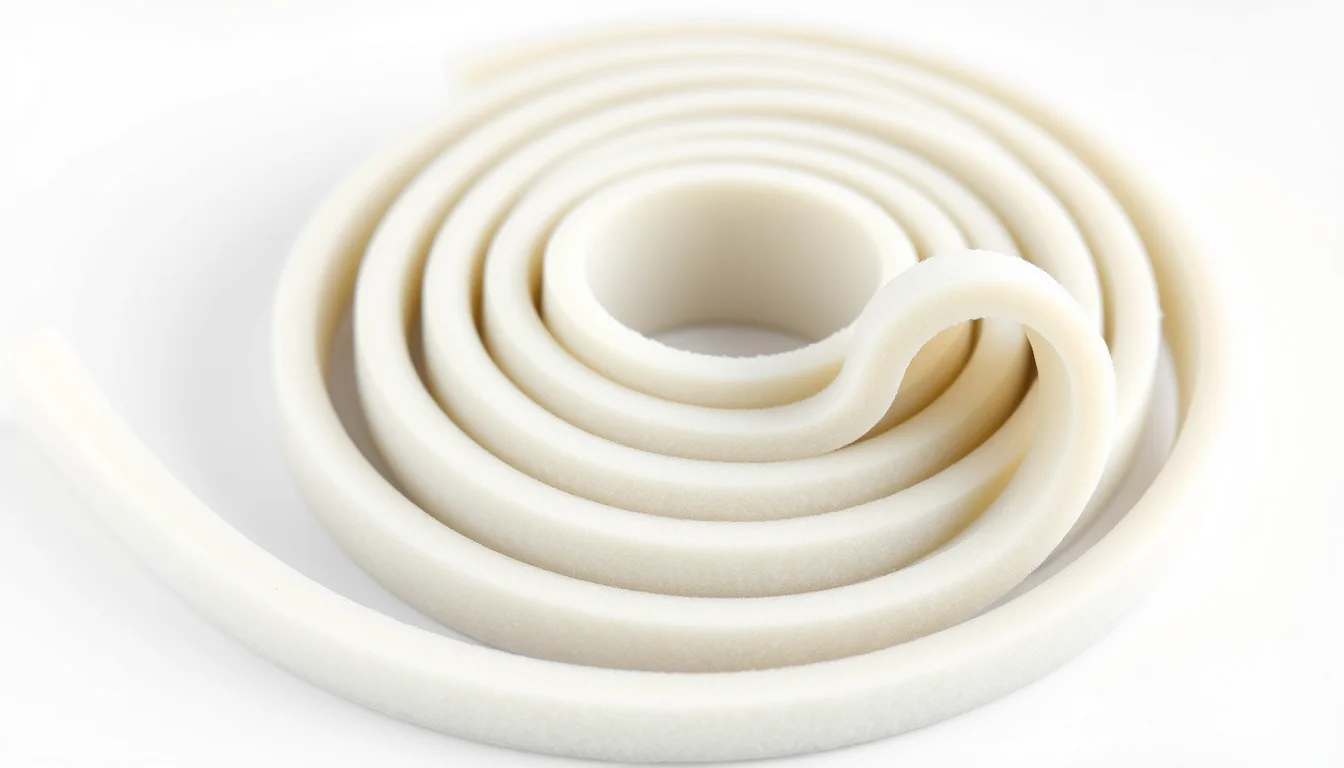
A silicone foam gasket roll is the most efficient way to procure continuous, closed-cell sealing profiles for high-volume gasketing, dust proofing, and vibration damping applications — but only if you source it from a factory that controls extrusion tolerance and density consistently across the entire roll length.
Why Buy Silicone Foam as a Gasket Roll Instead of Die-Cut Parts?
When you specify a silicone foam gasket roll, you are buying continuous extruded profiles that can be cut to length at installation or stamped into custom gaskets in-house. This eliminates the tooling cost of a flat die and reduces scrap waste compared to sheet goods. For OEMs running high-mix, low-volume production, a roll gives you the flexibility to adjust gasket length without re-ordering parts.
From a procurement standpoint, the roll format also simplifies logistics. A single 25-meter coil can replace hundreds of individual gaskets, reducing part numbers and warehouse SKUs. We supply silicone foam gasket rolls in widths from 5 mm to 500 mm, with cross-sectional shapes ranging from simple rectangles to complex hollow profiles with adhesive backing.
Factory Capability Comparison: What Separates a Real Extruder from a Trader
Many overseas buyers assume that all silicone foam suppliers are the same. They are not. The difference lies in whether the factory controls the polymer matrix and vulcanization process in-house. A trader resells commodity rolls; a manufacturer can adjust density, hardness, and cell structure to match your compression set requirements.
| Capability | Trader / Reseller | Full-Line Manufacturer (e.g., Hunan Zhouxin) |
|---|---|---|
| Density control (g/cm³) | Fixed range only | 0.25 – 0.85 ±0.05 |
| Shore 00 hardness | 10 – 30 | 5 – 50 |
| Extrusion tolerance | ±0.50 mm | ±0.15 mm (cross-section) |
| Custom tooling | No | Yes, in-house CNC machined dies |
| Compression set (ASTM D395) | Not tested | < 15% (22 hrs @ 100°C) |
| Thermal aging (ASTM D573) | No data | < 5% hardness change after 72 hrs @ 200°C |
| MOQ | 500 m | 100 m (custom profile) |
| Tooling cost | N/A | $150 – $400 per profile |
| Sample lead time | 2 weeks | 5 – 7 days |
If your drawing requires a durometer below Shore 00 10, or a tight tolerance on the width of the adhesive strip, you need a manufacturer with inline laser gauging. We run continuous measurement on every silicone foam gasket roll we extrude, so the cross-section stays within ±0.15 mm even over a 50-meter run.
The Real Custom Extrusion Process: From CAD to Coil
Step 1: Send a Proper CAD Drawing
The most common delay in custom silicone foam gasket roll projects is an incomplete drawing. We need three things: the cross-section profile (DXF or DWG), the required density or hardness range, and the compression deflection spec if it is a sealing application. If you do not have a drawing, send us a sample or a detailed sketch with critical dimensions marked.
Step 2: Tooling and Material Selection
Once we receive your CAD, our engineers review the profile for extrudability. Sharp internal corners in a foam profile are difficult to fill; we may suggest a 0.3 mm radius to ensure uniform cell structure. We then select the base polymer — typically platinum-cured or peroxide-cured silicone — and adjust the blowing agent to achieve your target density. Tooling is CNC-machined from aluminum and is ready in 5-7 days.
Step 3: Extrusion and Vulcanization
We extrude the uncured silicone compound through the die, then pass it through a hot-air vulcanization tunnel. The heat activates the blowing agent, creating a closed-cell structure. The key parameter is the balance between line speed and oven temperature — too fast and the skin is thin; too slow and the cells collapse. Our operators monitor this in real time.
Step 4: Post-Curing and Slitting
After vulcanization, the roll is post-cured to stabilize the polymer matrix. This step is critical for meeting UL 94 flame retardancy ratings and low outgassing specs. We then slit the roll to your required width and wind it onto cores with a protective film interleave if adhesive is applied.
In our Hunan factory experience, the most common reject reason for imported silicone foam gasket rolls is not dimensional — it is surface tackiness. When a roll is wound too tightly before post-curing, the foam layers can stick together, causing tearing when the buyer unrolls it. We solved this by adding a cooling zone before the winder and using a low-tack release film for rolls under Shore 00 15. If you have had delamination or tearing issues with previous suppliers, this is the first question you should ask them.
How to Send CAD Drawings That Reduce Back-and-Forth
To get an accurate quote on the first email, include the following in your drawing or spec sheet:
- Cross-section dimension with tolerances (default is ±0.20 mm unless you specify tighter).
- Hardness in Shore 00 or Shore A. For foam, Shore 00 is standard; specify the range, e.g., 10-15 Shore 00.
- Density in g/cm³ if known. If not, state the application (e.g., IP65 door seal) and we will recommend a value.
- Adhesive backing — specify if you need 3M™ VHB™ or a silicone PSA, and the liner color.
- Color — most silicone foam is available in black, gray, white, or red; custom colors require a minimum of 300 kg.
- End use — tell us if it will be exposed to UV, ozone, or chemicals. This affects the filler package.
Avoid sending a PDF of the drawing only. A PDF is fine for reference, but we need a vector file (DXF, DWG, or AI) to generate the extrusion die. If you only have a physical sample, mail it to us — we can reverse-engineer it within 2 days.
Material Specs and Standards for Silicone Foam Gasket Rolls
Silicone foam outperforms EPDM and neoprene in high-temperature and UV-rich environments. For outdoor door sealing strips and cabinet seals, the thermal aging resistance of silicone is unmatched. Below is a comparison of key properties.
| Property | Silicone Foam | EPDM Sponge | Neoprene Sponge |
|---|---|---|---|
| Temperature range | -55°C to 220°C | -40°C to 120°C | -30°C to 100°C |
| Tensile strength (MPa) | 0.5 – 2.0 | 1.0 – 3.0 | 1.5 – 4.0 |
| Compression set (ASTM D395, 22h @ 100°C) | < 15% | < 25% | < 35% |
| Ozone resistance | Excellent | Good | Fair |
| Flame retardancy (UL 94) | V-0 available | HB | HB |
| Chemical resistance (ISO 1817) | Fair (acids) | Good (oils) | Good (oils) |
For applications requiring flame retardancy, we formulate the silicone with a platinum catalyst and ceramic fillers to achieve UL 94 V-0 at 3 mm thickness. This is a common request for battery enclosures and EV charging stations.
Packing and Export: What to Expect for Sea and Air Freight
Silicone foam gasket rolls are lightweight but bulky. A standard 25-meter roll of 10 mm x 5 mm profile weighs about 1.2 kg and occupies 0.02 m³. We pack rolls on cardboard cores (76 mm ID), wrapped in kraft paper, and placed in cartons or on pallets for sea freight. For air freight, we vacuum-pack the rolls to reduce volume by up to 30%.
All exports from our Changde facility go through Shanghai or Shenzhen ports. We handle FOB, CIF, and DDP terms. For regular buyers, we hold safety stock of common profiles (e.g., 10x5, 15x8, 20x10 mm) so we can ship within 3 days of order confirmation.
Frequently Asked Questions
What is the MOQ for a custom silicone foam gasket roll profile?
The MOQ is 100 meters for a custom cross-section. For standard profiles from our catalog, we can split a 25-meter roll, but the unit price increases by 15%. If you are evaluating a new design, we recommend ordering a 10-meter trial roll first.
What is the tooling cost and who owns the die?
Tooling costs $150 to $400 depending on the profile complexity — a simple rectangle is at the low end, a hollow D-shape with a lip is at the high end. You own the die after payment. We store it free of charge for 5 years and will not use it for other buyers without your written consent.
What is the standard extrusion tolerance?
Our standard extrusion tolerance is ±0.20 mm on the cross-section. For critical sealing surfaces, we can hold ±0.10 mm using laser gauging and closed-loop feedback on the puller speed. Length tolerance is ±1% per roll.
How do you pack silicone foam gasket rolls for export?
Each roll is wound on a 76 mm core, wrapped in PE foam, and then packed in a carton. For sea freight, we load cartons on pallets and wrap with stretch film. We include a desiccant bag inside each carton to prevent moisture absorption during transit.
Can I get a sample before committing to bulk production?
Yes. We provide free samples of our standard silicone foam gasket rolls (up to 3 profiles) with you paying only the shipping cost. For custom profiles, we charge a sample fee of $50 plus tooling cost, which is fully credited back on your first production order. Samples ship within 5-7 days of tooling approval.
Send your CAD drawing for a 24-hour quote. Include your target density, hardness range, and estimated annual volume — we will reply with a per-meter price, tooling cost, and a delivery schedule based on our current extrusion line capacity.
Need a Custom Quote?
Send your CAD drawing or specs (material, hardness, profile, temperature range, MOQ) — our engineering team will respond within 24 hours.