
Silicone Sealing Strips by Application: OEM Spec Guide | Factory
By Zhouxin Sealing Engineering Team · · 202 views
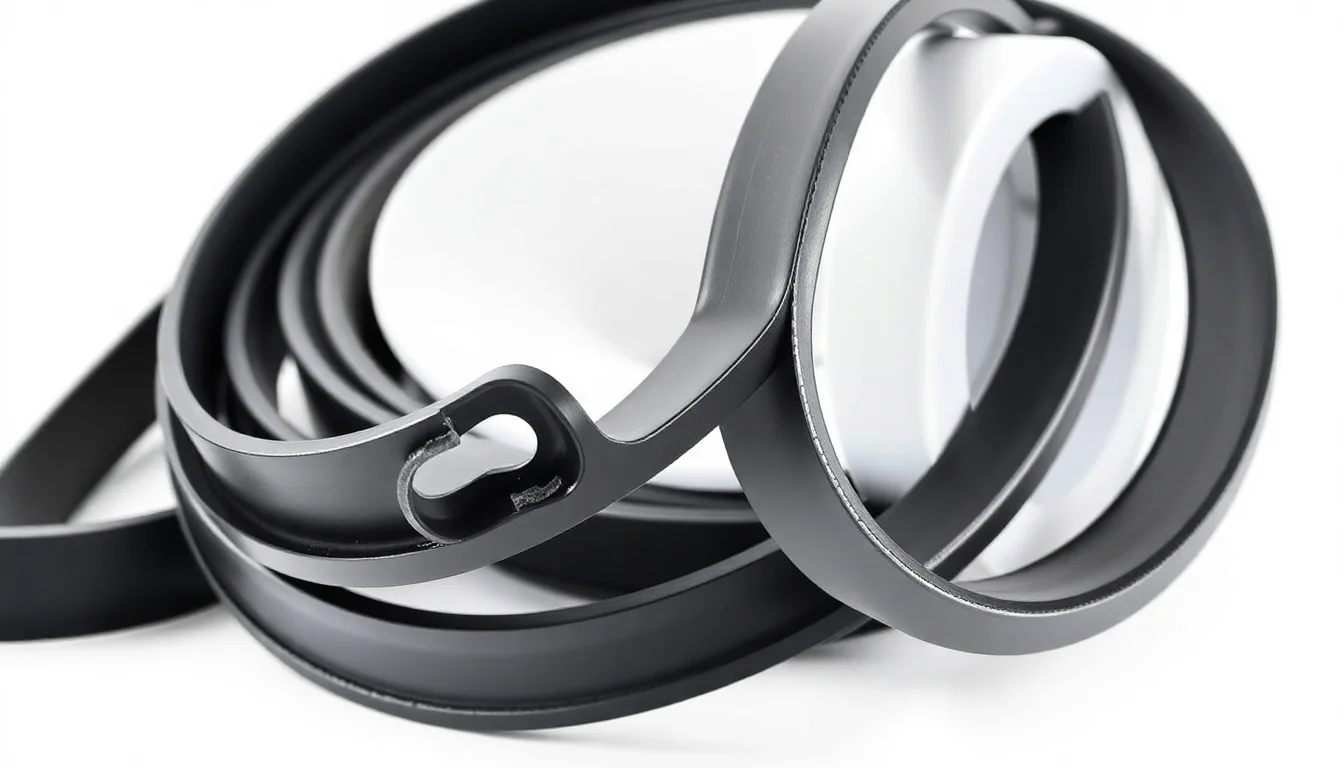
Selecting the right silicone sealing strip starts with defining the failure mode you are trying to prevent—not the price per meter. For OEM buyers engineering ovens, steamers, thermostats, and cold storage doors, the decision between a 40 Shore A food-grade silicone and a 70 Shore A high-temperature compound is a matter of thermal aging, compression set, and chemical resistance, not preference.
Defining the Operating Envelope: Temperature and Aging
The first filter is always continuous service temperature. A silicone strip that survives 200°C for 100 hours may fail catastrophically at 300 hours if the polymer matrix is not stabilized.
High-Temperature Oven and Steamer Seals
For oven door gaskets and steamer cabinet seals, you need a durometer that stays elastic at 180°C to 230°C. Standard EPDM (ethylene propylene diene monomer) tops out around 150°C continuous, which is why we see it fail prematurely in convection ovens. Our silicone series uses a fully vulcanized (peroxide-cured) silicone polymer with a durometer of 50 Shore A ± 5. This material maintains a tensile strength of 7.0 MPa after 72 hours of thermal aging at 200°C per ASTM D573. The compression set is critical here: after 22 hours at 175°C, we measure a maximum 25% set (ASTM D395 Method B). If your oven door slams shut, a lower compression set means the strip returns to shape and continues sealing.
Sub-Zero Cold Storage and Freezer Doors
Cold storage doors present the opposite problem. At -40°C, standard PVC (polyvinyl chloride) becomes brittle and cracks under the repeated friction of a sliding door. Silicone remains flexible at -60°C, but the wrong formulation will take a permanent set when the door is closed under heavy pressure. For freezer applications, we recommend a 60 Shore A silicone profile with a tensile strength of 6.5 MPa and an elongation at break of 400%. The key spec is the low-temperature compression set: we test at -40°C and require a maximum set of 30% after 24 hours. If you are building a walk-in freezer with a gasketed door sealing strip, this is the compound that prevents ice bridging and door warping.
Material Comparison: Silicone vs. EPDM vs. PVC
While silicone is the focus here, you must justify the cost premium over EPDM and PVC. Here is the engineering baseline we use for project specifiers.
| Material | Continuous Temp Range | Shore A Hardness | Tensile Strength | Compression Set (22h) | Ozone Resistance | UV Resistance | Relative Cost per Meter |
|---|---|---|---|---|---|---|---|
| Silicone (VMQ) | -60°C to 230°C | 40-70 | 6.5-8.0 MPa | 20-30% (at 175°C) | Excellent | Excellent | $$$ |
| EPDM | -40°C to 150°C | 50-80 | 8.0-12.0 MPa | 15-25% (at 100°C) | Excellent | Good | $$ |
| PVC (flexible) | -20°C to 60°C | 50-70 | 5.0-9.0 MPa | 40-60% (at 70°C) | Poor | Poor (cracks) | $ |
For a thermostat housing that sees 80°C and no UV, PVC is a budget option. For a steam oven that cycles between 30°C and 120°C with high humidity, EPDM will swell and lose its elastomer properties. Silicone is the only logical choice for steam because it resists hydrolysis—the breaking of polymer chains by water vapor—which is why we recommend it for cabinet seals in commercial kitchens.
Extrusion Tolerance and Dimensional Consistency
In a sealed oven cavity, a 1 mm deviation in the seal profile can cause a 5°C temperature gradient across the door glass. OEM buyers must demand tight extrusion tolerances. For silicone profiles, we hold a standard tolerance of ± 0.5 mm on cross-sectional dimensions up to 20 mm, and ± 1.0 mm on larger profiles. If your design uses a hollow D-shape seal, the wall thickness tolerance is critical to the closing force. We recommend specifying a wall thickness of 1.5 mm ± 0.15 mm to ensure the hollow chamber collapses evenly. When you send your CAD drawing for review, we verify the profile against the actual door gap—this is where a manufacturer with in-house tooling (like our Hunan factory) can adjust the die within 48 hours to achieve a perfect interference fit.
Flame Retardancy and Safety Compliance
Ovens and thermostats are heat sources, so your sealing strip must not become a fire hazard. Standard silicone is inherently more flame-retardant than EPDM, but it still needs additives to pass UL 94 V-0. In our high-performance silicone compounds, we add a platinum catalyst to achieve a UL 94 V-0 rating at a thickness of 3.0 mm. This is non-negotiable for any appliance intended for the European or North American market. Also, verify that the material does not emit toxic fumes during decomposition—silicone burns to a non-conductive ash (silica), whereas PVC releases hydrogen chloride gas. For a thermostat enclosure near electrical contacts, the non-conductive ash is a safety feature that prevents short circuits.
Food-Grade Compliance for Steamers and Kitchen Equipment
If your steamer or food warmer touches the food indirectly (e.g., a door seal that can drip condensation), the silicone must be food-grade. We use a compound that complies with FDA 21 CFR 177.2600 and EU 1935/2004. The critical spec here is the absence of plasticizers—silicone does not need them, which is a major advantage over PVC. We also test for volatile organic compound (VOC) migration per ISO 1817. In our experience, buyers often overlook the odor test; a low-grade silicone can impart a rubbery taste to food. Our food-grade compound is post-cured in an oven for 4 hours at 200°C to drive out residual volatile oligomers, ensuring a neutral odor and taste.
In our Hunan factory experience, we supplied a 60 Shore A food-grade silicone seal to a European steam oven manufacturer who had previously used EPDM. Their complaint was that the EPDM seal absorbed steam and swelled, causing the door to stick after six months. We replaced it with a hollow silicone profile with a 1.8 mm wall thickness. The silicone did not swell, the compression set remained under 20% after 500 hours of cycling, and the door closing force dropped by 30%. The client now specifies silicone for all their high-humidity appliances.
Handling Dynamic Friction and Abrasion
Sliding doors on cold storage units and thermostats with moving parts create friction. Silicone has a higher coefficient of friction than EPDM, which can cause chattering or squeaking. To mitigate this, we can coat the silicone surface with a PTFE (polytetrafluoroethylene) film or add a low-friction additive to the polymer matrix. For a sliding cold storage door, we recommend a 70 Shore A silicone with a PTFE coating on the sliding surface. This reduces the coefficient of friction from 0.8 (uncoated) to 0.2, extending the life of both the seal and the door mechanism. The coating also resists abrasion from repeated use, which is critical for a high-traffic commercial kitchen.
Frequently Asked Questions
What is the minimum order quantity (MOQ) for custom silicone profiles?
Our standard MOQ is 500 meters per profile for custom extrusions. For stock profiles (standard D-shapes, P-shapes, and bulb seals), we can split rolls at 100 meters. If you are prototyping, we offer a sample length of 5 meters at a nominal fee, which is credited to your first production order.
What is the lead time for a custom extrusion die and production?
For a new profile, the die fabrication takes 7-10 business days. Production and vulcanization take another 5-7 business days. For a standard profile with no tooling changes, we ship within 3-5 business days after receiving your purchase order and approved sample.
What extrusion tolerances can you guarantee?
We hold ± 0.5 mm on cross-sectional dimensions up to 20 mm. For dimensions between 20 mm and 50 mm, we guarantee ± 1.0 mm. Wall thickness tolerances are tighter at ± 0.15 mm. We use laser micrometers on the extrusion line to monitor these tolerances in real-time.
How do you pack silicone sealing strips for export?
We coil the strips into loops with a diameter of 500 mm to 800 mm, depending on the profile hardness. Each coil is wrapped in a polyethylene film, then placed in a reinforced carton or on a wooden pallet for sea freight. For self-adhesive strips, we apply a release liner and pack them flat to prevent curling.
Can I get a free sample before placing an order?
Yes, we provide up to 3 free samples of existing profiles for evaluation. For a custom profile, we ask you to share a CAD drawing or a physical sample. We will produce a 300 mm sample for your fit-and-function test. The sample cost is $30, which is refundable with your first order of 500 meters or more.
Send your CAD drawing for a 24-hour quote. We will validate the profile against your application's temperature, compression set, and tolerance requirements, and recommend the optimal silicone compound for your production schedule. | Profile Type | Shore A | Temp Range | Compression Set | Standard Tolerance | | --- | --- | --- | --- | --- | | Oven Door Seal | 50 | -60 to 230°C | 25% max | ± 0.5 mm | | Steamer Gasket | 50 (Food Grade) | -60 to 200°C | 20% max | ± 0.5 mm | | Cold Storage Seal | 60 | -60 to 180°C | 30% max | ± 1.0 mm | | Thermostat Seal | 70 (UL 94 V-0) | -60 to 200°C | 25% max | ± 0.5 mm |
Contact us to discuss your OEM project or request a quote for WPC profiles if you need rigid framing to complement the silicone seals.
Need a Custom Quote?
Send your CAD drawing or specs (material, hardness, profile, temperature range, MOQ) — our engineering team will respond within 24 hours.