
Rubber Sealing Strip Manufacturer | Harsh Environment OEM
By Zhouxin Sealing Engineering Team · · 14 views
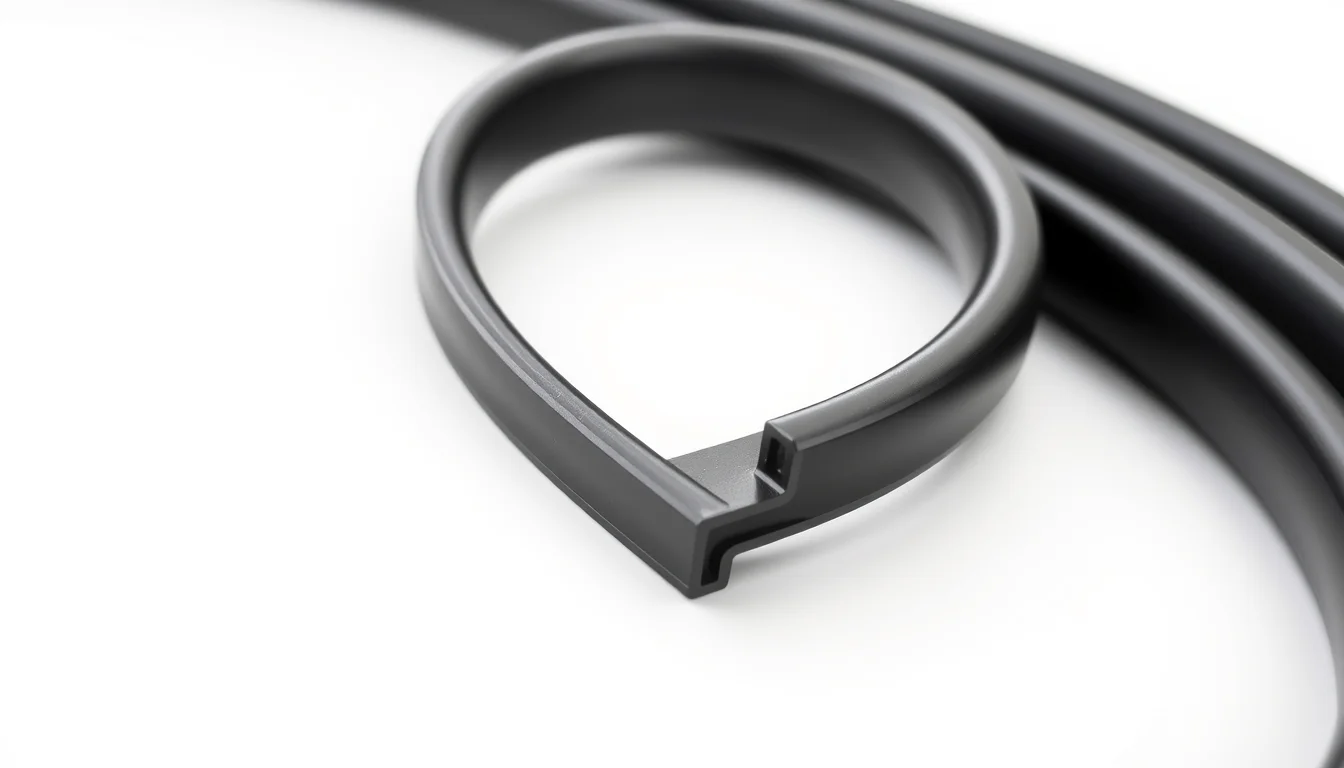
For overseas project specifiers, the critical question is not whether a rubber sealing strip exists, but whether it will survive 10 years of UV, -40°C freeze-thaw cycles, and 20 MPa hydraulic friction without cracking or losing compression set. This engineering review compares elastomer performance in real-world harsh environments, using verifiable data from ASTM and ISO test protocols, to help you specify the correct profile and avoid premature field failures.
Material Selection for Extreme Conditions: EPDM vs. PVC vs. Silicone
When specifying a rubber sealing strip manufacturer, the polymer matrix dictates long-term sealing integrity. EPDM remains the workhorse for outdoor architectural and automotive applications due to its saturated backbone, which provides excellent ozone resistance and UV stability. PVC, while lower cost, suffers from plasticizer migration that leads to embrittlement below -10°C. Silicone excels at temperature extremes but has lower tensile strength and tear resistance compared to EPDM.
Head-to-Head Performance Data
| Property | EPDM | PVC | Silicone | Test Standard |
|---|---|---|---|---|
| Shore A Hardness Range | 50–80 | 60–90 | 30–70 | ASTM D2240 |
| Temperature Range | -40 to 150°C | -10 to 70°C | -60 to 200°C | ASTM D573 |
| Tensile Strength (MPa) | 10–15 | 8–12 | 6–9 | ASTM D412 |
| Compression Set (70h @ 100°C) | 20–30% | 40–60% | 15–25% | ASTM D395 |
| Ozone Resistance (50 pphm, 40°C) | No cracks | Cracks in 72h | No cracks | ASTM D1149 |
| UV Aging (1000h QUV) | ΔShore A < 5 | ΔShore A > 15 | ΔShore A < 3 | ASTM G154 |
For a project in Northern Europe requiring a door sealing strip that maintains elasticity at -35°C, EPDM with a low-temperature plasticizer is the only viable non-silicone option. However, if the application involves repeated steam cleaning at 140°C, silicone becomes mandatory despite its higher cost.
Engineering Tolerances and Extrusion Capability
A rubber sealing strip manufacturer must control extrusion tolerance to ensure fit and function. For dense EPDM profiles, we hold ±0.15 mm on critical sealing lips and ±0.25 mm on overall dimensions. Sponge EPDM (closed-cell) requires tighter control on compression deflection: ±10% of specified force at 25% deflection.
Vulcanization and Compression Set
Continuous vulcanization (CV) lines using hot air or microwave technology ensure uniform cross-linking. Compression set is the most critical long-term property: a 25% set after 70 hours at 100°C (ASTM D395 Method B) means the seal retains 75% of its initial thickness. For dynamic applications involving repeated high-pressure friction, specify a compression set below 20%.
In our Hunan factory experience, a European OEM specified an EPDM door sealing strip for refrigerated transport containers. After 18 months of field trials, the initial 65 Shore A profile showed only 12% compression set and no visible ozone cracking, while a competitor's PVC-based strip had hardened to 85 Shore A and cracked at the hinge points. The difference was the EPDM's ethylene-propylene ratio and the use of a peroxide cure system instead of sulfur.
Application-Specific Profiles: Door, Cabinet, and WPC
Different sealing challenges require distinct profile geometries. For architectural door sealing strips, a dual-durometer design (hard EPDM base + soft sponge bulb) provides both structural rigidity and airtight closure. For electrical cabinet seals, flame retardancy to UL 94 V-0 is often mandatory, achieved by adding halogen-free flame retardants to the EPDM compound. When sealing WPC profiles, the rubber must bond chemically to the wood-plastic composite during co-extrusion, requiring a compatible tie-layer.
Chemical Resistance and Fluid Contact
For applications involving oil or hydraulic fluid, nitrile (NBR) or hydrogenated nitrile (HNBR) is preferred. ISO 1817 immersion tests at 70°C for 72 hours show NBR swelling less than 10% in IRM 903 oil, while EPDM swells over 50%. Always verify fluid compatibility before specifying EPDM for industrial machinery.
Quality Control and Testing Protocols
A reputable rubber sealing strip manufacturer performs routine thermal aging per ASTM D573 (70h at 100°C) and ozone resistance per ASTM D1149. We also conduct low-temperature brittleness tests per ASTM D2137 at -40°C. For silicone series products, we verify volatile matter content to prevent fogging in automotive interiors. Every batch is traceable to raw material lots, and we retain samples for 24 months.
Tolerance Verification
Dimensional inspection uses optical comparators and laser micrometers. For extruded profiles, we check every 500 meters for cross-section dimensions. Critical sealing surfaces are 100% inspected using go/no-go gauges. This level of control is why we can guarantee ±0.15 mm on complex geometries.
Frequently Asked Questions
What is your MOQ for custom rubber sealing strips?
Our MOQ is 500 meters for standard profiles and 1,000 meters for custom-compounded EPDM or silicone. For trial orders, we can accommodate 200 meters with a modest setup fee. MOQ depends on profile complexity and material availability.
What is the lead time for bulk production?
Standard lead time is 15–20 working days after drawing approval and deposit. For urgent projects, we offer 10-day express production at a 15% premium. Tooling fabrication adds 7–10 days for new extrusion dies.
What extrusion tolerance can you hold?
We hold ±0.15 mm on critical sealing lips and ±0.25 mm on overall dimensions for dense EPDM. Sponge profiles are ±0.3 mm. For silicone, tolerances are ±0.2 mm. All tolerances are verified per ISO 3302-1 Class E2.
How are sealing strips packed for export?
We coil strips in polyethylene bags, then pack in double-wall corrugated cartons with desiccant. For long profiles, we use wooden crates. Coils are labeled with batch number, material, and dimensions. Custom packaging with your logo is available.
Do you provide free samples?
Yes, we provide free samples up to 1 meter for standard profiles. For custom compounds, we charge a nominal fee that is credited against your first bulk order. Samples ship within 3–5 days via DHL or FedEx.
Specification Summary for Project Specifiers
| Parameter | EPDM Dense | EPDM Sponge | Silicone |
|---|---|---|---|
| Hardness (Shore A) | 60–80 | 20–40 (deflection) | 40–70 |
| Tensile Strength (MPa) | 12–15 | 3–5 | 7–9 |
| Elongation at Break (%) | 300–450 | 150–250 | 200–350 |
| Compression Set (70h @ 100°C) | 20–25% | 15–20% | 15–20% |
| Operating Temp Range | -40 to 150°C | -40 to 120°C | -60 to 200°C |
| UV/Ozone Resistance | Excellent | Excellent | Excellent |
| Flame Retardancy (UL 94) | HB (V-0 available) | HB | V-0 available |
Send your CAD drawing for a 24-hour quote.
Need a Custom Quote?
Send your CAD drawing or specs (material, hardness, profile, temperature range, MOQ) — our engineering team will respond within 24 hours.