
Rubber Gasket Cord Splicing Service | OEM Manufacturer
By Zhouxin Sealing Engineering Team · · 224 views
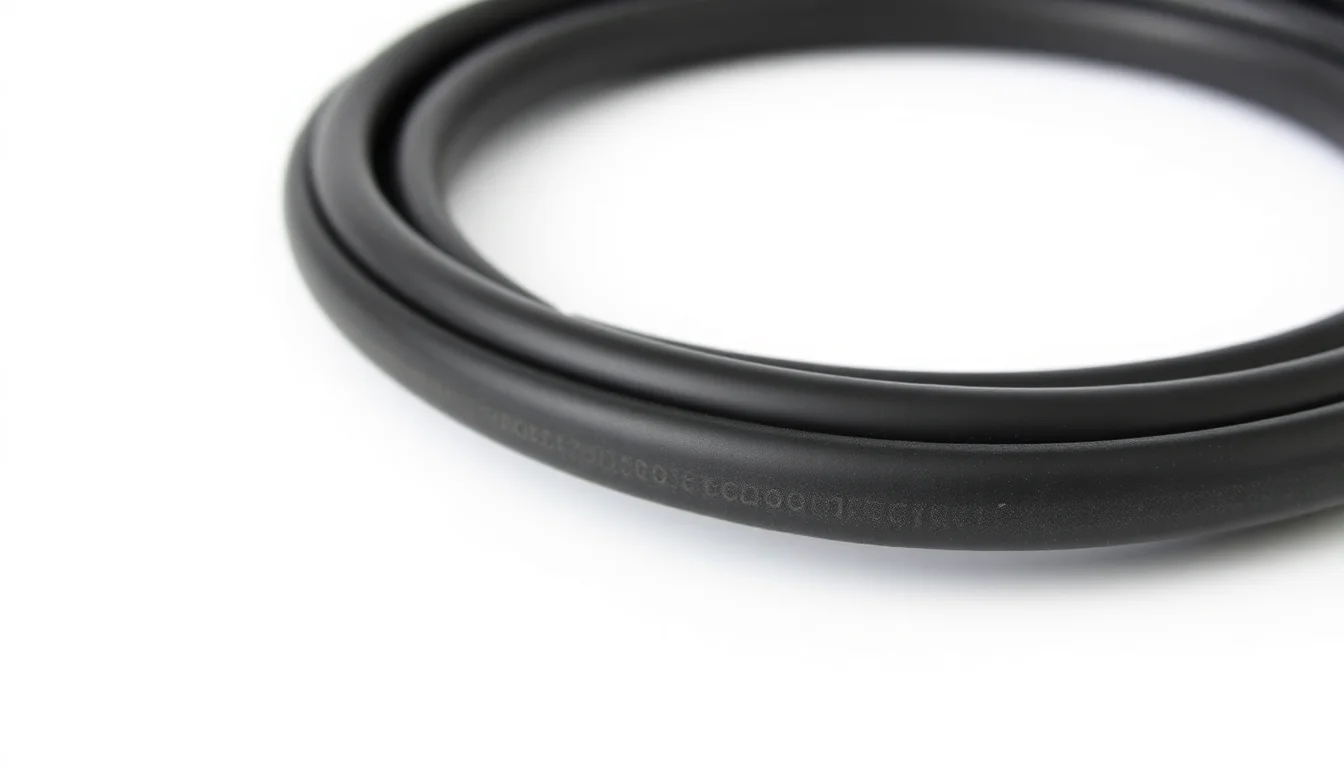
If you are sourcing a rubber gasket cord splicing service for an active OEM project, the core decision is not just about who can cut and glue ends — it is about matching your polymer matrix, durometer, and extrusion tolerance to a factory that validates every splice with thermal aging and compression set data. We have supplied spliced gasket cords for cabinet seals, door sealing strips, and WPC profiles to buyers across 30+ countries since 2009, and the difference between a reliable seal and a field failure often comes down to how the splice is prepared and tested.
Why Splicing Quality Matters in B2B Procurement
A spliced gasket cord is only as strong as its weakest joint. In continuous-length applications — such as perimeter sealing for electrical enclosures, refrigeration units, or automotive access panels — an improperly spliced cord can leak under compression or separate during thermal cycling. Our factory treats splicing as a precision operation: each cord end is skived at a controlled angle, cleaned with solvent, coated with a formulated adhesive matched to the elastomer, and cured under pressure in a heated fixture. We then test every production lot for tensile strength retention at the splice (minimum 85% of base material per ASTM D412) and compression set at the joint (ASTM D395 Method B, 22 hr at 70°C).
Real Numbers for Specification Writers
When you specify a spliced gasket cord, include these parameters in your RFQ:
| Property | Typical Range | Test Standard |
|---|---|---|
| Shore A Hardness | 40–80 ± 5 | ASTM D2240 |
| Tensile Strength | 5–12 MPa | ASTM D412 |
| Compression Set (22h/70°C) | ≤ 25% | ASTM D395 Method B |
| Thermal Aging (70h/100°C) | ≤ 15% change in hardness | ASTM D573 |
| Ozone Resistance (50 pphm, 40°C, 100 hr) | No cracks | ASTM D1149 |
| Splice Tensile Retention | ≥ 85% of base material | In-house method per ASTM D412 |
| Standard Extrusion Tolerance | ± 0.2 mm (cross-section) | ISO 3302-1 Class E2 |
The Custom Extrusion Process for Spliced Gasket Cords
Understanding how your spliced cord is made helps you avoid specification gaps. Here is the sequence we follow for every custom project:
1. Material Selection and Compound Formulation
Based on your operating environment — temperature range, fluid exposure, UV/ozone, and flame retardancy requirements — we select the base polymer. For high-temperature or food-contact applications, we typically recommend silicone series with UL 94 V-0 rating. For outdoor weathering and ozone resistance, EPDM is standard. For oil resistance in hydraulic systems, NBR or HNBR is used. We then adjust the durometer and cure system to optimize compression set and extrusion flow.
2. Die Design and Extrusion
Your CAD drawing is reviewed for cross-section geometry, wall thickness uniformity, and undercut angles. We produce a precision steel die (typical lead time 5–7 days). The compound is fed through a cold-feed extruder, vulcanized in a continuous hot-air tunnel or microwave line, and cooled in a water bath. For spliced cords, the continuous profile is then cut to calculated lengths with a 1–2% allowance for splice overlap.
3. Splicing and Post-Cure
Each cord end is skived at 30–45° to maximize bonding surface area. A two-part adhesive (or heat-cured tape splice for silicone) is applied, and the joint is clamped in a heated press at 150–180°C for 5–15 minutes depending on cross-section. After cooling, every splice is visually inspected and randomly pulled to 50% of rated tensile for quality assurance.
4. Testing and Certification
We provide a lot-specific test report including hardness, tensile, compression set, and splice strength. For orders requiring third-party certification, we can coordinate ASTM or ISO testing at an accredited lab.
How to Send Proper CAD Drawings to Reduce Back-and-Forth
Miscommunication on drawings is the #1 cause of sample delays. Follow this checklist when you send your file:
- Format: .dwg or .dxf (preferred), .step/.stp for 3D, or .pdf with clear dimensions.
- Critical dimensions: Overall length (including splice allowance), cross-section width and height, wall thickness at thinnest point, and any chamfer or radius callouts.
- Tolerance notes: If you need ±0.15 mm instead of ±0.20 mm, state it explicitly.
- Splice location: Mark where the splice should be located relative to the cord ends (e.g., centered, offset, or multiple splices per length).
- Material callout: Shore A target, color (RAL number), and any special requirements (UV stable, FDA, UL 94).
In our Hunan factory experience, the most common error we see from overseas buyers is specifying a cord cross-section with an aspect ratio over 5:1 (e.g., 5 mm wide × 1 mm thick) without noting that the thin section will distort during vulcanization. We always flag this during drawing review and suggest a slight profile adjustment to maintain tolerance — saving two to three email loops.
Packing and Export for Overseas Shipments
Spliced gasket cords are packed to prevent deformation and moisture damage during transit:
- Coils: For cords up to 10 mm cross-section, we wind onto cardboard reels with foam interlayers.
- Straight lengths: For rigid profiles, we bundle in telescoping cartons with internal supports.
- Splice protection: Each splice is wrapped with a low-tack protective tape to prevent adhesive contamination.
- Export documentation: Commercial invoice, packing list, bill of lading, and certificate of origin (Form A or COO) provided with every shipment.
Standard packing is suitable for ocean freight (20–45 days) with no degradation. For air freight, we reduce moisture barrier film to save weight.
Frequently Asked Questions
What is your MOQ for spliced gasket cords?
MOQ for standard cross-sections (up to 20 mm width) is 500 meters per profile. For larger cross-sections or complex geometries, MOQ may be 200 meters. We can discuss lower MOQs for prototype samples or repeat orders.
What is the sample lead time?
For an existing die (no tooling cost), sample lead time is 5–7 working days. For new dies, add 5–7 days for die fabrication. We ship samples via DHL, FedEx, or UPS — typical transit 3–5 days to major destinations.
What is the standard extrusion tolerance?
We hold ±0.2 mm for cross-section dimensions under 20 mm, and ±0.3 mm for 20–50 mm profiles, per ISO 3302-1 Class E2. Tighter tolerances (±0.15 mm) are achievable with secondary calibration but may increase tooling cost.
How do you pack spliced cords for export?
Cords are coiled on reels or cut to specified lengths and packed in export-grade cartons with moisture barrier bags. Splices are individually protected. Carton dimensions are optimized for pallet loading (standard 40" × 48" pallet).
What is your sample policy?
We charge a sample fee (typically $50–$150 depending on profile complexity) which is refunded upon placement of a production order. Tooling cost for new dies is quoted separately and amortized over the first 5,000 meters. We accept T/T, L/C, and PayPal for sample fees.
Common Materials for Spliced Gasket Cords
| Material | Temp Range | Key Features | Typical Applications |
|---|---|---|---|
| EPDM | -40°C to 150°C | Excellent ozone/UV resistance, good compression set | Outdoor door sealing strips, automotive trunk seals |
| Silicone | -60°C to 230°C | High temp stability, FDA compliant, UL 94 V-0 | Food equipment, lighting, medical device seals |
| NBR (Buna-N) | -30°C to 120°C | Oil and fuel resistance | Hydraulic systems, engine gaskets |
| Neoprene (CR) | -40°C to 120°C | Moderate oil resistance, flame retardant | Electrical enclosures, marine seals |
| SBR | -30°C to 100°C | Abrasion resistance, low cost | Industrial matting, low-temp gaskets |
Send your CAD drawing for a 24-hour quote.
Need a Custom Quote?
Send your CAD drawing or specs (material, hardness, profile, temperature range, MOQ) — our engineering team will respond within 24 hours.