
Rubber Gasket Cord Splicing Service | OEM Manufacturer
By Zhouxin Sealing Engineering Team · · 6 views
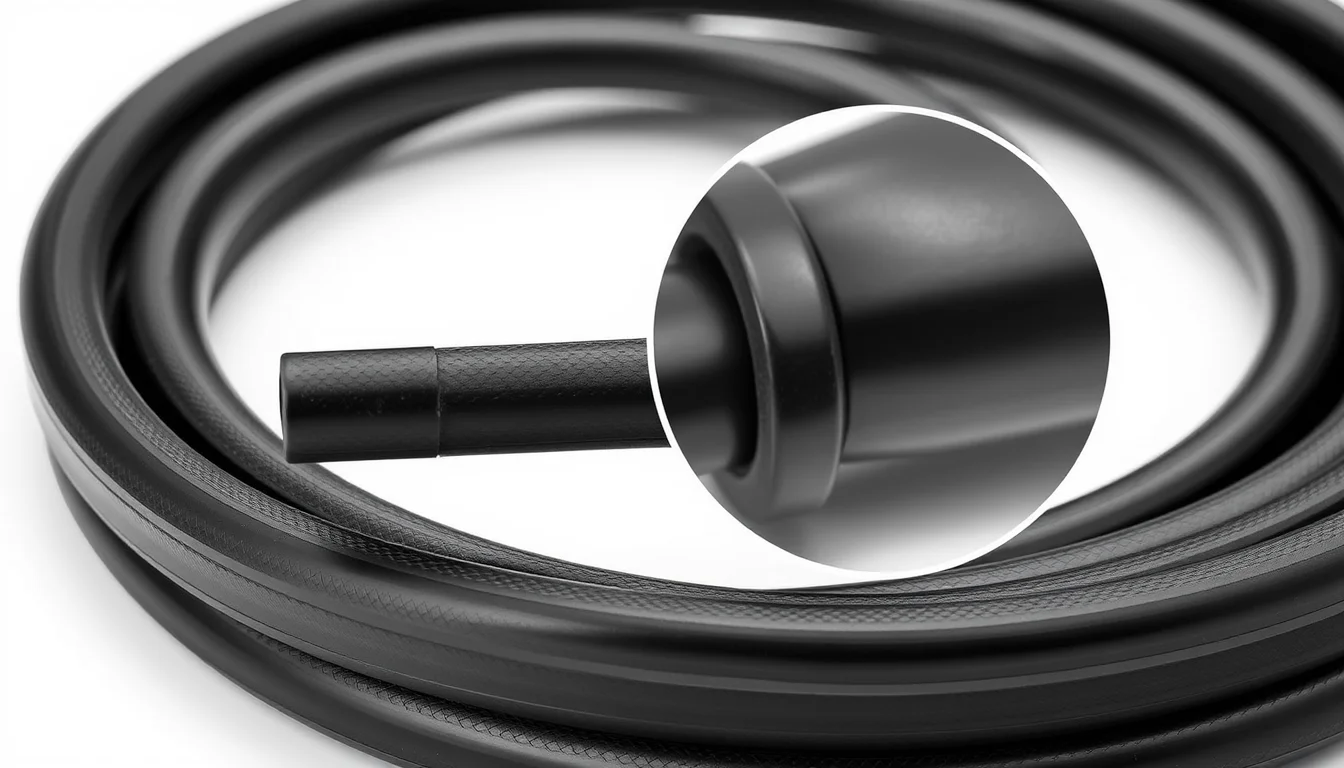
A rubber gasket cord splicing service is what you need when your sealing profile must survive long-term UV, sub-zero freeze-thaw cycles, or repeated high-pressure friction without joint failure — and the splice is almost always where a system leaks first. Below is a head-to-head engineering review of what actually holds up in the field, with real Shore A, temperature, and compression set data from production runs.
Why the Splice Joint Fails Before the Rubber Does
The three failure modes specifiers underestimate
In harsh-environment sealing, the polymer matrix rarely fails first. The splice does. Three mechanisms dominate:
- Thermal aging at the joint interface. Under ASTM D573, a poorly vulcanized splice can lose 40–60% of its original tensile strength after 70 h at 100°C, while the parent cord loses under 15%.
- Compression set creep. ASTM D395 Method B (22 h @ 70°C) separates a good splice from a bad one fast. A quality vulcanized EPDM splice returns to ≤25% set; a mechanically stapled or glued joint can exceed 45%.
- Ozone attack at the seam. Any micro-void at the splice concentrates stress and becomes the first crack initiation site under ISO 1817 ozone exposure.
For door and enclosure work where the cord is compressed thousands of times, this is the difference between a 2-year seal and a 10-year seal. That is why we treat splicing as a separate engineering discipline from extrusion — see our door sealing strips for how spliced cords are deployed in real assemblies.
What "splicing service" actually means at the factory level
A proper rubber gasket cord splicing service covers: cutting to length with a controlled-angle jig (typically 45° or 90° scarf), surface activation, vulcanization of the joint under heat and pressure, and post-cure. The output is a continuous loop or a finished gasket with a joint whose mechanical properties approach the parent extrusion.
Material Head-to-Head: EPDM vs PVC vs Silicone vs NBR
The table below reflects typical production values from our extrusion and splicing lines. Treat these as engineering baselines, not catalog maximums.
| Material | Temp Range | Shore A | Tensile (MPa) | Compression Set (ASTM D395, 22h@70°C) | Ozone Resistance | Relative Cost |
|---|---|---|---|---|---|---|
| EPDM | -40 to +150°C | 50–80 | 8–12 | 15–25% | Excellent | $$ |
| PVC (flexible) | -20 to +70°C | 60–85 | 6–10 | 30–45% | Good | $ |
| Silicone | -60 to +200°C | 30–70 | 5–9 | 20–35% | Excellent | $$$ |
| NBR | -30 to +100°C | 50–80 | 8–14 | 20–30% | Fair | $$ |
| TPE/TPV | -40 to +120°C | 55–85 | 5–9 | 25–40% | Good | $$ |
EPDM: the default for outdoor and UV-exposed cord
EPDM remains the workhorse for exterior gasket cord. Its saturated backbone gives it outstanding ozone and UV resistance, and a properly vulcanized EPDM splice holds 85–90% of parent tensile after thermal aging. For architectural and cabinet applications, this is the material to specify unless temperature or chemical exposure says otherwise.
PVC: cheap, but watch the temperature ceiling
PVC is the lowest-cost option and machines cleanly, but its plasticizer migrates over time. Above 60°C continuous, expect hardening and shrinkage at the splice. It is acceptable for indoor, moderate-cycle applications — not for sub-zero or high-UV duty.
Silicone: when temperature wins over everything
Silicone tolerates -60 to +200°C and stays flexible at temperatures that embrittle EPDM. The trade-off is lower tensile strength and higher cost. For high-temp cabinet or oven-door sealing, review our silicone series before committing to EPDM.
NBR and TPE: niche roles
NBR is the choice when oil or fuel contact is present; its ozone resistance is only fair, so it should not be specified for outdoor UV duty. TPE/TPV offers recyclability and good UV performance but lower compression set recovery than thermoset EPDM.
Extrusion Tolerance and Splicing Tolerance Are Not the Same
Why your ±0.15 mm extrusion tolerance does not guarantee a good joint
Extrusion tolerance (ISO 3302-1 Class E2 or E3, typically ±0.15 to ±0.30 mm on a 10 mm section) governs the cord cross-section. Splicing tolerance governs joint geometry — angular alignment, length, and surface flushness. A 0.5 mm misalignment at a 45° scarf can create a leak path even if every extruded meter is in spec.
Tolerances we hold on spliced cord
| Parameter | Standard Tolerance | Tight Tolerance (on request) |
|---|---|---|
| Cut length | ±1.5 mm | ±0.8 mm |
| Splice angularity | ±2° | ±1° |
| Joint offset (flushness) | ±0.3 mm | ±0.15 mm |
| Cross-section (extruded) | ±0.20 mm | ±0.10 mm |
| Durometer (Shore A) | ±5 | ±3 |
If your assembly is a compression seal in a machined groove, specify tight tolerance on joint offset — that is where leaks initiate.
Real Deployment: Sub-Zero Cabinet Sealing Case
A European cabinet OEM needed spliced EPDM cord for outdoor telecom enclosures rated to -40°C. Their prior supplier used glued joints; field failures clustered at the splice after two winters. We switched the joint to vulcanized EPDM, 65 Shore A, and ran ASTM D573 aging at 100°C for 168 h. Post-aging tensile retention was 88%, and compression set held at 22%. Field returns dropped to near zero across the following two winter cycles. The relevant product family is our cabinet seals, where spliced cord is a standard build option.
In our Hunan factory experience, the single most common cause of splice failure in cold climates is not the rubber compound — it is insufficient vulcanization time at the joint. We extended cure time by 40% on one -40°C telecom program and eliminated a recurring winter leak complaint that had persisted for three seasons across two prior suppliers.
Flame Retardancy and Special-Environment Add-Ons
For enclosed cabinets and transit applications, flame retardancy may be required. UL 94 V-0 rated EPDM and silicone compounds are available, though they typically trade 10–20% tensile strength versus non-FR equivalents. For chemical exposure, ISO 1817 immersion testing should be specified up front — swelling above 20% usually disqualifies a compound for that media. If your project combines decorative and sealing functions, our WPC profiles can be co-specified with rubber gaskets in the same assembly.
Frequently Asked Questions
What is your MOQ for a rubber gasket cord splicing service?
For standard EPDM and PVC cord profiles, MOQ is typically 500 meters of spliced length or 200 finished loops, whichever is greater. Custom compounds and FR-rated materials carry a higher MOQ of 1,000 meters due to compound batching. Sample quantities below MOQ can be arranged for qualification testing.
What is your lead time?
Standard spliced EPDM cord ships in 12–18 working days after drawing approval. Custom compound development adds 7–10 days for mixing and cure trials. FR-rated and silicone programs typically run 18–25 working days. Rush programs can be quoted on a case-by-case basis.
What tolerance can you hold on spliced joints?
Standard splice tolerance is ±1.5 mm on cut length and ±0.3 mm on joint offset, with cross-section held to ±0.20 mm. Tight tolerance of ±0.8 mm length and ±0.15 mm offset is available for compression-seal applications. Durometer is held to ±5 Shore A standard, ±3 on request.
How is the cord packed for export?
Spliced cord is coiled and packed in PE bags, then into export cartons with desiccant where humidity is a concern. Long loops are shipped flat to prevent kinking. Palletized cartons are stretch-wrapped and can be labeled to your warehouse SKU system.
What is your sample policy?
We provide free samples of standard profiles up to 2 meters, with freight collect. Custom-spliced samples for qualification are quoted at a nominal tooling and setup fee, credited against the first production order. Sample lead time is 5–7 working days.
Specification Summary
| Spec | Value |
|---|---|
| Materials | EPDM, PVC, Silicone, NBR, TPE/TPV |
| Hardness | 30–85 Shore A |
| Temp Range | -60 to +200°C (material dependent) |
| Tensile Strength | 5–14 MPa |
| Compression Set | 15–45% (ASTM D395) |
| Splice Tolerance | ±0.8 to ±1.5 mm length |
| Standards | ASTM D573, ASTM D395, ISO 1817, UL 94 |
| MOQ | 500 m standard / 1,000 m custom |
| Lead Time | 12–25 working days |
Send your CAD drawing for a 24-hour quote.
Need a Custom Quote?
Send your CAD drawing or specs (material, hardness, profile, temperature range, MOQ) — our engineering team will respond within 24 hours.