
P-Profile Sealing Strips for Harsh Environments | OEM Supplier
By Zhouxin Sealing Engineering Team · · 217 views
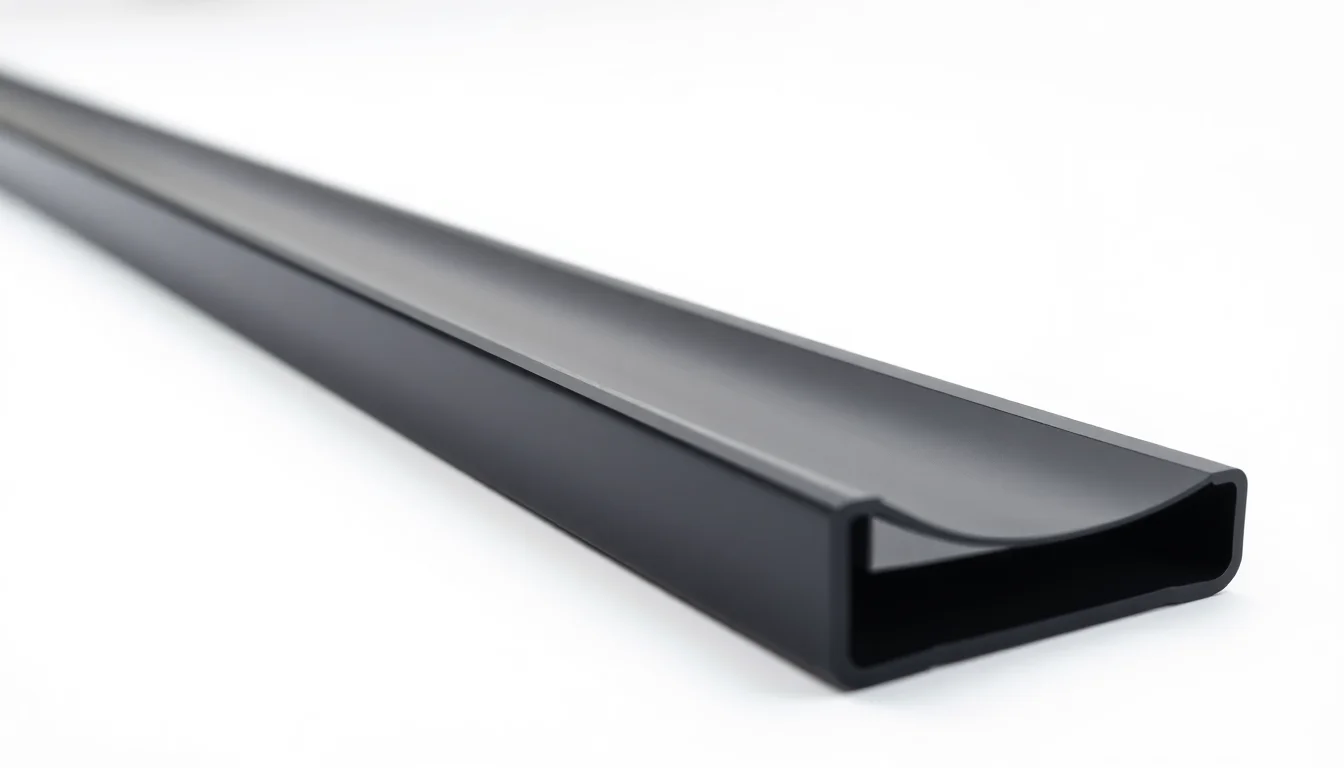
If your application demands a sealing strip that withstands continuous UV exposure, sub-zero cycling, and repeated high-pressure friction, standard PVC extrusions will fail within months. P-profile sealing strips engineered from high-durometer EPDM or specialized elastomers deliver the thermal aging resistance and compression recovery required for heavy equipment doors, transport vehicle hatches, and industrial cabinet seals.
Material Selection for Extreme Conditions
Choosing the right polymer matrix for your P-profile sealing strips determines service life in harsh environments. Below is a direct comparison of the three most common materials we extrude, based on ASTM D573 thermal aging and ASTM D395 compression set data.
EPDM vs PVC vs Silicone: Head-to-Head
| Property | EPDM (70 Shore A) | PVC (65 Shore A) | Silicone (60 Shore A) |
|---|---|---|---|
| Temperature range | -50°C to +150°C | -20°C to +70°C | -60°C to +230°C |
| Tensile strength (MPa) | 7 – 10 | 5 – 8 | 6 – 9 |
| Compression set (22h/70°C, %) | ≤ 25 | ≤ 45 | ≤ 20 |
| Ozone resistance (ASTM D1149) | Excellent | Poor | Excellent |
| UV resistance (1000h QUV) | Excellent | Fair (cracks) | Excellent |
| Tear resistance (kN/m) | 25 – 35 | 15 – 25 | 20 – 30 |
| Flame retardancy (UL 94) | V-0 (with additive) | HB | V-0 (with additive) |
| Extrusion tolerance (±mm) | 0.15 – 0.25 | 0.20 – 0.35 | 0.15 – 0.20 |
| Relative cost per meter | $$ | $ | $$$ |
For sub-zero door sealing on refrigerated trucks or outdoor electrical enclosures in northern climates, EPDM provides the best balance of low-temperature flexibility and long-term ozone resistance. PVC becomes brittle below -20°C and suffers UV embrittlement within two years of outdoor exposure.
When to Specify Silicone P-Profiles
Silicone is the preferred elastomer when the sealing environment exceeds 150°C continuously or requires food-grade compliance (FDA 21 CFR 177.2600). Its low compression set (≤20%) ensures reliable sealing after years of static compression in oven doors or solar thermal collectors. The trade-off is lower tear strength and higher material cost — typically 2–3× EPDM per linear meter.
Extrusion Tolerance & Dimensional Control
P-profile sealing strips function by fitting into a channel or compressing against a flat surface. Dimensional consistency directly affects sealing force and installation ease.
Standard vs Precision Tolerances
At our Changde factory, we hold standard extrusion tolerances of ±0.25 mm for cross-section dimensions under 20 mm. For precision applications — such as hermetic cabinet seals for electronics enclosures — we can achieve ±0.15 mm using laser-controlled vulcanization lines. This is critical when the P-profile lip must maintain 0.5–1.0 mm interference fit across a 2-meter length.
Compression Set Performance
A P-profile that takes a permanent set after a winter season will leak. We test every production batch per ASTM D395 Method B (22 hours at 70°C, 25% deflection). Our standard EPDM compound achieves ≤25% compression set; our low-set variant (for gaskets in pressure vessels) delivers ≤18%. This is one of the most important numbers for a project engineer specifying a long-life seal.
Real Project: Arctic-Class Heavy Equipment Doors
In our Hunan factory experience, a European mining equipment OEM needed P-profile sealing strips for cab doors on loaders operating in northern Canada. The initial PVC profile cracked at -35°C after 200 hours of UV exposure. We reformulated a 75 Shore A EPDM with 50 phr carbon black and 2 phr antioxidant, achieving -50°C TR-10 (ASTM D1329) and 1500 hours of UV stability without surface crazing. The client now orders 12,000 meters per year with ±0.20 mm tolerance and a 0.8 mm lip interference.
Chemical & Fluid Resistance Considerations
If your P-profile sealing strips contact oils, fuels, or industrial solvents, EPDM is not suitable — it swells in hydrocarbons. For such environments, consider:
- Nitrile rubber (NBR) for fuel and oil resistance (ISO 1817).
- Chloroprene (CR) for moderate oil resistance plus flame retardancy.
- Fluoroelastomer (FKM) for aggressive chemicals and high heat (up to 250°C).
We can co-extrude a P-profile with a soft sealing lip (60 Shore A) and a harder base (80 Shore A) for structural stability — a technique often used in door sealing strips for industrial ovens.
Flame Retardancy & Safety Compliance
Many B2B specifiers require UL 94 V-0 or FM 4924 approval for sealing strips used in public transit, HVAC plenums, or electrical enclosures. Our standard EPDM can be formulated with halogen-free flame retardants to pass UL 94 V-0 at 3 mm thickness. Silicone achieves V-0 more easily, but at a higher cost. We have also developed a low-smoke, zero-halogen (LSZH) P-profile for tunnel and ship applications.
Custom Co-Extrusion Options
P-profiles are often combined with a rigid mounting base for snap-fit installation. Common co-extrusion combinations:
- EPDM sealing lip + PP/ABS rigid base for structural retention.
- TPE lip + aluminum carrier for EMI shielding integration.
- Silicone lip + stainless steel spring for high-temperature duct seals.
For decorative applications where the seal is visible, we offer WPC profiles with a wood-grain surface co-extruded over an EPDM core — popular in luxury RV and marine door seals.
Frequently Asked Questions
What is the minimum order quantity (MOQ) for custom P-profile sealing strips?
Our MOQ is 500 meters per profile for custom extrusions. For standard P-profile shapes from our existing tooling library, we offer 200 meters minimum. Tooling development takes 7–10 days for new cross-sections.
What is the typical lead time for a production order?
After tooling approval, production lead time is 15–20 working days for orders up to 5,000 meters. Larger orders (10,000+ meters) require 25–30 working days. We can expedite to 10 days for repeat orders with existing tooling.
What extrusion tolerance can you hold on P-profile sealing strips?
Standard tolerance is ±0.25 mm on cross-section dimensions under 20 mm. Precision tolerance of ±0.15 mm is available for critical applications. Length tolerance is +10 mm / -0 mm for cut-to-length pieces.
How are the sealing strips packed for export?
Strips are coiled on plastic spools (max 50 kg per spool) or cut to length and packed in wooden crates. Each spool is wrapped with kraft paper and stretch film. For delicate silicone profiles, we use foam interleaving to prevent surface marking.
Can I get samples before placing a bulk order?
Yes. We provide free A4-sized sample strips (up to 3 profiles per request) with freight collect. For full-length production samples (1 meter), we charge a nominal fee of $20 per profile, refundable with the first order. Send your CAD drawing or cross-section sketch for a 24-hour quote.
| Specification | Standard Value | Precision Option |
|---|---|---|
| Shore A hardness | 60 ± 5 | As specified ± 2 |
| Tensile strength (MPa) | ≥ 7 | ≥ 10 (custom compound) |
| Compression set (22h/70°C) | ≤ 25% | ≤ 18% |
| Temperature range | -40°C to +120°C | -50°C to +150°C |
| Extrusion tolerance | ±0.25 mm | ±0.15 mm |
| UV aging (1000h) | No cracks | No cracks, ΔE ≤ 3 |
Send your CAD drawing for a 24-hour quote.
Need a Custom Quote?
Send your CAD drawing or specs (material, hardness, profile, temperature range, MOQ) — our engineering team will respond within 24 hours.