
MOQ Custom Rubber Extrusion Supplier | OEM/ODM Factory
By Zhouxin Sealing Engineering Team · · 328 views
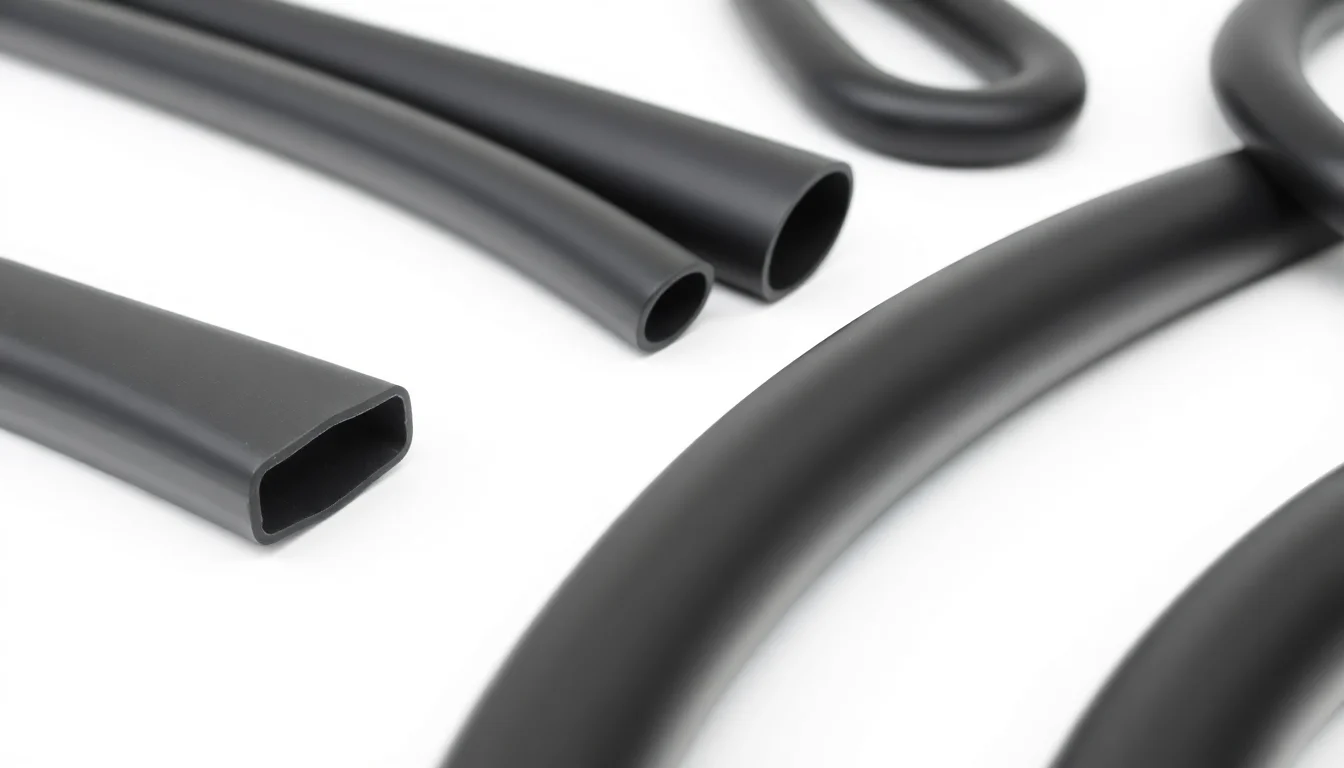
For overseas B2B buyers, the practical answer on MOQ custom rubber extrusion supplier selection is this: a true low-MOQ partner should quote from 500 m per profile, hold ±0.15 mm on critical dimensions, and document material performance to ASTM D573 and ASTM D395 before you commit tooling. The rest of this review walks through a real deployment where UV, sub-zero cold, and repeated high-pressure friction killed three supplier candidates before production.
Project Background: A Container Door Seal That Failed Three Times
A European OEM approached us after two failed field trials on a refrigerated container door. The operating window was brutal: -35°C winter yard storage, 85°C solar gain on the door frame in summer, 12,000 open/close cycles per year, and continuous UV exposure at 340 nm. Their previous extruded profile was a generic EPDM compound that passed the drawing but cracked at the hinge radius within 14 months.
Why the Failure Was Predictable
The original supplier quoted a 70 Shore A EPDM with no documented thermal aging data. Compression set at 70°C × 22 h (ASTM D395 Method B) was 38% — well above the 25% ceiling we target for dynamic door seals. That single number explained the permanent set, the gap at the hinge, and the water ingress. For specifiers reading this, the lesson is simple: a low MOQ custom rubber extrusion supplier that cannot show compression set and thermal aging curves is selling you a shape, not a seal.
Material Head-to-Head: EPDM vs PVC vs Silicone vs TPE
Most project specifiers default to EPDM because it is cheap and UV-stable. That default is correct maybe 60% of the time. The table below reflects compounds we actually run on our extrusion lines in Changde, not catalog averages.
| Material | Temp Range | Shore A | Tensile (MPa) | Compression Set (70°C×22h) | UV / Ozone | Relative Cost |
|---|---|---|---|---|---|---|
| EPDM (sulfur-cured) | -45 to 130°C | 55–80 | 8–12 | 20–30% | Excellent | $ |
| EPDM (peroxide-cured) | -50 to 150°C | 60–85 | 10–14 | 15–22% | Excellent | $$ |
| PVC (flexible) | -20 to 70°C | 60–90 | 6–10 | N/A (plastic) | Moderate | $ |
| Silicone (VMQ) | -60 to 200°C | 30–80 | 6–10 | 20–35% | Excellent | $$$ |
| TPE/TPV | -40 to 120°C | 60–90 | 5–9 | 25–40% | Good | $$ |
EPDM: The Default, With Caveats
EPDM remains the workhorse elastomer for exterior door sealing strips and cabinet seals. Sulfur-cured grades are fine for static seals above -40°C. Peroxide-cured EPDM is what we specify when the seal sees thermal cycling past 120°C or when compression set must stay under 22%. The trade-off is 15–25% higher compound cost and a narrower cure window, which pushes extrusion tolerance slightly.
PVC: Cheap, But Not a Cold-Weather Seal
PVC extrusion is the wrong answer for sub-zero specifiers. Glass transition sits around -20°C, and below that the polymer matrix stiffens, durometer effectively rises, and the profile cracks at flex points. We still run PVC for interior cabinet seals where temperature stays above 0°C and flame retardancy (UL 94 V-0) is the driving requirement.
Silicone: When Temperature Wins Over Budget
For oven doors, EV battery pack seals, and high-temp industrial enclosures, silicone series profiles justify the 3–4× cost premium. VMQ holds -60 to 200°C continuously, and low-compression-set grades stay under 25% after 70 h at 150°C. The weakness is tear strength — silicone tears at roughly half the force of EPDM, so it needs generous radii and no sharp undercuts in the cross-section.
Engineering the Extrusion: Tolerance, Vulcanization, and Surface
Extrusion Tolerance in Real Numbers
Dimensional control on a continuous rubber extrusion is not the same as molded parts. Our standard published tolerance is ±0.15 mm on critical sealing faces under 10 mm, ±0.25 mm on overall profile width up to 40 mm, and ±0.5 mm on length per 300 mm. Buyers comparing suppliers should ask for the tolerance table, not a single number — a supplier quoting ±0.1 mm across the whole profile is either molding or bluffing.
Vulcanization and Compression Set
Continuous vulcanization in a hot-air tunnel (HAV) or microwave-oven line determines whether the compound reaches full cure. Under-cured EPDM shows high compression set and premature cracking. We verify every batch with ASTM D573 air-oven aging (70 h at 100°C) and ASTM D395 compression set. A supplier running a 12 m tunnel at 220°C with a 4-minute residence is not delivering the same product as one running 18 m at 200°C with 7 minutes.
Surface, Coating, and Friction
For high-pressure friction applications — sliding door seals, drawer gaskets — we apply a PTFE or silicone slip coating post-extrusion. Uncoated EPDM against painted steel runs a coefficient of friction around 0.9; coated profiles drop to 0.25–0.35, which cuts actuation force and wear debris. This is also where ozone resistance matters: coated profiles resist surface crazing longer under ASTM D1149 exposure.
MOQ, Tooling, and the Real Cost of a Custom Profile
What MOQ Actually Means
A custom rubber extrusion supplier quoting "MOQ 5,000 m" is usually amortizing a new die across a small run. A supplier quoting "MOQ 500 m" is either running your profile through an existing die or accepting setup cost. Both can be legitimate. The number to interrogate is not the MOQ — it is whether the die is new, and whether the first 100 m carries a trial-run surcharge.
Tooling Lead Time and Cost
Custom extrusion dies for EPDM typically run 7–12 working days and $180–$450 depending on cross-section complexity. Silicone dies run slightly longer. This is a one-time cost that should be quoted separately from the per-meter price.
In our Hunan factory experience, the single biggest cause of a failed first article is not the die — it is the buyer sending a 2D PDF instead of a 3D STEP file with defined sealing faces. On a recent WPC profiles project for a German wholesaler, the customer's drawing omitted a 0.8 mm undercut that their assembly needed. We caught it in DFM review, adjusted the die, and shipped a passing first article in 11 days. Without that review, the die would have been scrapped.
Quality Documentation Buyers Should Demand
For any project where the seal is safety- or warranty-relevant, request the following with the quotation: compound data sheet with durometer, tensile strength, elongation at break, and compression set; ASTM D573 thermal aging report; ASTM D395 compression set at the specified temperature; ISO 1817 fluid resistance if the seal contacts oil or coolant; and UL 94 rating if flame retardancy is specified. A serious MOQ custom rubber extrusion supplier provides these before the PO, not after.
Frequently Asked Questions
What is the minimum order quantity for a custom rubber extrusion?
For an existing die, we run from 500 m per profile per compound. For a new die, the practical MOQ is 1,000–2,000 m to amortize tooling. Mixed-color or dual-durometer profiles carry a higher MOQ because of setup complexity. If your project is under 500 m, ask whether a standard profile can be trimmed or spliced to fit.
What is your lead time for custom extrusion orders?
New die plus first article runs 12–18 working days. Repeat orders on an existing die ship in 10–15 working days for 1,000–5,000 m. Silicone and peroxide-cured EPDM run 3–5 days longer because of cure scheduling. Air freight adds 5–7 days to Europe or North America.
What extrusion tolerance can you hold?
Standard: ±0.15 mm on critical sealing faces under 10 mm, ±0.25 mm on profile width up to 40 mm, ±0.5 mm on cut length per 300 mm. Tighter tolerances are possible on molded corner sections but not on continuous extrusion. Always specify which dimension is the sealing face — that is the one we control hardest.
How are profiles packed for export?
Coils of 50–100 m in PE film, then woven bag or carton, on pallets. Long straight lengths ship in rigid tubes. We include desiccant for sea freight and can print your label and barcode. For silicone series, we add a slip liner to prevent coil blocking.
Do you provide free samples?
Yes — 200 mm cut samples of existing profiles ship free, buyer pays courier. For a new custom die, we produce a paid first article (typically $150–$300 including die amortization), and the cost credits against your first production PO above 2,000 m.
Specification Summary for RFQ
| Parameter | Standard Range | Tightest Achievable |
|---|---|---|
| Material | EPDM, silicone, PVC, TPE | Peroxide EPDM, VMQ |
| Shore A | 40–90 | ±3 points |
| Temperature | -50 to 200°C | Material-dependent |
| Extrusion tolerance | ±0.15 mm | ±0.10 mm on molded ends |
| Compression set | ≤25% @ 70°C×22h | ≤18% peroxide EPDM |
| Thermal aging | ASTM D573, 70h @ 100°C | 168h on request |
| MOQ (existing die) | 500 m | 300 m on select profiles |
| MOQ (new die) | 1,000 m | Tooling amortized separately |
Send your CAD drawing for a 24-hour quote.
Need a Custom Quote?
Send your CAD drawing or specs (material, hardness, profile, temperature range, MOQ) — our engineering team will respond within 24 hours.