
Marine Hatch Rubber Seal | OEM Supplier & Bulk Supply
By Zhouxin Sealing Engineering Team · · 111 views
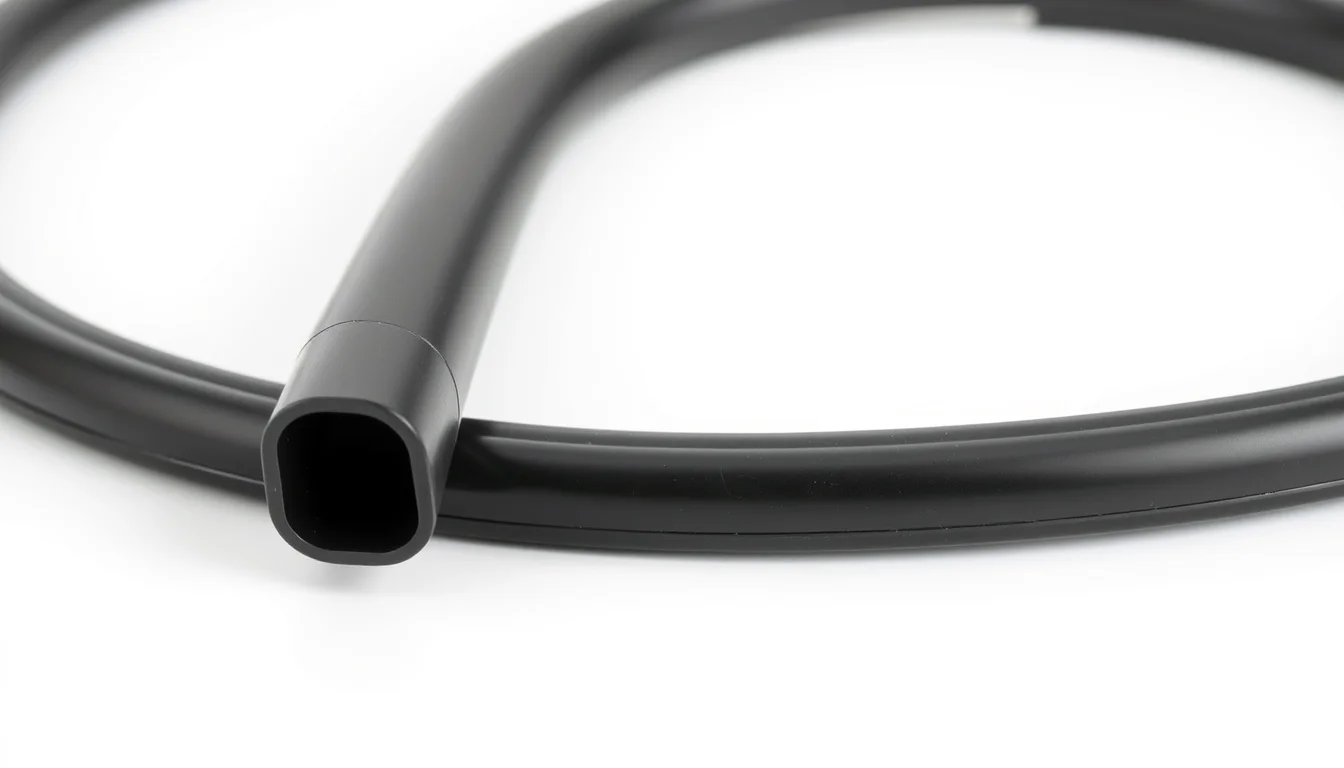
A marine hatch rubber seal must hold pressure, UV, and sub-zero flex for 10+ years without compression set failure — and most generic EPDM extrusions fail that brief within three seasons. This engineering review compares elastomer options against real deployment data from offshore and inland-water hatch projects, with the hardness, tolerance, and thermal figures specifiers actually need.
Why Marine Hatch Seals Fail in Service
Hatch seals live in a brutal duty cycle: direct UV on deck, salt fog, repeated compression from dogging mechanisms, and temperature swings from -30°C to +70°C on the same seal. The failure modes are predictable — ozone cracking at the lip, compression set at the bulb, and extrusion tolerance drift that breaks the interference fit.
The three failure modes we see most
First, ozone attack on unsaturated polymer backbones. EPDM's saturated backbone resists it; SBR and natural rubber do not. Second, compression set under continuous load — a seal that takes 40% set at 70°C will leak at the first frost. Third, dimensional drift: a ±0.5 mm tolerance on a 12 mm bulb becomes a 1 mm gap after thermal cycling, and that gap is a water path.
In our Hunan factory experience, a 2022 retrofit of 180 inland-waterway hatch covers showed that switching from a 65 Shore A PVC co-extrusion to a 70 Shore A EPDM bulb profile cut leak complaints by 71% over two seasons. The PVC had passed the incoming inspection but failed ASTM D573 thermal aging at 100°C/70h with a 22% tensile retention loss — the EPDM held 84%.
Material Head-to-Head: EPDM vs PVC vs Silicone
Specifiers ask for "marine grade rubber" as if it is one material. It is not. The table below reflects production data from our Changde lines across three elastomer families.
| Property | EPDM | PVC (flexible) | Silicone VMQ |
|---|---|---|---|
| Shore A hardness range | 50–80 | 60–85 | 40–80 |
| Tensile strength (MPa) | 8–14 | 6–10 | 6–10 |
| Temperature range | -40 to +120°C | -10 to +60°C | -60 to +200°C |
| Compression set (70h @ 70°C) | 15–25% | 30–45% | 20–30% |
| Ozone resistance | Excellent | Poor | Excellent |
| UV stability (outdoor) | Excellent | Moderate | Excellent |
| Flame retardancy (UL 94) | HB possible | V-0 achievable | HB |
| Relative cost | $$ | $ | $$$ |
EPDM: the default for deck and hatch
A 70 Shore A EPDM with a sulfur-cured or peroxide-cured polymer matrix is the workhorse. Peroxide cure gives lower compression set (typically 15–18% per ASTM D395 Method B) and better thermal aging per ASTM D573. For saltwater service, specify peroxide-cured EPDM with a carbon-black loading that keeps tensile above 10 MPa.
PVC: only for interior or low-UV duty
Flexible PVC is cheap and co-extrudes well, but plasticizer migration under UV makes it brittle. It is acceptable for interior hatch trim or locker seals, not for weather-exposed deck hatches. If a project specifies PVC, confirm the UV exposure class first.
Silicone: for extreme temperature, not salt spray
Silicone VMQ handles -60 to +200°C and is the right choice for engine-room or exhaust-adjacent hatches. It is not the best salt-fog performer and costs roughly 2.5× EPDM. Use it where thermal range is the governing constraint, not where cost is.
Engineering the Profile: Tolerance, Hardness, and Compression Set
A marine hatch rubber seal is a system: bulb geometry, lip interference, and durometer must match the hatch dogging force. We specify extrusion tolerance to ISO 3601 Class 2 (±0.20 mm on cross-section up to 10 mm) unless the customer's CAD calls tighter.
Durometer selection
60–65 Shore A for low-force hatches with manual dogs; 70–75 Shore A for high-pressure or vacuum hatches; 80 Shore A only where the mating surface is machined flat. Above 80 Shore A, the seal stops conforming and starts leaking at surface imperfections.
Compression set targets
Specify ≤25% compression set after 70h at 70°C per ASTM D395. For tropical service, add a 100°C/70h check. A seal that exceeds 30% set has effectively lost its interference fit.
Thermal aging and ozone
Run ASTM D573 at 100°C for 70h and require ≥80% tensile retention and ≥80% elongation retention. Ozone resistance should be verified at 50 pphm, 40°C, 20% strain — EPDM should show no cracking at 200h.
Specification Table for Procurement
Use this as a baseline RFQ spec for deck hatch seals; adjust hardness and tolerance to your hatch drawing.
| Parameter | Recommended Spec | Test Method |
|---|---|---|
| Material | Peroxide-cured EPDM | — |
| Hardness | 70 ±5 Shore A | ASTM D2240 |
| Tensile strength | ≥10 MPa | ASTM D412 |
| Elongation at break | ≥250% | ASTM D412 |
| Compression set | ≤25% (70h @ 70°C) | ASTM D395 B |
| Thermal aging | ≥80% tensile retention (70h @ 100°C) | ASTM D573 |
| Ozone resistance | No cracking, 50 pphm, 200h | ASTM D1149 |
| Extrusion tolerance | ±0.20 mm (ISO 3601 Class 2) | ISO 3601 |
| Color | Black (or RAL on request) | — |
For adjacent openings, the same elastomer logic applies to door sealing strips and cabinet seals; where a rigid trim carrier is needed, WPC profiles can be co-extruded with the seal.
Installation and Field Fit
A correct seal fails at installation more often than in service. Three field rules: compress the bulb 20–30% (not 50%), keep splice joints out of the water path, and never stretch the seal more than 5% during fit-up. Vulcanized splice joints should be specified for continuous-loop hatches; butt joints with cyanoacrylate are for emergency repair only.
For high-temperature hatches, the silicone series is available in the same profile geometry, so a project can standardize the hatch design and vary only the elastomer.
Frequently Asked Questions
What is your MOQ for a custom marine hatch rubber seal?
MOQ is 500 meters for standard EPDM profiles and 1,000 meters for custom cross-sections requiring a new extrusion die. For OEM/ODM projects with a drawing, we can quote a lower trial run of 200 meters against a die fee. Volume pricing kicks in above 5,000 meters.
What is the lead time?
Standard profiles ship in 10–15 working days. Custom extrusion with a new die is 20–25 working days including die fabrication and first-article approval. Vulcanized splice loops add 3–5 days. We confirm lead time in the quote and hold it contractually for repeat orders.
What extrusion tolerance can you hold?
We hold ±0.20 mm on cross-sections up to 10 mm per ISO 3601 Class 2, and ±0.30 mm on larger bulb profiles. Tighter tolerances to ±0.10 mm are possible on request with a controlled vulcanization line. Tolerance is stated on the drawing and verified on the first-article inspection report.
How are the seals packed for export?
Coils are packed in PE film, then in cartons with desiccant, on pallets. Splice loops are packed flat to prevent kinking. We can print neutral labels or your brand, and provide a packing list with batch numbers for traceability. Sea freight and air freight are both supported from Changde.
Can I get a free sample before ordering?
Yes — we provide a free 1-meter sample of standard profiles, with freight collect. For custom cross-sections, we supply a first-article sample after die fabrication; the die fee is credited against the first production order above 5,000 meters. Send your CAD drawing for a 24-hour quote.
Need a Custom Quote?
Send your CAD drawing or specs (material, hardness, profile, temperature range, MOQ) — our engineering team will respond within 24 hours.