
Industrial Rubber Profiles | Custom OEM Manufacturer & Bulk Supply
By Zhouxin Sealing Engineering Team · · 10 views
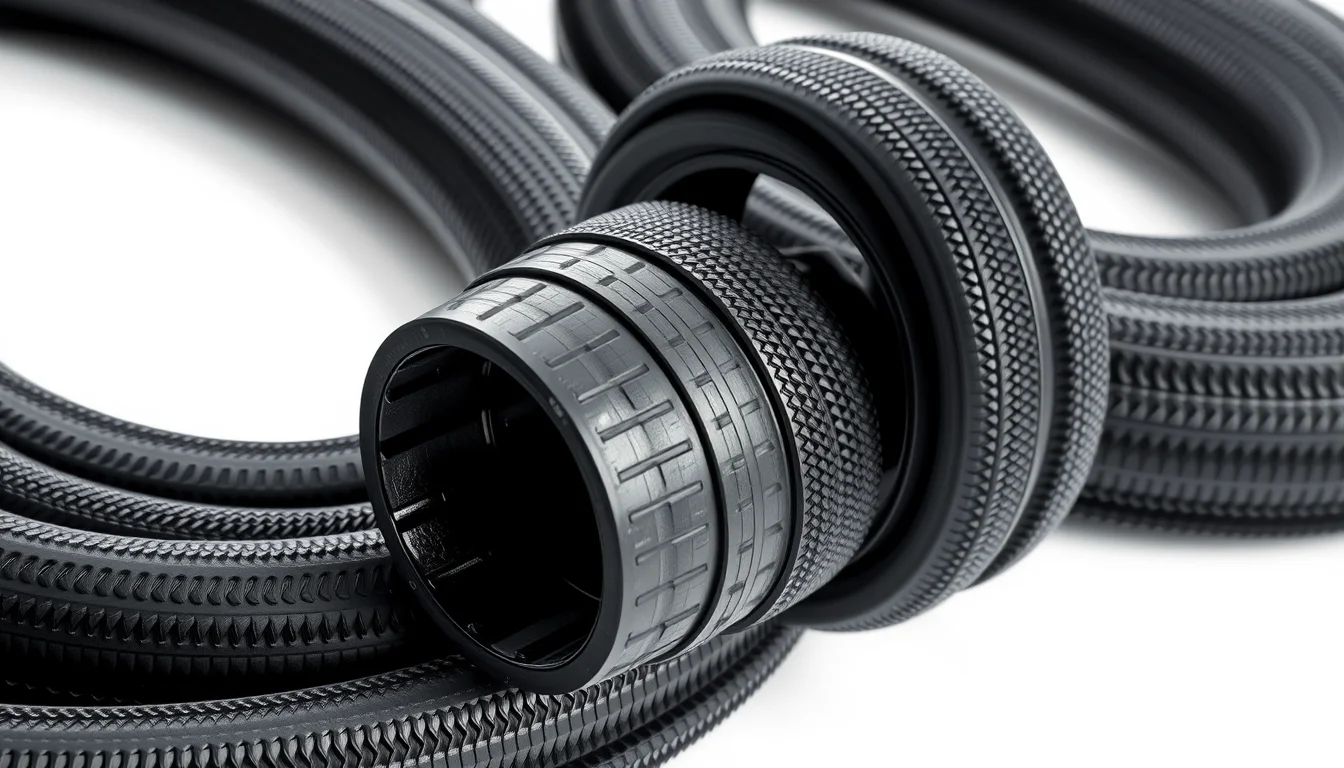
Industrial rubber profiles are custom-extruded elastomer seals manufactured to your drawing, with tooling costs typically $300–$800, MOQs from 500–2,000 meters, and sample lead times of 7–12 days. This guide walks overseas B2B buyers through factory capability comparison, the real extrusion workflow, and how to submit CAD files that eliminate back-and-forth.
Factory Capability Comparison: What Actually Matters
When you audit a supplier for industrial rubber profiles, the sales brochure tells you nothing. Ask for these five data points instead.
Extrusion Lines and Polymer Matrix Range
A factory running only EPDM is a commodity shop. A factory running EPDM, silicone, NBR, Neoprene, Viton, and TPE can match your polymer matrix to the chemical and thermal environment. Cold-feed vs. hot-feed extruders, microwave vs. salt-bath vulcanization lines, and co-extrusion capability (dense + sponge in one pass) determine what profiles are even possible.
Tooling Shop In-House vs. Outsourced
If the die is cut in-house, tooling revisions take 3–5 days. If outsourced, add 7–10 days per iteration. For custom industrial rubber profiles, the die is the project. Ask: "Do you cut dies on-site?"
Testing Lab
A real lab runs tensile strength (ASTM D412), compression set (ASTM D395), thermal aging (ASTM D573), and ozone resistance (ASTM D1149). If the supplier only issues a CoC without in-house data, you are buying risk.
Export Experience
Ask for the last three shipping destinations. A factory that regularly ships to Germany, the US, and Australia understands REACH, RoHS, and Prop 65 documentation without hand-holding.
Material Specification Table
| Material | Temp Range | Shore A | Tensile (MPa) | Compression Set (70h @ 100°C) | Cost Index |
|---|---|---|---|---|---|
| EPDM | -40 to 150°C | 50–90 | 8–15 | 20–30% | $ |
| Silicone | -60 to 200°C | 30–80 | 6–10 | 15–25% | $$$ |
| NBR | -30 to 120°C | 50–90 | 10–18 | 15–25% | $$ |
| Neoprene (CR) | -40 to 120°C | 40–80 | 8–14 | 20–30% | $$ |
| Viton (FKM) | -20 to 200°C | 60–90 | 8–14 | 15–25% | $$$$$ |
| TPE/TPV | -60 to 135°C | 40–90 | 5–12 | 25–40% | $$ |
Cost index is relative, not absolute. Always request a quote against your specific profile geometry and annual volume.
The Real Custom Extrusion Process: Step by Step
Step 1 — Drawing Review and DFM Feedback
Send a 2D PDF or DXF with dimensions, tolerances, and material callout. Within 24 hours, an engineer should return a DFM (Design for Manufacturing) note flagging thin walls under 1.5 mm, undercuts, and tolerance stack-ups that will fail at the die.
Step 2 — Die Design and Cutting
Die cost for a standard industrial rubber profile runs $300–$800. Complex multi-chamber or co-extruded profiles run $800–$1,500. Lead time: 7–10 working days.
Step 3 — Sample Extrusion and Vulcanization
First-off samples are extruded, vulcanized, and cut to 300–500 mm lengths. You receive 3–5 pieces for fitment testing. Sample lead time: 7–12 days after die completion.
Step 4 — Sample Approval and Tolerance Lock
Once you approve the sample, tolerances are locked against the approved piece. Extrusion tolerance for industrial rubber profiles typically follows ISO 3302-1 Class E2 or E3, depending on profile complexity.
Step 5 — Production Run and Packaging
Production runs 15–25 days depending on volume. Coils, straight lengths, or cut-to-size. Packaging per your label and barcode spec.
In our Hunan factory experience, ... a German buyer sent a DXF with a 0.8 mm wall on a silicone profile. The die could not hold tolerance. We flagged it in DFM, suggested 1.5 mm, and saved the project a $1,200 re-tool. That conversation happens in the first 24 hours or it does not happen at all.
How to Send CAD Drawings That Reduce Back-and-Forth
What to Include in Every Drawing Submission
- 2D PDF with overall dimensions and cross-section
- DXF or DWG file (not a photo of a printout)
- Material callout with durometer (e.g., EPDM 70 Shore A)
- Critical tolerances marked with ±mm
- Surface finish requirements (smooth, matte, textured)
- Color reference (RAL, Pantone, or physical chip)
- Annual volume and first-order quantity
- Any regulatory requirement (UL 94, REACH, FDA, ISO 1817 fluid resistance)
What Kills a Quote
- "Same as sample" with no drawing
- Scanned hand sketch with no scale
- Tolerance callout of ±0.1 mm on a 20 mm profile
- No material specification
Drawing Submission Checklist Table
| Item | Required | Format |
|---|---|---|
| Cross-section | Yes | DXF/DWG |
| Overall dimensions | Yes | |
| Material + durometer | Yes | Text callout |
| Tolerances | Yes | ±mm on drawing |
| Color | Yes | RAL/Pantone |
| Annual volume | Yes | |
| Regulatory spec | If applicable | Text callout |
MOQ, Tooling, and Sample Policy: What to Expect
MOQ Reality for Industrial Rubber Profiles
Standard MOQ is 500–2,000 meters per profile per material. For Viton or specialty compounds, MOQ can rise to 3,000 meters. If you are a wholesaler testing a new line, ask about a "trial run" at 300 meters with a tooling amortization clause.
Tooling Cost and Ownership
Tooling is a one-time cost. Confirm in writing whether the die is owned by you or the factory. For OEM/ODM buyers, die ownership should transfer to you after the first production order.
Sample Policy
Standard samples of existing profiles are free; you pay freight. Custom samples require tooling payment upfront, then sample pieces are free. Sample lead time: 7–12 days after die completion.
Packing, Export, and Documentation
Packing Options
- Coils in cartons (standard for flexible profiles)
- Straight lengths in bundles (for rigid or semi-rigid profiles)
- Cut-to-size in poly bags then cartons
- Palletized for LCL or FCL
Export Documentation
Commercial invoice, packing list, bill of lading, certificate of origin, and material CoC. For EU shipments, REACH SVHC declaration. For US, Prop 65 statement. For automotive, PPAP if required.
Lead Times Summary
| Stage | Working Days |
|---|---|
| DFM review | 1–2 |
| Die cutting | 7–10 |
| Sample extrusion | 7–12 |
| Production run | 15–25 |
| Export packing | 2–3 |
Frequently Asked Questions
What is the MOQ for custom industrial rubber profiles?
Standard MOQ is 500–2,000 meters per profile per material. Specialty compounds like Viton or FDA-grade silicone may require 3,000 meters. For trial orders, we can discuss 300-meter runs with tooling amortization.
What is the lead time for custom profiles?
From drawing approval to first sample: 15–22 working days. From sample approval to production shipment: 15–25 working days depending on volume. Rush orders can be expedited with prior arrangement.
What extrusion tolerance can you hold?
We hold ISO 3302-1 Class E2 for standard profiles and Class E3 for complex multi-chamber profiles. Typical tolerance is ±0.15 mm to ±0.50 mm depending on dimension and profile geometry. Critical dimensions are marked on the drawing.
How are industrial rubber profiles packed for export?
Coils in cartons, straight lengths in bundles, or cut-to-size in poly bags. All cartons are labeled per your spec with barcode and batch number. Pallets are fumigation-free and suitable for LCL or FCL.
What is your sample policy?
Existing standard profiles: free samples, you pay freight. Custom profiles: tooling payment upfront, then 3–5 sample pieces free. Sample lead time is 7–12 days after die completion.
Send Your CAD Drawing for a 24-Hour Quote
We review every drawing within 24 hours and return a DFM note, tooling cost, MOQ, and lead time. No sales fluff. Send your DXF, DWG, or PDF to our engineering team and get a real answer.
door sealing strips | silicone series | cabinet seals | WPC profiles
Need a Custom Quote?
Send your CAD drawing or specs (material, hardness, profile, temperature range, MOQ) — our engineering team will respond within 24 hours.