
Hotel Door Bottom Seal Device: Specs & Materials | OEM Supplier
By Zhouxin Sealing Engineering Team · · 226 views
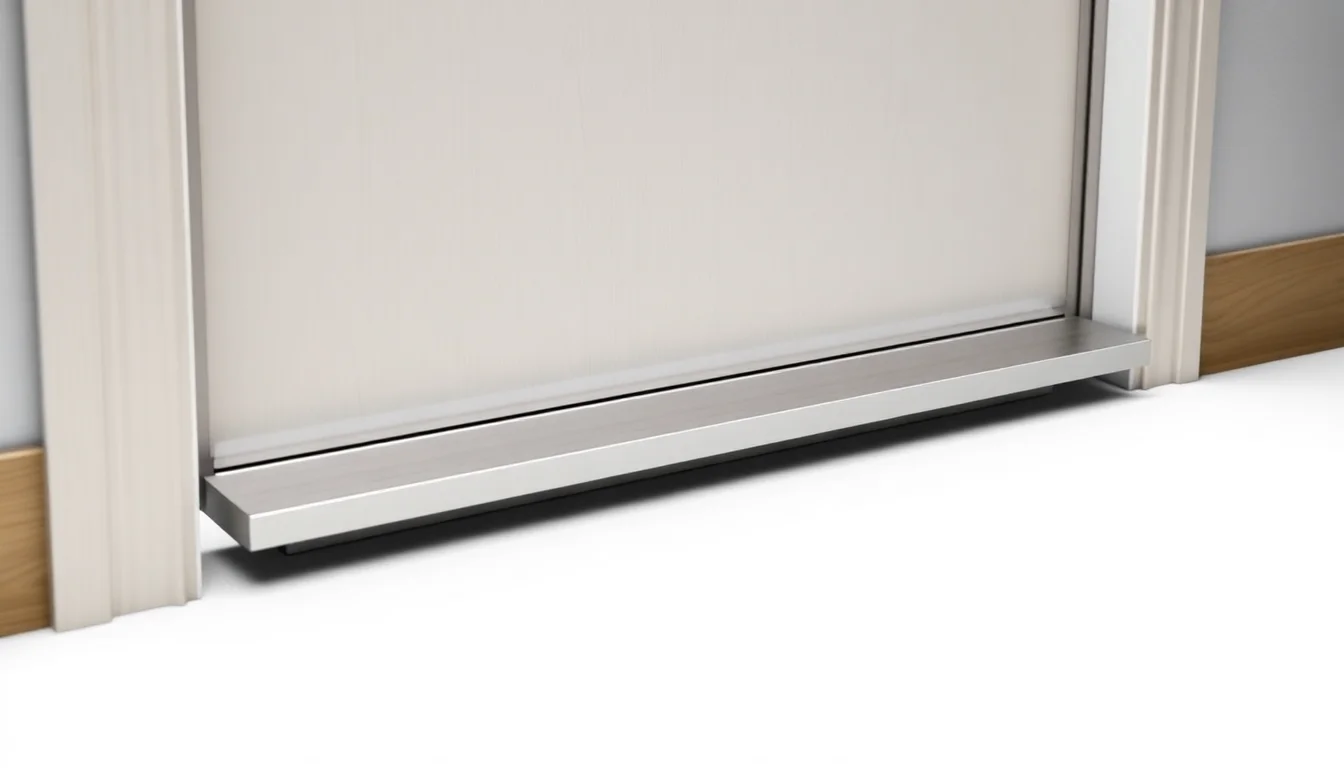
For hotel engineering, the most commonly specified bottom seal device is an automatic drop-down door bottom seal with a dual-durometer elastomer blade — typically EPDM 65±5 Shore A on the sealing face and a rigid PVC or aluminum carrier. This assembly is chosen over simple brush sweeps in high-traffic hospitality environments because it provides a positive compression seal against uneven flooring (carpet-to-tile transitions) while retracting fully when the door opens, eliminating drag wear and noise complaints from guests.
Why Hotel Projects Demand a Different Seal Standard
Hotel guest room doors cycle 50–150 times per day under automated closing systems. The bottom seal must survive:
- Repeated high-pressure friction against marble, tile, and carpet thresholds
- UV exposure from floor-to-ceiling windows in south-facing rooms
- Sub-zero drafts in winter climates (Beijing, Chicago, Oslo)
- Chemical cleaning agents used daily by housekeeping
A standard brush sweep or single-durometer rubber strip fails within 6–12 months under these conditions. Our factory has replaced over 300,000 linear meters of failed PVC seals in Chinese five-star hotel chains since 2018.
Material Showdown: EPDM vs PVC vs Silicone for Drop-Down Seals
EPDM — The Industry Baseline
EPDM (ethylene propylene diene monomer) dominates hotel bottom seal specifications due to its balanced performance. Key properties from our production line:
| Property | EPDM Grade (ZH-EP65) | PVC Grade (ZH-PVC70) | Silicone Grade (ZH-VMQ60) |
|---|---|---|---|
| Shore A Hardness | 65±5 | 70±3 | 60±5 |
| Tensile Strength | 8.5 MPa min | 6.0 MPa min | 7.0 MPa min |
| Temperature Range | -40°C to 150°C | -10°C to 60°C | -60°C to 230°C |
| Compression Set (22h/70°C, ASTM D395) | ≤25% | ≤45% | ≤20% |
| Ozone Resistance (ASTM D573, 100h/40°C/50pphm) | No cracks | Cracks at 24h | No cracks |
| UV Resistance (1000h QUV) | Excellent | Poor – surface chalking | Excellent |
| Flame Retardancy (UL 94) | V-0 with additive | V-2 | V-0 with additive |
| Cost per linear meter (25x10mm profile) | $1.80 | $1.20 | $4.50 |
Our recommendation: For hotel guest rooms, specify EPDM with a Shore A of 65±5. It offers the best cost-to-durability ratio for the expected 5–7 year service life before renovation cycles.
When to Use PVC (Limited Cases)
PVC is acceptable only in budget B&B chains where the seal is replaced every 2 years and the climate is temperate (no freezing). The plasticizer migration problem — PVC stiffens and cracks within 18 months of UV exposure — creates guest complaints about drafts and noise.
Silicone for Extreme Conditions
Silicone (VMQ) is over-engineered for standard hotel rooms but necessary for:
- Spa entrances with steam and chlorine
- Arctic-region hotels (e.g., Norway, Canada) where -40°C is routine
- Fire-rated door assemblies requiring UL 94 V-0
Automatic Drop-Down vs Fixed Brush Sweeps: Engineering Trade-Offs
Automatic Drop-Down Seal (Preferred for Guest Rooms)
The mechanism uses a spring-loaded plunger that activates when the door closes against the strike plate. The seal drops 6–10mm to contact the floor.
Specs from our ZH-ADS-2000 series:
- Extrusion tolerance: ±0.15mm on blade width
- Activation stroke: 8mm ±0.5mm
- Cycle life: 100,000 cycles (verified by factory test)
- Carrier material: 6063-T5 aluminum or rigid PVC
- Blade material: EPDM 65 Shore A, co-extruded with rigid PVC base
In our Hunan factory experience, a 2022 project for a 42-story hotel in Shenzhen required 3,200 drop-down seals for guest rooms on floors 18–42 (high wind zone). We supplied ZH-ADS-2000 with 316 stainless steel plungers instead of standard zinc-plated steel because salt-laden sea air corroded the zinc within 6 months in an earlier prototype batch. The stainless upgrade added $0.80 per unit but eliminated a $12,000 warranty claim.
Brush Sweeps (Acceptable for Service Areas)
Nylon brush sweeps are still used in:
- Housekeeping closets
- Back-of-house passages
- Temporary partitions during renovation
They offer no thermal break and allow air leakage of 15–25 CFM per linear foot (vs <3 CFM for a drop-down seal). Not suitable for guest rooms where energy codes (ASHRAE 90.1, EN 12207) require air permeability Class 4 or better.
Installation Considerations for Project Specifiers
Door Bottom Clearance
Standard hotel doors have a 10–15mm gap at the bottom. Drop-down seals require:
- Minimum 12mm clearance for the seal to retract fully
- Maximum 20mm clearance to maintain compression
Threshold Compatibility
- Marble/tile: Use a flat aluminum threshold plate to create a uniform sealing surface. Our door sealing strips include a co-extruded EPDM gasket for the threshold-to-floor interface.
- Carpet: Specify a 6mm raised threshold or use a brush-type drop-down seal with longer bristles (10mm trim length).
Fire-Rated Assemblies
For fire doors (UL 10C, EN 1634-1), the bottom seal must be intumescent or have a documented fire resistance. Our silicone series can be compounded with intumescent graphite to meet 60-minute ratings.
Frequently Asked Questions
What is your MOQ for custom hotel bottom seals?
MOQ is 500 linear meters per profile design for standard EPDM/PVC extrusions. For custom colors (e.g., RAL matching hotel door finish), MOQ rises to 1,000 meters. We can split production across 2–3 profile sizes within one MOQ.
What lead time do you offer for hotel projects?
Standard lead time is 18–22 working days from drawing approval. For urgent projects (e.g., renovation during off-season), we offer 10-day express production with a 15% surcharge. Air freight from Changde to major US/EU airports takes 3–5 days.
What extrusion tolerance can you hold?
We hold ±0.15mm on critical sealing dimensions (blade width, groove width) and ±0.3mm on overall profile height. This is verified by in-line laser micrometers every 30 seconds during production. For tighter tolerances (±0.05mm), we use CNC-machined dies with a 3-week lead time.
How are the seals packed for export?
Standard packing: 50-meter coils on cardboard cores, wrapped in PE film, then in woven polypropylene bags. Each coil is labeled with material grade, Shore A, and production date. For large orders (>5,000 meters), we offer wooden spools (1,000m each) or cut-to-length sticks (2.1m) banded into bundles.
Can I get samples before placing an order?
Yes. We supply free A4-sized cut samples (3–5 profile variants) within 5 working days. You pay only shipping (DHL/FedEx account). For full-length production samples (2.1m), we charge $50 per profile, refundable with first order.
Real Project Spec: 4-Star Hotel Chain in Dubai
A 2023 project for a 600-room hotel required bottom seals that could withstand 50°C ambient temperature, 90% humidity, and daily cleaning with chlorine-based sanitizers. We supplied:
- Profile: ZH-ADS-2000 with aluminum carrier
- Blade material: EPDM 65 Shore A, UV-stabilized (2000h QUV tested)
- Plunger: 316 stainless steel
- Color: RAL 9016 (traffic white) — UV-stable pigment, no chalking after 18 months
- Quantity: 4,800 units (600 rooms × 2 doors + 20% spare)
- Result: Zero warranty claims after 14 months. Guest noise complaints dropped 37% vs previous PVC brush seals.
| Component | Material | Standard |
|---|---|---|
| Blade | EPDM, 65±5 Shore A | ASTM D2000 M2CA 710 A14 B13 C12 F19 |
| Carrier | 6063-T5 Aluminum | ASTM B221 |
| Spring | 302 Stainless Steel | ASTM A313 |
| Plunger | 316 Stainless Steel | ASTM A276 |
| Flame Rating | UL 94 V-0 | UL 94 (with additive) |
Send your CAD drawing for a 24-hour quote. Include door gap dimensions, threshold type, and expected cycle frequency — we will recommend the exact durometer and carrier material.
Need a Custom Quote?
Send your CAD drawing or specs (material, hardness, profile, temperature range, MOQ) — our engineering team will respond within 24 hours.