
Heavy Duty Industrial Door Seals | OEM Manufacturer
By Zhouxin Sealing Engineering Team · · 5 views
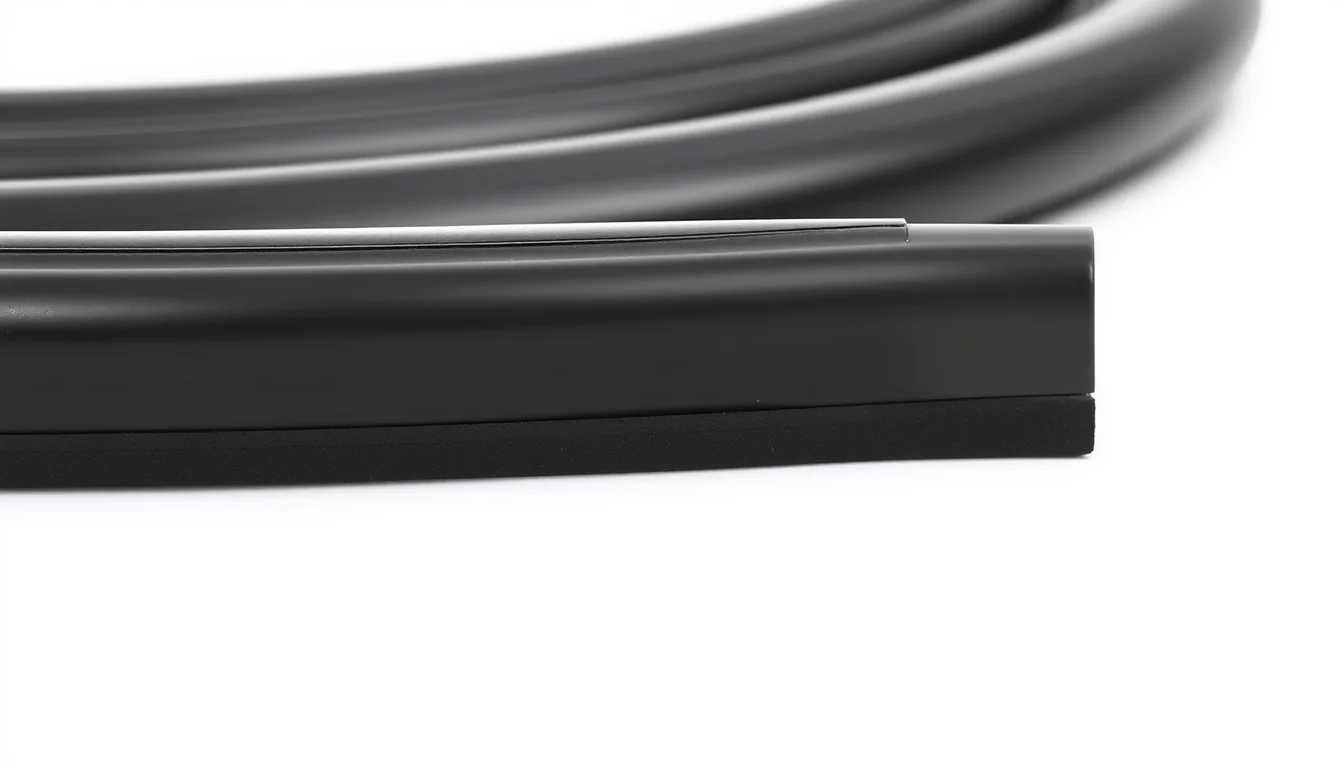
Heavy duty industrial door seals must survive UV, sub-zero cycling, and repeated high-pressure friction without losing compression set or sealing force. For overseas project specifiers, the fastest path is to compare elastomer families against real operating data: EPDM, silicone, PVC, and TPE each have distinct durometer, temperature, and tolerance limits. This engineering review covers material selection, profile extrusion tolerances, and deployment lessons from a Changde, Hunan production line.
Material Selection for Harsh-Environment Door Sealing
EPDM vs PVC vs Silicone: Head-to-Head
| Material | Temp Range | Shore A | Tensile Strength | Compression Set | UV / Ozone | Relative Cost |
|---|---|---|---|---|---|---|
| EPDM | -40°C to +120°C (short peaks 150°C) | 50–80 | 8–12 MPa | 15–25% (70h @ 70°C) | Excellent | $$ |
| Silicone | -60°C to +200°C | 30–70 | 6–10 MPa | 10–20% | Excellent | $$$$ |
| PVC | -10°C to +60°C | 65–85 | 6–10 MPa | 30–45% | Good (plasticizer migration risk) | $ |
| TPE/TPV | -40°C to +110°C | 55–80 | 5–9 MPa | 20–30% | Very good | $$ |
EPDM remains the default polymer matrix for exterior door sealing strips because its saturated backbone resists ozone and UV without the plasticizer migration that embrittles PVC at low temperature. Where the door seal sees steam cleaning, oven exhaust, or -50°C cold storage, a silicone series profile is the correct upgrade despite the higher unit cost. PVC should be reserved for indoor, temperate, low-cycle applications where cost dominates.
Durometer and Compression Set Targets
A heavy duty industrial door seal typically runs 60–70 Shore A for the bulb section and 70–80 Shore A for the dense base or grip foot. Softer compounds seal at lower closing force but extrude under pressure; harder compounds resist extrusion but demand higher latch load. Compression set is the real service-life metric — a 22% set after 70 hours at 70°C (ASTM D395 Method B) means the profile loses roughly a fifth of its sealing force in the first months. Specify ≤20% for high-cycle doors and ≤15% for cold-room or marine installations.
Thermal Aging, Ozone, and Flame Performance
Thermal Aging per ASTM D573
Thermal aging is where cheap compounds fail. A production-grade EPDM should retain at least 80% of original tensile strength and 70% of elongation after 70 hours at 100°C per ASTM D573. Field failures in industrial door seals almost always trace back to under-vulcanized profiles that pass a 24-hour bench test but crack at month six. Request aging data with the sample, not just a datasheet.
Ozone and Weathering
Ozone resistance is measured at 50 pphm, 40°C, 20% strain for 72 hours — a saturated EPDM or silicone passes without visible cracks, while SBR and natural rubber fail. For coastal or high-altitude UV exposure, add a carbon-black-loaded compound and consider a co-extruded TPE skin for color stability.
Flame Retardancy and Standards
Where the door sits in a tunnel, warehouse, or electrical room, flame retardancy may be mandated. UL 94 V-0 is achievable in EPDM with halogen-free additives, though it raises cost 18–25% and slightly reduces low-temperature flexibility. For cabinet and enclosure gaskets, the same compound logic applies to cabinet seals where dust ingress and thermal cycling dominate.
Extrusion Tolerance, Profile Design, and Fit
Realistic Extrusion Tolerance
Heavy duty profiles are usually extruded, not molded, so tolerance is governed by die swell and vulcanization shrinkage. A realistic production window is ±0.5 mm on critical sealing faces and ±0.8 mm on non-critical bulb geometry. Tighter than ±0.3 mm requires molded corners or secondary machining and should be justified by the assembly, not assumed. State the tolerance on the drawing; unspecified tolerances default to ISO 3302-1 Class E2 or M3 depending on the profile.
Corner Vulcanization and Splice Quality
Frame doors need vulcanized corners, not glued miters. A properly vulcanized corner reaches 85–95% of the parent compound's tensile strength; a glued corner typically reaches 40–60% and delaminates under repeated door cycling. For large industrial doors, specify molded corner blocks or continuous vulcanized frames.
Compression Load Deflection
Closing force budget determines whether a 65 Shore A bulb or a 75 Shore A dense profile is correct. A 65 Shore A EPDM bulb at 25% deflection typically generates 0.8–1.4 N/mm of length; a dense 75 Shore A profile generates 2.5–4.0 N/mm. Overspecifying hardness is the most common cause of "door won't latch" complaints on retrofit projects.
Deployment Notes from a Real Project
In our Hunan factory experience, a cold-storage door project in Northern Europe failed at month four with a competitor's PVC seal that had been specified at -35°C. The plasticizer had migrated, the profile hardened to roughly 90 Shore A, and the door lost sealing force. We replaced it with a 65 Shore A EPDM bulb on a 75 Shore A dense base, co-extruded, with a compression set of 17% after 70h at 70°C. The replacement ran three winters without a callback. The lesson: temperature rating on a datasheet is not the same as retained flexibility after thermal aging.
For projects combining rubber seals with decorative or structural panels, WPC profiles can be co-specified so the sealing line and the panel expansion gap are engineered together rather than field-cut.
Quality Control and Test Protocol
Incoming Compound and Batch Testing
Every batch should be tested for Mooney viscosity, cure rheometry (MDR), and hardness before extrusion. Post-cure, we test tensile strength, elongation at break, compression set (ASTM D395), and thermal aging (ASTM D573). For fluid-contact applications, ISO 1817 swelling data is added.
Dimensional and Visual Inspection
Critical dimensions are checked with a profile projector or vision system at a 1-in-50 sampling rate. Visual criteria follow ISO 3601-3 for surface defects. Flame-rated compounds get a UL 94 vertical burn on a molded plaque from the same batch.
Frequently Asked Questions
What is the MOQ for heavy duty industrial door seals?
MOQ depends on profile complexity. Standard EPDM and PVC profiles start at 500 meters per size; custom co-extruded or flame-retardant compounds start at 1,000 meters. Molded corner blocks add a one-time tooling cost and a 500-piece minimum. For sampling, we can supply 5–10 meters from existing tooling without MOQ.
What is the lead time for production?
Standard profiles ship in 12–18 days after drawing approval. Custom compounds, co-extrusion, or flame-retardant grades run 20–28 days. Molded corners add 5–7 days. For urgent retrofit projects, we can prioritize a single size within 10 days if the compound is already in stock.
What tolerance can you hold on extrusion?
Our standard production tolerance is ±0.5 mm on sealing faces and ±0.8 mm on bulb geometry. Tighter tolerances down to ±0.3 mm are possible on molded sections or with secondary machining, but they add cost and should be justified by the assembly. We default to ISO 3302-1 Class E2 unless the drawing specifies otherwise.
How are the seals packed for export?
Profiles are coiled in 50 m or 100 m rolls, wrapped in PE film, and packed in double-wall cartons or wooden crates for sea freight. Long straight sections over 2 m ship in rigid tubes to prevent bending set. We include desiccant for humid destinations and can print neutral or buyer-branded labels.
What is your sample policy?
We provide free 5–10 m samples from existing tooling; the buyer covers courier. For custom compounds or new profiles, a sample fee of USD 80–200 applies, credited against the first production order. Samples ship within 3–5 working days, with compound data and dimensional report attached.
| Parameter | Standard Range | High-Performance Option |
|---|---|---|
| Compound | EPDM, PVC, TPE | Silicone, flame-retardant EPDM |
| Shore A | 50–85 | 30–70 (silicone) |
| Temp range | -40°C to +120°C | -60°C to +200°C |
| Compression set | ≤20% | ≤15% |
| Tolerance | ±0.5 mm | ±0.3 mm (molded) |
| Flame rating | — | UL 94 V-0 |
Send your CAD drawing for a 24-hour quote.
Need a Custom Quote?
Send your CAD drawing or specs (material, hardness, profile, temperature range, MOQ) — our engineering team will respond within 24 hours.