
Extruded Silicone Profiles Manufacturer | OEM & Bulk Supply
By Zhouxin Sealing Engineering Team · · 38 views
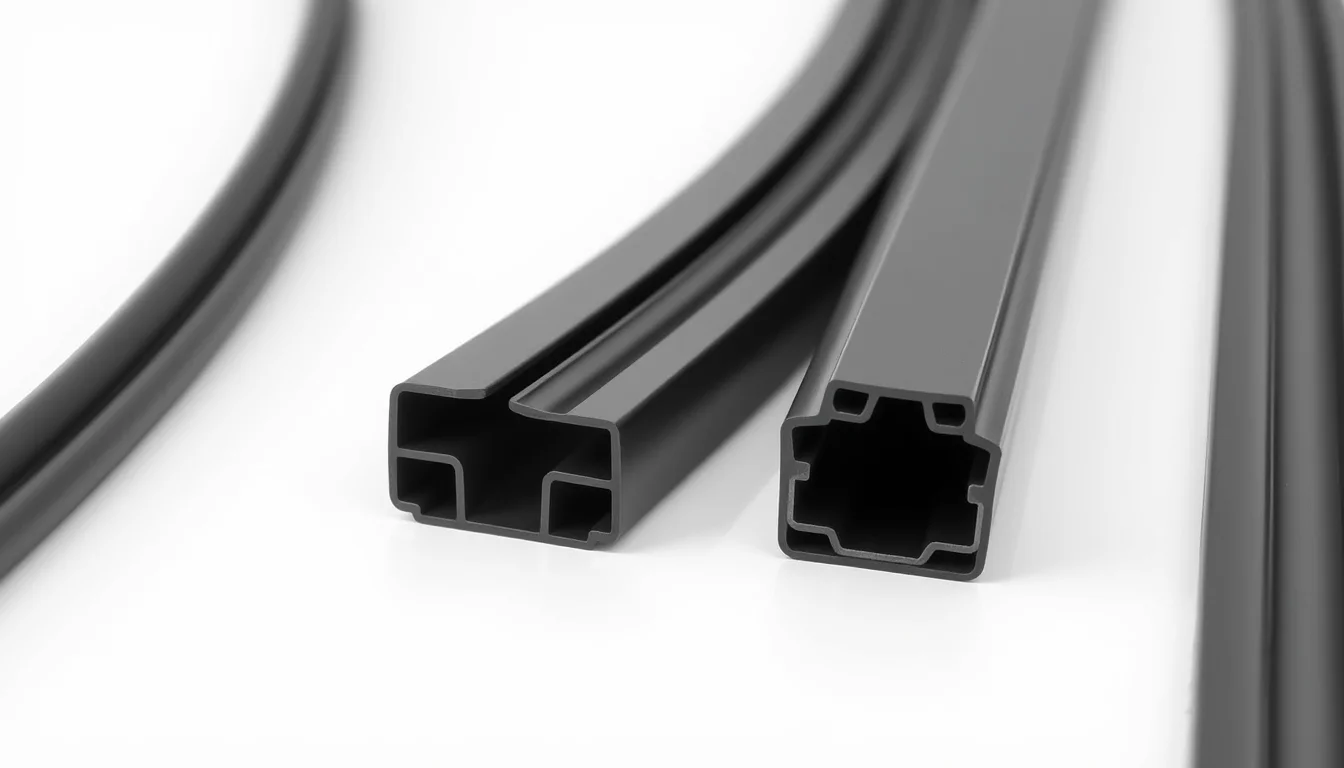
For overseas B2B buyers specifying extruded silicone profiles for harsh environments, the critical decision is matching polymer matrix to the exact UV, thermal, and mechanical load. This review compares EPDM, PVC, and silicone with real Shore A, temperature, and tolerance data from a 15-year application engineer's project files.
Material Head-to-Head: EPDM vs. PVC vs. Silicone
When a project specifier sends a drawing with a -40°C cold-chain requirement and 2000-hour UV exposure, the first question is not price—it is elastomer selection. The table below reflects typical values from production runs and third-party lab reports, not marketing sheets.
| Property | EPDM | PVC (flexible) | Silicone (VMQ) |
|---|---|---|---|
| Shore A hardness range | 50–80 | 55–90 | 30–80 |
| Tensile strength (MPa) | 7–12 | 10–20 | 5–10 |
| Temperature range (°C) | -40 to +150 | -20 to +70 | -60 to +200 |
| Compression set (22h @ 70°C, %) | 15–25 | 20–35 | 10–20 |
| Ozone resistance | Excellent | Poor | Excellent |
| UV resistance (1000h) | Good | Fair | Excellent |
| Flame retardancy (UL 94) | Not inherent | V-0 possible | V-0 possible |
| Relative cost | $ | $ | $$$ |
EPDM remains the workhorse for outdoor architectural seals, but its compression set at 150°C is double that of silicone. PVC is a cost-effective choice for indoor cabinets with no thermal cycling, yet it embrittles below -20°C. Silicone wins on the extremes: -60°C to +200°C, minimal compression set, and inherent ozone resistance. For a door sealing strips application on a cold-storage facility in Norway, we specified a 60 Shore A silicone because EPDM would have exceeded 30% compression set after 500 thermal cycles.
Why durometer alone is not enough
A 50 Shore A EPDM and a 50 Shore A silicone can have identical initial hardness but diverge after thermal aging. ASTM D573 (heat aging) at 100°C for 70 hours typically shows EPDM hardening by 5–10 points, while silicone changes less than 3 points. That difference determines whether a seal still functions after five years.
Extrusion Tolerance and Real-World Fit
Extrusion tolerance is where many overseas buyers get burned. A drawing calling for ±0.5 mm on a 10 mm bulb may pass incoming inspection but fail in assembly when the mating extrusion is at the opposite limit. Our standard production tolerance for silicone profiles is ±0.1 mm on critical dimensions and ±0.2 mm on non-critical, verified with laser micrometers every 500 meters.
Vulcanization control
Silicone requires precise vulcanization to avoid under-cure (tacky surface, high compression set) or over-cure (brittle edges). We run platinum-cured silicone for medical and food-contact grades, and peroxide-cured for general industrial. The cure state is validated via ASTM D395 (compression set) and a solvent swell test per ISO 1817.
The tolerance stack-up trap
A common mistake is specifying ±0.1 mm on a profile that will be spliced into a 2-meter frame. The splice tolerance alone can add ±0.3 mm. For long runs, we recommend a silicone series with a molded corner instead of a spliced corner, eliminating that stack-up.
Harsh Environment Case Files
In our Hunan factory experience, a European OEM sent us a failed EPDM profile from a rooftop HVAC unit in Dubai. After 18 months, the EPDM had cracked at the UV-exposed edge and taken a 40% compression set. We replaced it with a 70 Shore A silicone profile, same cross-section, and ran ASTM D573 at 150°C for 168 hours. The silicone retained 92% of its original tensile strength and had only 12% compression set. That project now runs three shifts, and the silicone seals have passed 36 months without field failure.
Sub-zero cold chain
For a Canadian cold-storage door, the specifier initially chose PVC because of cost. At -35°C, PVC flexural modulus rises sharply, and the seal cracked during door slam testing. We switched to a 50 Shore A silicone with a hollow bulb design, which maintained flexibility down to -55°C. The cabinet seals in that project now use a co-extruded rigid PVC base with a silicone bulb, balancing cost and performance.
High-pressure friction
In hydraulic cylinder wipers, silicone is often too soft. A 80 Shore A EPDM or a polyurethane composite is better for scraping. But for a low-friction dynamic seal in a food-processing line, silicone with a PTFE insert reduced friction by 40% compared to EPDM. We source the PTFE insert and co-extrude in one pass, keeping the WPC profiles line separate to avoid cross-contamination.
Quality Control and Test Protocols
Every production lot of extruded silicone profiles is tested for:
- Hardness: ASTM D2240, ±3 Shore A
- Tensile strength: ASTM D412, minimum 5 MPa
- Compression set: ASTM D395, Method B, 22h @ 70°C
- Thermal aging: ASTM D573, 70h @ 100°C or 168h @ 150°C
- Ozone resistance: ASTM D1149, 50 pphm, 20% strain, 72h
- Flame retardancy: UL 94 horizontal burn, if specified
We issue a 3.1 certificate with each batch, and retain samples for 24 months. For OEM buyers, we can also run custom protocols, such as 1000-hour QUV per ASTM G154.
Sourcing from a Chinese Extruded Silicone Profiles Manufacturer
Overseas B2B buyers often ask about tooling lead time and minimum order quantity. Our standard extrusion die lead time is 7–10 working days for a new profile, and we keep a library of over 400 existing dies for common bulb, U-channel, and lip profiles. That library reduces both cost and lead time for door sealing strips and cabinet seals.
Tooling and MOQ
For a new die, MOQ is 500 kg for silicone and 1000 kg for EPDM. For existing dies, MOQ drops to 200 kg. We accept mixed containers with other rubber products, and we can ship LCL from Shanghai or Shenzhen.
Packaging and labeling
Standard packaging is 100-meter coils in PE bags, then cartons on pallets. We can print your logo and part number on the carton. For long profiles, we use wooden crates. All packaging passes ISTA 1A drop tests.
Frequently Asked Questions
What is your MOQ for extruded silicone profiles?
MOQ is 500 kg for a new custom die and 200 kg for an existing die. For standard profiles from our library, we can go as low as 100 kg for trial orders. We recommend a 200 kg trial to validate fit and material before scaling.
What is your lead time?
New die: 7–10 working days for tooling, then 15–20 days for production. Existing die: 12–18 days for production. We ship from Changde, Hunan, to Shanghai or Shenzhen in 3–5 days by truck, then ocean freight. Air freight is available for urgent samples.
What extrusion tolerance can you hold?
Standard tolerance is ±0.1 mm on critical dimensions and ±0.2 mm on non-critical, measured per ISO 3302-1 Class E2. For very small profiles (under 5 mm), we can hold ±0.05 mm on request. We provide a first article inspection report with every new die.
How do you pack the profiles?
Profiles are coiled in 100-meter lengths, wrapped in PE bags, and packed in cartons on pallets. For long straight lengths, we use wooden crates. We can also pack in your branded cartons. All packaging is designed for sea freight and passes ISTA 1A.
Can I get a sample before ordering?
Yes. We provide free samples up to 1 meter for existing dies. For new dies, we charge a tooling fee and provide a 1-meter sample for approval. Sample lead time is 3–5 days for existing dies and 10–14 days for new dies. You pay only the courier cost.
| Parameter | EPDM | Silicone | PVC |
|---|---|---|---|
| Shore A | 50–80 | 30–80 | 55–90 |
| Temp range (°C) | -40 to +150 | -60 to +200 | -20 to +70 |
| Compression set (%) | 15–25 | 10–20 | 20–35 |
| Tolerance (mm) | ±0.1–0.2 | ±0.1–0.2 | ±0.2–0.3 |
| UV resistance | Good | Excellent | Fair |
| Cost | $ | $$$ | $ |
Send your CAD drawing for a 24-hour quote.
Need a Custom Quote?
Send your CAD drawing or specs (material, hardness, profile, temperature range, MOQ) — our engineering team will respond within 24 hours.