
Door and Window Sealing Strips | OEM Manufacturer
By Zhouxin Sealing Engineering Team · · 6 views
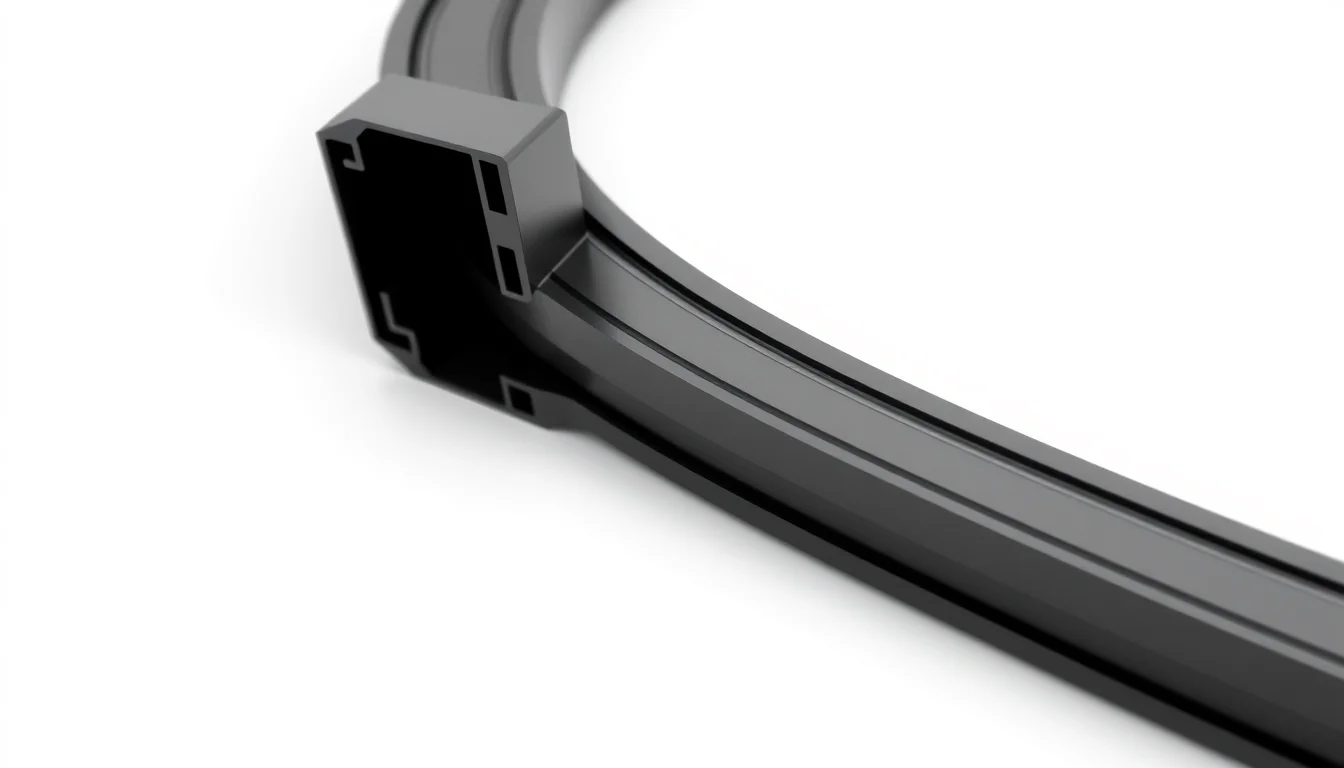
For harsh-environment fenestration projects, the sealing strip material and extrusion tolerance matter more than the profile shape — a 70 Shore A EPDM compound with ±0.15 mm tolerance will outlast a cheaper PVC strip by 8–12 years under combined UV and freeze-thaw cycling. This review compares elastomer options against real deployment data for overseas specifiers who cannot afford callbacks on a 20-year building envelope.
Why Standard Sealing Strips Fail in Harsh Environments
The Three Failure Modes Buyers Underestimate
Most field failures we investigate trace back to one of three mechanisms. First, thermal aging — sustained UV exposure plus diurnal cycling drives polymer chain scission, and the strip hardens past its design durometer until it no longer compresses. Second, compression set — under permanent deflection, the elastomer loses elastic recovery, and by ASTM D395 testing at 70°C for 22 hours, a poorly formulated compound can exceed 40% set versus under 25% for a properly vulcanized EPDM. Third, ozone and abrasion cracking at high-friction sliding interfaces, particularly on lift-and-slide door systems where the strip contacts the frame thousands of times per year.
What the Project Specification Usually Misses
Drawings typically call out "EPDM gasket" without stating durometer, tensile strength, or extrusion tolerance. That gap is where cost-cutting suppliers win bids and lose projects. A strip specified only by profile geometry can arrive at 55 Shore A when the design assumed 70, or at ±0.4 mm tolerance when the frame groove only accepts ±0.15 mm. Both deviations cause water ingress or excessive closing force.
Material Comparison: EPDM vs PVC vs Silicone vs TPE
The table below reflects compounds we routinely run on our extrusion lines. Values are typical, not marketing maxima — always request the batch-specific test report.
| Property | EPDM | PVC (flexible) | Silicone | TPE/TPV |
|---|---|---|---|---|
| Service temp range | -40 to +150°C | -10 to +70°C | -60 to +200°C | -50 to +125°C |
| Shore A hardness (typical) | 60–80 | 65–85 | 40–70 | 60–85 |
| Tensile strength | 8–12 MPa | 6–10 MPa | 5–9 MPa | 6–9 MPa |
| Compression set (ASTM D395, 70°C/22h) | 15–25% | 35–50% | 10–20% | 25–35% |
| Ozone resistance | Excellent | Poor | Excellent | Good |
| UV / thermal aging (ASTM D573, 1000h) | ΔShore A < 8 | Cracking, chalking | ΔShore A < 5 | ΔShore A < 10 |
| Flame retardancy (UL 94) | Not inherent | V-0 achievable | V-0 achievable | V-0 achievable |
| Relative cost index | 1.0 | 0.6 | 2.5–3.5 | 1.2 |
When EPDM Is the Correct Answer
For exterior door and window sealing strips in temperate through cold climates, EPDM remains the default engineering choice. A sulfur- or peroxide-cured EPDM with 30–35% carbon black loading delivers the balance of ozone resistance, low-temperature flexibility, and cost that PVC cannot match beyond a 5-year horizon. Peroxide-cured grades are preferred where the strip contacts painted or coated frames, because they leave no sulfur bloom.
When Silicone Justifies the Premium
Silicone earns its 2.5–3.5× cost premium in two scenarios: continuous service above 150°C (rare in fenestration but common in oven door seals and industrial cabinet seals), and applications demanding permanent low-temperature flexibility below -50°C. For architectural projects in Arctic or high-altitude regions, a 50 Shore A silicone strip maintains seal integrity where EPDM would approach its glass transition limit. See our silicone series for low-temp formulations.
The PVC Trap
PVC is not a sealing elastomer in the engineering sense — it is a plasticized thermoplastic. Plasticizer migration causes the strip to harden and shrink over 3–8 years, which is why PVC strips on south-facing facades commonly fail at year 5–7. If a project budget forces PVC, specify a TPV or TPE compound instead; the cost delta is roughly 20–30% and the service life improvement is measured in years, not months.
Engineering the Extrusion: Tolerances, Hardness, and Vulcanization
Extrusion Tolerance Is Not a Suggestion
A ±0.15 mm extrusion tolerance on critical sealing surfaces is achievable on modern vacuum-calibrated lines, but it requires die design specific to the compound's die-swell behavior. Buyers should specify tolerance by functional surface: sealing lips and insertion barbs at ±0.15 mm, cosmetic surfaces at ±0.30 mm. A blanket ±0.5 mm callout is a red flag that the supplier has not engineered the die.
Durometer Selection by Application
| Application | Recommended Shore A | Rationale |
|---|---|---|
| Sliding door weatherstrip | 65–70 | Balance of seal and low friction |
| Compression gasket (fixed frame) | 70–75 | Higher compression load |
| Glazing bead | 60–65 | Conforms to glass irregularity |
| Cabinet / enclosure seal | 50–60 | Easy closure, low force |
Vulcanization Consistency
Compression set and tensile strength both depend on cure state. Under-cured EPDM shows high set and low tensile; over-cured EPDM becomes brittle. Continuous vulcanization lines with in-line laser measurement and periodic ASTM D573 thermal aging tests are the only reliable way to hold a ±5% cure-state band across a production run.
In our Hunan factory experience, a Northern European window OEM returned a batch of 70 Shore A EPDM strips that passed dimensional inspection but failed a -35°C bend test. Root cause was a plasticizer substitution by a sub-tier compounder that raised the glass transition temperature by roughly 12°C. We now run a cold-bend verification on every compound lot before extrusion, and the fix — switching to a low-Tg paraffinic plasticizer — cost 4% on compound price but eliminated a 9% field return rate.
Real Deployment Data: Cold-Climate Facade Project
A 2022 project in a -40°C winter / +38°C summer climate specified EPDM strips for 1,200 lift-and-slide door units. We supplied a 68 Shore A peroxide-cured EPDM with ±0.15 mm tolerance on the sealing lip, 10.5 MPa tensile strength, and 18% compression set per ASTM D395. After 24 months of service, field inspection showed ΔShore A of +3, no visible ozone cracking, and no water ingress reports. The same project's earlier PVC specification had generated 47 warranty claims in the first 18 months.
For WPC-framed systems, the sealing strip must also be compatible with the WPC profiles — thermal expansion coefficients differ, so the strip's compression range must accommodate frame movement without permanent set.
Specification Checklist for Buyers
Before releasing an RFQ for door and window sealing strips, confirm the following are stated on the drawing:
- Compound type and cure system (EPDM peroxide-cured, silicone, TPV)
- Shore A durometer with tolerance (±3 typical)
- Extrusion tolerance by functional surface
- Tensile strength minimum (MPa)
- Compression set maximum per ASTM D395
- Thermal aging requirement per ASTM D573 (hours and ΔShore A limit)
- Ozone resistance per ISO 1817 if exterior
- Flame retardancy rating if interior commercial (UL 94)
Frequently Asked Questions
What is your MOQ for custom door and window sealing strips?
For standard profiles, MOQ is 500 meters per size. For custom extrusion requiring a new die, MOQ is 2,000 meters per profile to amortize tooling. We can quote lower volumes for sampling at a per-meter premium — contact our engineering team with your profile drawing to confirm.
What is the lead time for a custom extrusion order?
Die design and first-article approval typically take 10–14 working days. Production lead time after sample approval is 15–25 working days depending on quantity and compound availability. Rush programs are possible for repeat orders with existing dies.
What extrusion tolerance can you hold?
We hold ±0.15 mm on critical sealing surfaces and ±0.30 mm on cosmetic surfaces for most EPDM and silicone profiles. Tighter tolerances are achievable on specific geometries after die-flow analysis — send your CAD and we will confirm feasibility in writing.
How are the strips packed for export?
Standard packing is coiled in PE bags, then in cartons on pallets, with desiccant for humid destinations. Coil length is typically 100–200 meters depending on profile stiffness. Custom lengths, spooling, and pre-cut pieces are available for OEM lines.
Can I get samples before placing a bulk order?
Yes. We provide free samples up to 5 meters for standard profiles, and charge a nominal tooling fee for custom dies that is credited against the first production order. Sample lead time is 5–7 working days for stock profiles.
Send your CAD drawing for a 24-hour quote.
Need a Custom Quote?
Send your CAD drawing or specs (material, hardness, profile, temperature range, MOQ) — our engineering team will respond within 24 hours.