
D-Profile Rubber Gaskets | OEM Supplier & Manufacturer
By Zhouxin Sealing Engineering Team · · 226 views
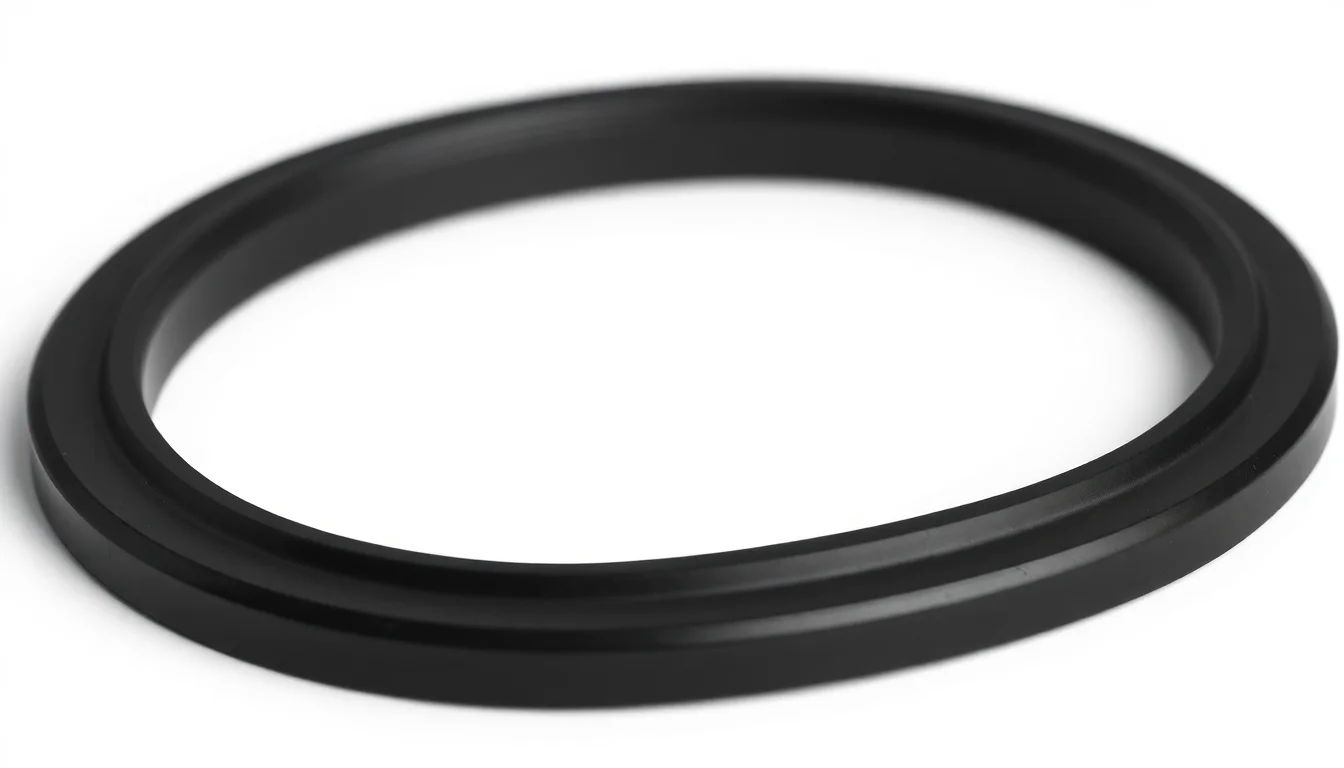
D-profile rubber gaskets are specified when your sealing plane requires a compliant bulb that compresses under closure force while the flat base anchors against the frame — ideal for door, window, cabinet, and equipment seals exposed to cyclic loading. The geometry delivers a lower closure force than O-rings or solid rectangular profiles, but the material selection determines whether the seal survives five years or five months in your application.
Why D-Profile Geometry Matters in Harsh Environments
The D-shape combines a hollow or solid semicircular bulb with a flat mounting base. In dynamic sealing — think industrial freezer doors, railway cabinet hatches, or outdoor electrical enclosures — the bulb absorbs tolerance stack-ups and maintains contact pressure as the frame expands and contracts. The flat base simplifies adhesive mounting or channel insertion.
But the real test comes when you combine long-term UV exposure, sub-zero temperatures, and repeated high-pressure friction. A standard PVC D-profile will harden and crack within 18 months under Arizona sun. An EPDM compound with proper carbon black loading will still seal at -40°C after 1,000 hours of UV-condensation cycling per ASTM D573.
Material Showdown: EPDM vs. PVC vs. Silicone for D-Profile Gaskets
Each elastomer family brings a different balance of cost, temperature range, and environmental resistance. The table below summarizes the critical specs for a typical 10 mm × 8 mm D-profile gasket.
| Property | EPDM (70 Shore A) | PVC (65 Shore A) | Silicone (60 Shore A) |
|---|---|---|---|
| Temperature range | -40°C to +150°C | -10°C to +60°C | -60°C to +230°C |
| Tensile strength (MPa) | 7 – 12 | 4 – 8 | 5 – 10 |
| Compression set (22h/70°C, %) | ≤ 25% (ASTM D395) | ≤ 45% | ≤ 20% |
| Ozone resistance (50 pphm, 40°C, 100h) | No cracks | Cracks after 48h | No cracks |
| UV resistance (1000h QUV) | Excellent | Poor | Excellent |
| Flame retardancy (UL 94) | V-0 with additive | V-2 typical | V-0 with additive |
| Relative cost index | 1.0 (baseline) | 0.6 | 1.8 |
EPDM is the workhorse for outdoor and cold-storage D-profile gaskets. Its saturated polymer backbone resists ozone and UV degradation better than any general-purpose elastomer except silicone. For applications requiring flame retardancy (e.g., rolling stock or building fire doors), we compound EPDM with halogen-free additives to achieve UL 94 V-0 while maintaining the -40°C flexibility.
PVC is cost-effective for indoor, temperature-stable environments — think consumer electronics enclosures or interior cabinet doors. But its plasticizer migration causes hardening and shrinkage over time, and it embrittles below -10°C. We do not recommend PVC for any D-profile gasket that will see direct sunlight or freezing temperatures.
Silicone excels where extreme temperatures or food-grade compliance is required. However, its lower tear strength (typically 10–20 kN/m vs. 25–40 kN/m for EPDM) makes it vulnerable to repeated high-pressure friction against sharp metal edges. For railway door seals that slam thousands of cycles per year, we specify EPDM over silicone.
Tolerances, Hardness, and Compression Set: What Specifiers Must Control
When you send us a CAD drawing for a D-profile gasket, the three numbers we check first are Shore A hardness, extrusion tolerance, and compression set.
Shore A Hardness Selection
- 60–65 Shore A: Soft bulb, low closure force. Suitable for light-duty cabinet seals or dust exclusion. Risk of collapse under high clamping pressure.
- 70–75 Shore A: Standard for most industrial door and window seals. Good balance of compression force and recovery.
- 80 Shore A: High contact pressure, but requires stronger actuators or hinges. Used in high-pressure hydraulic or pneumatic panel seals.
Extrusion Tolerances (ISO 3302-1 Class E1)
For a D-profile with a 10 mm bulb width, we hold:
- Width: ±0.15 mm
- Height: ±0.15 mm
- Base flatness: ≤0.2 mm over 100 mm length
- Cut length tolerance: ±0.5 mm for lengths up to 500 mm
Tighter tolerances are achievable with post-extrusion vulcanization and laser measurement, but they increase tooling and unit cost. For most B2B orders, Class E1 (ISO 3302-1) provides reliable sealing without over-specifying.
Compression Set (ASTM D395 Method B)
This measures how well the gasket recovers after being compressed for a defined time at temperature. For D-profiles that remain compressed for weeks (e.g., shipping container door seals), we recommend:
- EPDM: ≤ 20% after 22 h at 70°C
- Silicone: ≤ 15% after 22 h at 175°C
- PVC: ≤ 40% after 22 h at 50°C
In our Hunan factory experience, a major railcar OEM rejected a competitor’s EPDM D-profile because compression set exceeded 35% after 1,000 hours at 85°C — the gasket took a permanent flat spot and leaked water during pressure wash testing. We reformulated with a peroxide-cured EPDM (instead of sulfur-cured) and reduced compression set to 18%, passing the OEM’s 10-year durability target.
Thermal Aging and Ozone Resistance: Avoiding Surprise Failures
Two accelerated tests separate commodity gaskets from engineered sealing solutions.
Thermal Aging (ASTM D573)
We age D-profile samples at 100°C for 168 hours and measure change in hardness and tensile strength. A stable compound shows:
- Hardness change ≤ ±5 Shore A
- Tensile retention ≥ 80%
If a supplier cannot provide this data, the gasket may embrittle after two summers in a rooftop HVAC unit.
Ozone Resistance (ISO 1817 / ASTM D1149)
Standard test: 50 pphm ozone at 40°C for 100 hours with 20% strain. EPDM and silicone pass with no cracks. PVC and SBR fail within 48 hours. For any D-profile gasket exposed to electrical motors, transformers, or industrial atmospheres, specify ozone-resistant elastomer.
Flame Retardancy for Fire-Rated Applications
Building codes in Europe (EN 13501), North America (UL 94, NFPA 285), and China (GB 8624) increasingly require sealing strips in fire doors and curtain walls to limit flame spread. Our standard flame-retardant EPDM formulation for D-profiles achieves:
- UL 94 V-0 at 3 mm thickness
- Limiting Oxygen Index (LOI) ≥ 28%
- No flaming drips
For projects requiring low smoke toxicity (e.g., subway stations, hospitals), we offer a silicone D-profile with UL 94 V-0 and smoke density ≤ 100 per ASTM E662.
Frequently Asked Questions
What is your MOQ for custom D-profile rubber gaskets?
For extruded profiles using existing tooling, MOQ is 500 meters per profile. For new tooling (custom cross-section), MOQ is 2,000 meters to amortize die cost. We can split across multiple colors or durometers within the same order.
What is the typical lead time for a custom D-profile?
Existing tooling: 10–15 working days after order confirmation. New tooling: 20–25 working days, including die fabrication, first-article inspection, and production. Urgent orders can be expedited to 12 working days with a 15% surcharge.
What extrusion tolerance can you hold on a D-profile?
Standard: ±0.20 mm on width and height (ISO 3302-1 E2). Precision: ±0.15 mm (E1) available for an additional tooling cost. We use laser micrometers inline and manual gauging every 10 meters.
How are the gaskets packed for export?
Standard: 50-meter coils on cardboard reels, wrapped in PE film, then in woven poly bags. For long lengths (over 100 m), we use plywood reels with steel cores. Each reel is labeled with material grade, hardness, and batch number. Palletized and stretch-wrapped for container loading.
Can I get a sample before placing a bulk order?
Yes. We provide free A4-sized cut samples (up to 3 profiles per inquiry) with freight collect. For full-length production samples (e.g., 5-meter piece), we charge a nominal fee refundable on first order. Send your drawing or profile description to our engineering team.
Technical Specifications at a Glance
| Parameter | Standard D-Profile (EPDM) | Precision D-Profile (EPDM) |
|---|---|---|
| Shore A hardness | 70 ± 3 | 70 ± 2 |
| Tensile strength (MPa) | ≥ 8 | ≥ 10 |
| Elongation at break (%) | ≥ 300 | ≥ 350 |
| Compression set (22h/70°C, %) | ≤ 25 | ≤ 20 |
| Temperature range | -40°C to +150°C | -40°C to +150°C |
| UV resistance (1000h) | No cracks | No cracks |
| Ozone resistance (50 pphm) | No cracks | No cracks |
| UL 94 flammability | V-0 (with additive) | V-0 (with additive) |
| Tolerance (width/height) | ±0.20 mm | ±0.15 mm |
Send your CAD drawing for a 24-hour quote.
Need a Custom Quote?
Send your CAD drawing or specs (material, hardness, profile, temperature range, MOQ) — our engineering team will respond within 24 hours.