
D-Profile Rubber Gaskets | Harsh Environment OEM Supplier
By Zhouxin Sealing Engineering Team · · 9 views
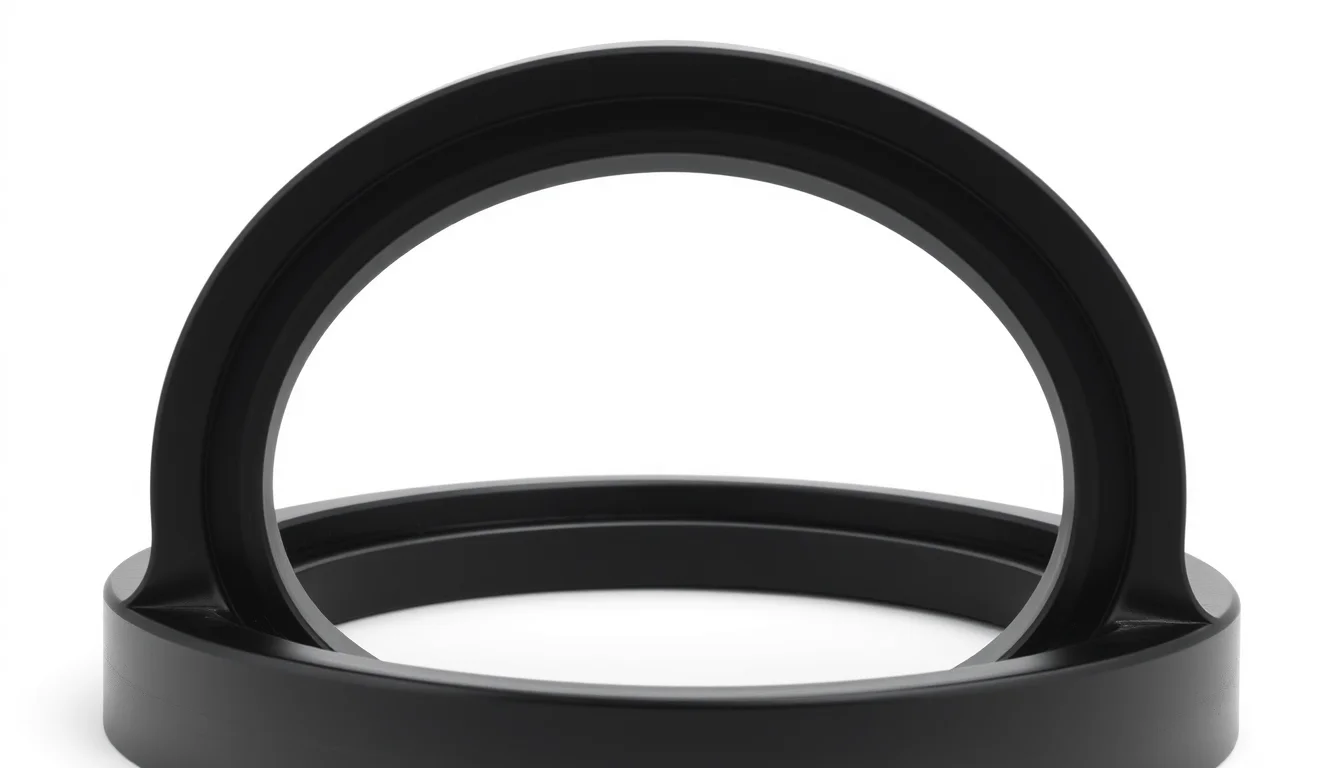
For overseas project specifiers, D-profile rubber gaskets are the default choice when a seal must survive long-term UV, sub-zero cold, and repeated high-pressure friction in one duty cycle — and the fastest way to fail is to specify a generic EPDM bulb without checking durometer, compression set, and extrusion tolerance against the actual gap and load. This review compares the materials and numbers we see in real deployments, so your next RFQ carries the right specification.
Why D-Profile Geometry Wins in Harsh Environments
A D-profile rubber gasket combines a solid base with a hollow bulb. The base anchors the strip into an aluminum or PVC carrier; the bulb deforms to absorb tolerance stack-up between door, frame, and cabinet. In harsh environments this geometry matters more than the polymer itself, because the hollow section converts a small compression force into a large sealing contact patch.
Where the profile fails first
Three failure modes dominate field returns: UV-induced surface crazing on the bulb crown, compression set that leaves a permanent flat spot after thermal cycling, and extrusion of the base under repeated high-pressure friction. Each is a material and tolerance problem, not a design problem.
What the specifier must fix before quoting
Lock down four values before you send an RFQ: Shore A durometer, bulb wall thickness, base extrusion tolerance, and continuous service temperature. Without these, two suppliers will quote the same "D-profile" at 30% different cost and neither will match the other's fit.
Material Head-to-Head: EPDM vs PVC vs Silicone vs TPV
The table below reflects typical production values for D-profile rubber gaskets we run on extrusion lines, not laboratory best-case data. Tensile strength is measured per ASTM D412; compression set per ASTM D395 Method B (70 h at 70°C); thermal aging per ASTM D573.
| Material | Temp Range | Shore A | Tensile (MPa) | Compression Set | UV / Ozone | Relative Cost |
|---|---|---|---|---|---|---|
| EPDM | -40 to 150°C | 60–80 | 8–12 | 20–30% | Excellent | $$ |
| PVC (flexible) | -20 to 70°C | 65–85 | 6–10 | 35–50% | Poor (needs stabilizer) | $ |
| Silicone | -60 to 200°C | 40–70 | 6–9 | 15–25% | Excellent | $$$$ |
| TPV (PP/EPDM) | -40 to 125°C | 60–85 | 5–9 | 25–40% | Very good | $$$ |
| Neoprene (CR) | -30 to 120°C | 55–75 | 8–12 | 20–30% | Good | $$$ |
EPDM — the workhorse for outdoor and cold
An EPDM polymer matrix delivers the best balance of ozone resistance, UV stability, and low-temperature flexibility per dollar. At -40°C a 70 Shore A EPDM bulb still flexes without cracking; PVC at the same temperature turns brittle and shatters on the first door slam. For exterior door sealing strips exposed to sun and freeze-thaw, EPDM is the default.
PVC — cheap, but not for UV or cold
Flexible PVC is the lowest-cost option and machines to tight extrusion tolerance easily. Its weakness is the plasticizer: UV exposure drives plasticizer migration, the profile hardens, and compression set climbs past 40%. If the application is indoor and moderate, PVC is fine. For anything outdoors or below -20°C, do not specify it.
Silicone — when temperature beats budget
Silicone holds -60 to 200°C and resists thermal aging better than any elastomer in this class. It is the right call for oven doors, engine-adjacent seals, and high-temp cabinet gaskets. The trade-off is cost and lower tear resistance — silicone bulbs tear more easily on sharp carrier edges, so radius the extrusion corners. See our silicone series for high-temp D-profiles.
TPV — the co-extrusion play
TPV (a PP/EPDM blend) is fully recyclable and bonds directly to rigid PP or ABS carriers in a single co-extrusion pass. It is the standard choice for automotive and appliance cabinet seals where a two-shot process would add cost. Its temperature ceiling is lower than thermoset EPDM, so verify the duty cycle first.
Engineering Numbers That Decide Pass or Fail
Durometer and compression force
A 70 Shore A EPDM bulb needs roughly 3–5 N per 100 mm to compress 30%. Drop to 50 Shore A and the force falls by half, which helps on thin-walled doors but increases the risk of over-compression and set. Match durometer to the closing force your hardware can deliver.
Extrusion tolerance
For a D-profile gasket, we hold ±0.15 mm on bulb wall and ±0.25 mm on overall height on standard dies. Tighter (±0.10 mm) is achievable on secondary-calibrated lines but adds cost and lead time. If your carrier groove is ±0.20 mm, do not specify a ±0.10 mm gasket — you are paying for precision the assembly cannot use.
Compression set and thermal aging
Compression set is the single best predictor of long-term sealing. Per ASTM D395 Method B, a good EPDM D-profile should stay under 30% after 70 h at 70°C. After 1000 h at 100°C (ASTM D573), tensile retention should stay above 80%. If a supplier cannot quote these two numbers, they have not tested the compound.
Ozone and flame requirements
Outdoor applications should pass ASTM D1149 ozone testing at 50 pphm, 40°C, 20% strain, 72 h without cracking. For rail, marine, and electrical cabinet work, UL 94 V-0 flame retardancy may be mandatory — this requires a halogen-free or halogenated additive package that changes the durometer and cost. Specify it early.
In our Hunan factory experience, ... a European cold-storage door project failed at -35°C because the original supplier used a 65 Shore A PVC D-profile. The bulb cracked within two winters. We re-engineered it in 70 Shore A EPDM with a 1.2 mm bulb wall and ±0.15 mm extrusion tolerance; three years on, compression set measured 24% and no cracking. The lesson: for sub-zero duty, EPDM is not a preference — it is a requirement.
Sourcing and Quality Control Checklist
Compound traceability
Ask for the batch record: base polymer grade, carbon black type, cure system, and vulcanization curve. A supplier who cannot produce this is buying compound on the open market and cannot guarantee repeatability across orders.
Dimensional verification
Request a first-article inspection report with CMM or optical comparator data on bulb height, wall thickness, and base width. For long runs, in-line laser gauging should log every meter.
Aging and environmental testing
Confirm the supplier runs ASTM D573 thermal aging and ASTM D395 compression set on each compound lot, not just on the initial sample. Annual re-testing is the minimum.
Related profiles
If your project also needs rigid decorative or structural trim alongside the gasket, our WPC profiles co-extrude cleanly with TPV and EPDM D-profiles in the same assembly.
Frequently Asked Questions
What is your MOQ for custom D-profile rubber gaskets?
Standard MOQ is 500 meters per profile for existing dies, and 1,000 meters for a new die. For trial orders we can run 200 meters at a surcharge. MOQ scales with profile complexity — a co-extruded TPV/PP D-profile carries a higher minimum than a single-material EPDM strip.
What is your lead time?
Sample lead time is 7–10 working days after drawing approval. Production lead time is 15–20 working days for standard EPDM and PVC, and 20–25 working days for silicone or co-extruded TPV. Peak season (Q3–Q4) can add 5 working days; book capacity early.
What extrusion tolerance can you hold?
Standard tolerance is ±0.15 mm on bulb wall and ±0.25 mm on overall height. Precision-calibrated lines hold ±0.10 mm on critical dimensions. We quote the tolerance explicitly on every drawing so there is no ambiguity at incoming inspection.
How are D-profile gaskets packed for export?
Profiles are coiled in 50 m or 100 m rolls, wrapped in PE film, then packed in double-wall cartons or wooden crates for LCL and FCL shipments. Coil diameter is kept at 400–600 mm to prevent kinking. Custom labeling and barcoding are available for OEM buyers.
Do you provide free samples?
Yes — 1–2 meters of stock profile or a short length of a custom run is free; the buyer covers courier. Custom-compound samples carry a small tooling charge, refundable against the first production order above 5,000 meters.
Specification Summary
| Parameter | Standard Range | Precision Option |
|---|---|---|
| Material | EPDM, PVC, Silicone, TPV, CR | Custom compound |
| Shore A | 50–85 | ±3 |
| Temp range | -40 to 150°C (EPDM) | -60 to 200°C (Silicone) |
| Tensile strength | 6–12 MPa | Per ASTM D412 |
| Compression set | ≤30% (70 h / 70°C) | ≤20% on request |
| Extrusion tolerance | ±0.15 mm | ±0.10 mm |
| Ozone resistance | ASTM D1149, 50 pphm | 72 h, no crack |
| Flame retardancy | Optional UL 94 V-0 | Halogen-free available |
| MOQ | 500 m (stock die) | 1,000 m (new die) |
Send your CAD drawing for a 24-hour quote.
Need a Custom Quote?
Send your CAD drawing or specs (material, hardness, profile, temperature range, MOQ) — our engineering team will respond within 24 hours.