
Bus and Truck Window Rubber Seal | OEM Manufacturer
By Zhouxin Sealing Engineering Team · · 117 views
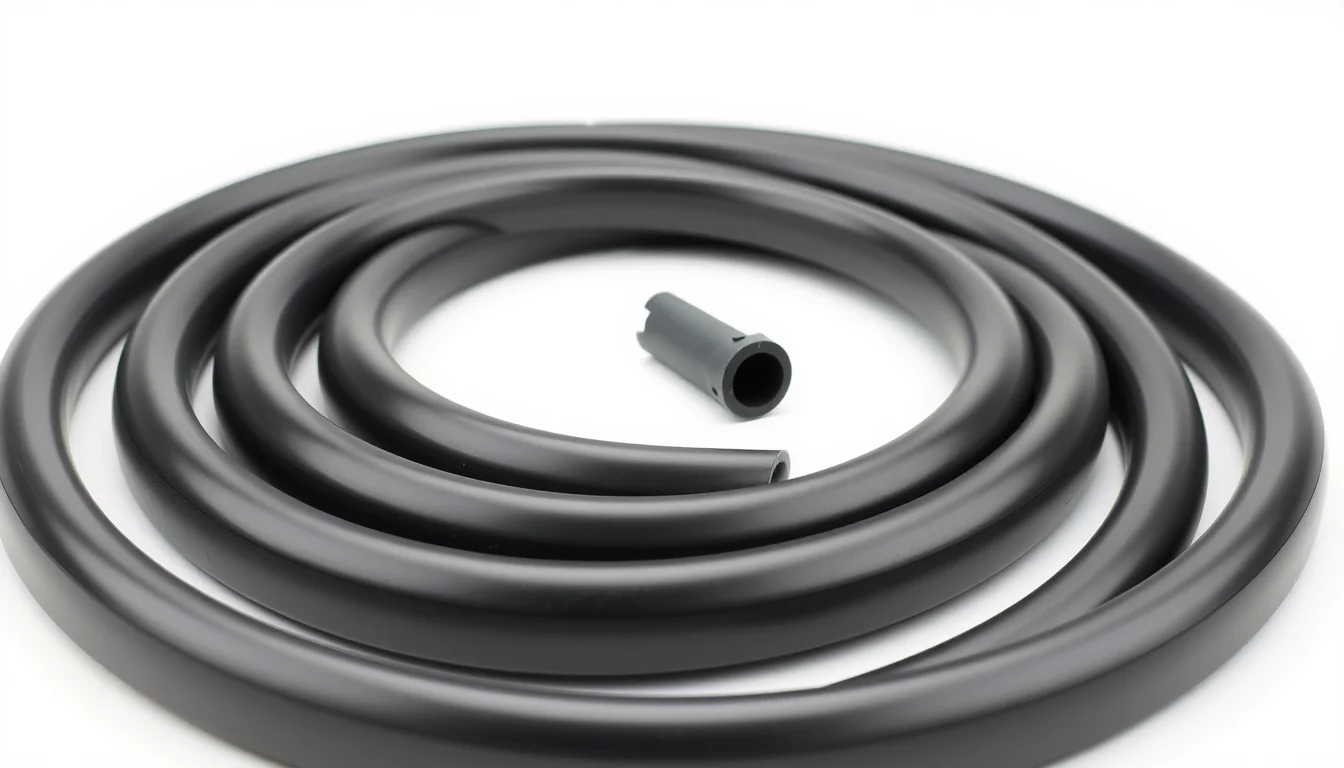
Bus and truck window rubber seal selection hinges on four verifiable figures: tensile strength (MPa), compression set (%), thermal aging resistance (hours at °C), and fluid resistance per ISO 1817. This datasheet-grade comparison gives overseas OEM and fleet specifiers the polymer matrix data needed to lock a material grade before tooling. All values below reflect production lots from our Changde, Hunan lines.
Material Comparison Matrix for Bus and Truck Window Rubber Seals
| Property | EPDM (dense) | EPDM (sponge) | Silicone VMQ | TPE-SEBS | PVC/NBR blend |
|---|---|---|---|---|---|
| Shore A hardness | 60–80 | 25–45 (Shore 00) | 40–70 | 55–75 | 65–85 |
| Tensile strength (MPa) | 8–14 | 1.5–3.5 | 6–10 | 5–9 | 7–11 |
| Elongation at break (%) | 300–450 | 200–350 | 250–400 | 350–500 | 200–300 |
| Temp range (continuous) | -40 to +120°C | -40 to +110°C | -55 to +200°C | -50 to +90°C | -30 to +100°C |
| Compression set (ASTM D395, 70h @ 70°C) | 18–25% | 20–30% | 12–20% | 25–35% | 30–40% |
| Ozone resistance (50 pphm, 200h) | No crack | No crack | No crack | No crack | Slight crack |
| Oil resistance (ASTM #3, 70h @ 100°C) | Poor (swell >80%) | Poor | Moderate | Poor | Good (<25% swell) |
| Acid/alkali (10% H₂SO₄/NaOH, 168h) | Good | Good | Excellent | Fair | Fair |
| Thermal aging (ASTM D573, 1000h @ 100°C) | Δ tensile −15% | Δ tensile −20% | Δ tensile −8% | Δ tensile −30% | Δ tensile −25% |
| Estimated service life (UV + ozone, exterior) | 10–15 years | 8–12 years | 15–20 years | 5–8 years | 4–6 years |
| Relative cost index | 1.0 | 0.9 | 2.8–3.5 | 0.8 | 0.7 |
Data derived from in-house testing per ASTM D412 (tensile), ASTM D2240 (durometer), ASTM D573 (thermal aging), and ASTM D395 Method B (compression set).
Why EPDM Remains the Baseline for Exterior Window Seals
The saturated polymer backbone of EPDM blocks ozone attack at the double-bond level, which is why exterior bus and truck window rubber seal profiles routinely pass 200-hour ozone tests at 50 pphm without cracking. For fleet operators running 8–12 year duty cycles across UV-heavy latitudes, EPDM delivers the lowest cost-per-service-year of any elastomer class.
Vulcanization Package Effects on Compression Set
Peroxide-cured EPDM achieves 18–22% compression set versus 24–30% for sulfur-cured equivalents under ASTM D395. For a window seal under permanent 30% deflection, that 6–8 point delta translates to roughly 2–3 additional years of sealing force retention before water ingress risk rises.
Extrusion Tolerance Reality
Dense EPDM profiles hold ±0.15 mm on critical sealing lips and ±0.30 mm on non-sealing geometry. Sponge co-extrusions typically widen to ±0.50 mm due to post-vulcanization expansion variance. Specifiers should define a separate tolerance class for the sealing lip and the retention foot — a single blanket tolerance is the most common cause of field leaks we see in RFQs.
In our Hunan factory experience, a European bus OEM rejected an initial tooling run of a triple-durometer window seal because the sponge bulb drifted +0.7 mm on the retention side, exceeding the ±0.5 mm print. Switching the sponge compound from a 0.85 g/cm³ to a 0.72 g/cm³ density grade and adjusting the microwave vulcanization tunnel line speed from 6 m/min to 5.2 m/min brought the profile back to ±0.35 mm without a tooling change. That single process correction saved a 12-week re-tool cycle.
Silicone and Specialty Grades for Extreme Duty
Silicone VMQ enters the specification when continuous operating temperatures exceed 120°C — turbo-diesel engine-adjacent windows, exhaust-shielded compartments, or desert-fleet duty cycles. The 12–20% compression set and −55°C low-temperature flexibility outperform EPDM on both ends of the thermal envelope, at a 2.8–3.5× cost multiplier.
Flame Retardancy Requirements
For intercity coach interiors, UL 94 V-0 grades are achievable in silicone and in halogen-free EPDM formulations using ATH (alumina trihydrate) loading at 40–55 phr. Note that ATH loading raises Shore A by 5–8 points and reduces tensile strength by approximately 20% — specifiers must re-baseline mechanical targets when adding flame retardancy.
Oil and Fuel Exposure
Window seals adjacent to fuel filler necks or hydraulic service bays require NBR or PVC/NBR blends, which hold ASTM #3 oil swell under 25% versus >80% for EPDM. The trade-off is ozone cracking resistance: NBR blends show surface cracking at 50 pphm/200h, so a co-extruded dual-material profile (EPDM exterior, NBR interior contact) is often the correct engineering answer.
Compression Set and Long-Term Sealing Force
Compression set is the single best predictor of long-term sealing performance in a bus and truck window rubber seal. A seal molded at 30% deflection that exhibits 25% compression set after ASTM D395 testing retains only 22.5% of its original deflection — a 25% loss of sealing force. Materials exceeding 30% set should not be specified for windows expected to remain watertight beyond 5 years.
Thermal Aging Trajectory
ASTM D573 aging at 100°C for 1000 hours is the industry proxy for 10–12 years of field service in temperate climates. EPDM loses 15% tensile; silicone loses 8%; TPE loses 30%. The silicone advantage is real but rarely justifies the cost premium unless the duty cycle includes sustained temperatures above 130°C.
Co-Extrusion and Multi-Durometer Architecture
Modern bus window profiles frequently combine a dense EPDM sealing lip (70 Shore A) with a sponge bulb (35 Shore 00) and a rigid TPE retention foot in a single extrusion pass. This architecture optimizes three functions simultaneously: sealing force, deflection compliance, and clip-free installation. Related profile families include door sealing strips and cabinet seals, which share the same co-extrusion tooling logic.
For interior trim-adjacent seals where color matching and surface finish dominate, WPC profiles are sometimes specified as a rigid substrate behind the elastomer seal. Where high-temperature or high-purity contact is required, our silicone series covers −55 to +200°C continuous duty.
Frequently Asked Questions
What is the MOQ for a custom bus and truck window rubber seal?
Standard MOQ is 500 meters for existing tooling and 3,000 meters for new extrusion dies. Co-extruded dual-durometer profiles carry a 5,000-meter MOQ due to the additional die complexity. Sample-length orders (10–50 m) are accepted for qualification testing before production commitment.
What is the lead time for OEM window seal production?
New tooling runs 18–25 working days from drawing approval to first article. Production after PPAP sign-off ships in 12–18 working days for orders under 20,000 meters. Air freight for qualification samples is standard; sea freight is standard for production volumes.
What extrusion tolerance can you hold on window seal profiles?
Dense EPDM sealing lips hold ±0.15 mm; non-sealing geometry holds ±0.30 mm. Sponge sections hold ±0.50 mm. Tolerances are defined per dimension on the drawing, not as a blanket class, in line with ISO 3302-1 Class E2/E3 conventions.
How are window seals packed for export?
Profiles are coiled at 200–500 meter lengths, wrapped in PE film, and packed in double-wall corrugated cartons or on wooden pallets for LCL shipments. Cut-length kits are packed flat in layered cartons. All packaging is moisture-barrier rated for 90-day sea transit.
What is your sample policy?
Free 10–50 cm cut samples from existing tooling ship within 48 hours of request. Custom-compounded samples for material qualification (specific durometer, color, flame rating) ship in 7–10 working days at cost, credited against the first production order.
Specification Reference Table
| Parameter | Standard Range | Premium Range | Test Method |
|---|---|---|---|
| Hardness | 60–80 Shore A | 65–75 Shore A | ASTM D2240 |
| Tensile strength | 8–12 MPa | 12–14 MPa | ASTM D412 |
| Compression set | 22–28% | 18–22% | ASTM D395 B |
| Thermal aging (1000h @ 100°C) | Δ −20% | Δ −15% | ASTM D573 |
| Ozone resistance | 200h @ 50 pphm | 500h @ 50 pphm | ASTM D1149 |
| Low temp flexibility | −40°C | −45°C | ASTM D2137 |
| Extrusion tolerance (lip) | ±0.30 mm | ±0.15 mm | ISO 3302-1 |
| Service life (exterior) | 8–12 years | 12–15 years | Field correlation |
Send your CAD drawing for a 24-hour quote.
Need a Custom Quote?
Send your CAD drawing or specs (material, hardness, profile, temperature range, MOQ) — our engineering team will respond within 24 hours.