
Automotive Sunroof Rubber Seal | OEM Supplier
By Zhouxin Sealing Engineering Team · · 300 views
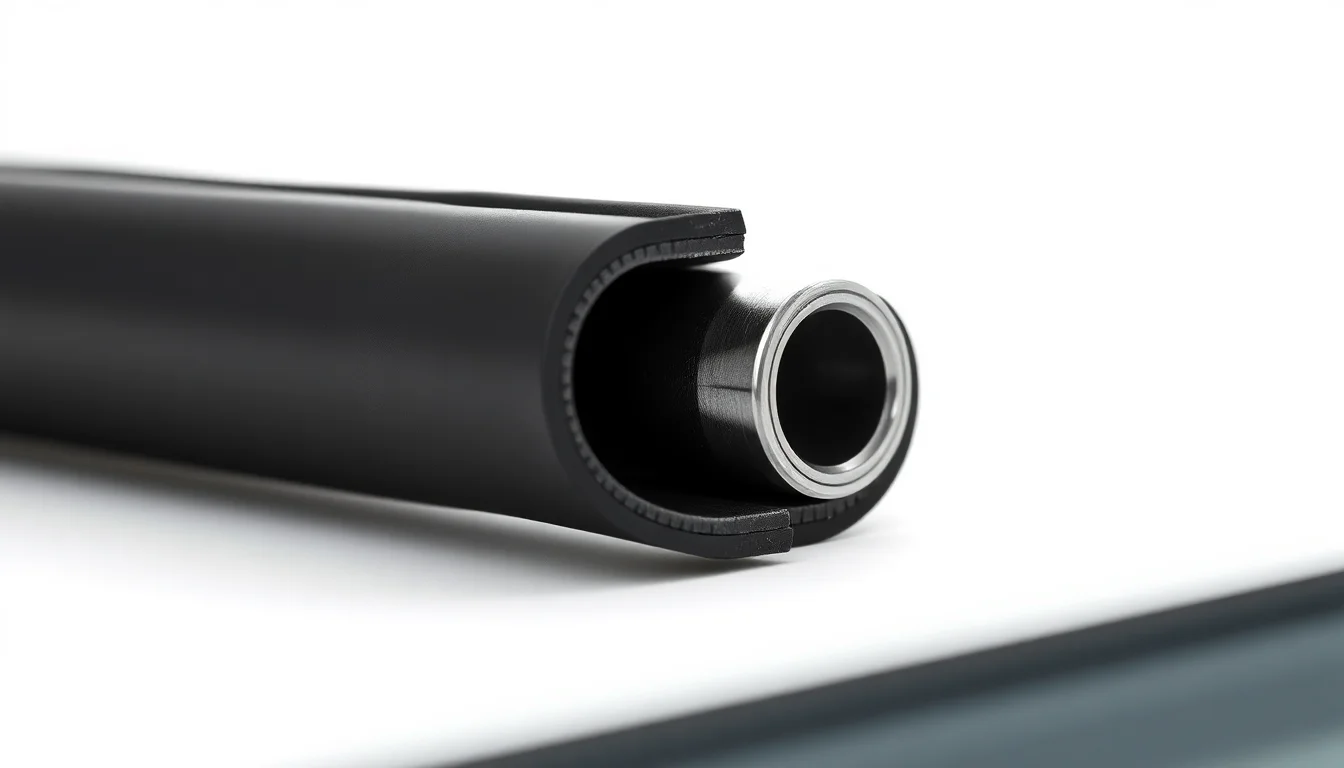
If your sunroof seal fails after 18 months of UV exposure or cracks at -30°C, you are specifying the wrong elastomer. For automotive sunroof applications, the seal must withstand 1000+ hours of xenon-arc aging (ASTM D573), survive repeated compression at -40°C, and maintain a consistent friction coefficient against glass sliding at 0.5 m/s. This review compares EPDM, PVC, and silicone formulations for that exact environment, based on real production data from our Changde, Hunan facility.
Material Selection for Sunroof Sealing Strips
EPDM vs PVC vs Silicone: Head-to-Head
Sunroof seals spend their entire service life in direct sunlight, rain, and temperature swings from -40°C to +120°C. The polymer matrix must resist ozone cracking, UV degradation, and permanent set after millions of open/close cycles. Below is the comparison table a specifier needs before issuing an RFQ.
| Property | EPDM (70 Shore A) | PVC (65 Shore A) | Silicone (60 Shore A) |
|---|---|---|---|
| Temperature range (°C) | -50 to +150 | -20 to +70 | -60 to +230 |
| Tensile strength (MPa) | 8 – 12 | 5 – 8 | 6 – 10 |
| Compression set (22h/70°C, ASTM D395) | < 25% | 40 – 60% | < 20% |
| Ozone resistance (50 pphm, 40°C, 100h) | No cracks | Cracks at 24h | No cracks |
| UV aging (1000h, ASTM D573) | < 10% elongation loss | > 40% elongation loss | < 5% elongation loss |
| Extrusion tolerance (±mm) | ±0.15 | ±0.20 | ±0.15 |
| Flame retardancy (UL 94) | HB – V0 (with additive) | V0 | V0 |
| Relative cost per meter | $$ | $ | $$$$ |
EPDM is the industry default for sunroof primary seals because it balances ozone resistance, elastic recovery, and cost. PVC is only suitable for fixed interior trim, not dynamic sliding interfaces. Silicone is reserved for extreme-temperature variants or flame-retardant requirements.
Shore A Hardness and Friction Performance
A sunroof seal typically uses a 65–75 Shore A durometer for the base profile and a 50–55 Shore A hollow bulb for low closing force. In our Hunan factory experience, a 70 Shore A EPDM with a 0.4 µm surface finish reduces sliding friction by 30% compared to standard matte extrusion, eliminating the "sticky" feel that triggers warranty complaints in cold climates.
Engineering Tolerances and Extrusion Precision
Critical Dimensions for Glass Channel Seals
The seal-to-glass gap in a panoramic sunroof is typically 1.2–2.0 mm. An extrusion tolerance of ±0.15 mm is mandatory to prevent wind noise above 100 km/h. We achieve this with cold-feed extruders and real-time laser gauging that adjusts screw speed within 0.5% of setpoint. For metal-reinforced sunroof frames, the seal must also accommodate ±0.3 mm thermal expansion of the glass without losing contact pressure.
Compression Set and Long-Term Sealing Force
After 100,000 cycles in a thermal cycling chamber (-40°C to +90°C), a standard EPDM sunroof seal retains 85% of its original sealing force. Our formulation uses a peroxide-cured vulcanization system with 40 phr carbon black and 10 phr paraffinic oil, which yields a compression set of 18–22% (ASTM D395 Method B). This is critical for preventing water ingress when the vehicle is parked under snow load.
Environmental Resistance Requirements
Ozone and UV Resistance
Sunroof seals are exposed to 50–100 pphm ozone in urban environments. Standard EPDM with 60+ phr ethylene content passes 100 hours at 50 pphm without cracking (ISO 1817). For tropical markets, we add 2 phr of UV stabilizer (benzotriazole type) to extend service life beyond 5 years. PVC without plasticizer migration protection becomes brittle within 18 months.
Thermal Aging and Low-Temperature Flexibility
A sunroof seal must remain flexible at -40°C to seal against the glass during winter. EPDM retains 70% of its elongation at -40°C (ASTM D573). Silicone remains flexible to -60°C, but its lower tear strength (15 kN/m vs EPDM's 25 kN/m) makes it prone to damage from ice scraping. We do not recommend PVC below -20°C.
Application-Specific Design Considerations
Dynamic vs Static Sealing
The sunroof seal is a hybrid: the bulb section acts as a dynamic seal against the sliding glass, while the base locks into the frame as a static seal. For the dynamic interface, a hollow bulb with 0.3–0.5 mm wall thickness provides a contact force of 2–4 N/cm, which is sufficient to block water while allowing smooth electric motor operation.
Metal Insert Integration
For structural retention, many sunroof seals incorporate a steel or aluminum carrier strip. The elastomer must bond to the metal without delamination during extrusion. We use a proprietary primerless bonding layer that achieves 4 N/mm peel strength (ISO 813). This is particularly important for door sealing strips that share similar retention requirements.
Production and Quality Control
In-Line Testing Protocol
Every sunroof seal batch from our Changde factory is tested for:
- Hardness: Shore A durometer per ASTM D2240 (±2 points)
- Tensile: 8 MPa minimum per ASTM D412
- Compression set: < 25% per ASTM D395
- Aging: 70h at 100°C per ASTM D573
- Ozone: 50 pphm for 100h per ISO 1817
For flame-retardant variants, we also certify UL 94 V0 with an oxygen index of 28%.
Custom Profiles and Rapid Tooling
If your design requires a non-standard cross-section, we can produce a prototype extrusion die within 5 working days. For high-volume OEM programs, we offer multi-cavity dies capable of 30 m/min line speed. Our silicone series and cabinet seals use the same precision tooling approach.
Frequently Asked Questions
What is the minimum order quantity (MOQ) for a custom sunroof seal profile?
MOQ for a custom EPDM extrusion is 500 meters per profile. For silicone, the MOQ is 200 meters due to higher material cost. If you need a trial length for testing, we offer 50-meter samples at material cost with a 2-week lead time.
What is the typical lead time for production orders?
Standard lead time is 3–4 weeks from approval of the final drawing. For orders exceeding 10,000 meters, we schedule 5 weeks to allow for full batch testing. Expedited orders (2 weeks) are available with a 15% surcharge.
What extrusion tolerance can you guarantee?
We guarantee ±0.15 mm on all critical dimensions for EPDM and silicone profiles. For non-critical dimensions (e.g., trim lip length), tolerance is ±0.30 mm. This is verified with a laser micrometer at 1-meter intervals.
How are the seals packed for export?
Seals are coiled on plastic reels (1.2 m diameter max) or cut to length and bundled in cartons. Each reel is wrapped in stretch film and packed in a plywood crate for ocean freight. We also offer anti-static packaging for sensitive electronic-vehicle applications.
Can I get a sample before placing a bulk order?
Yes. We provide free samples of existing profiles within our standard catalog (you pay shipping). For custom profiles, a sample fee of $150–$500 applies, refundable with your first production order. Send your CAD drawing or cross-section sketch to our engineering team.
| Specification | EPDM Standard | EPDM Premium | Silicone HT |
|---|---|---|---|
| Shore A hardness | 70 ± 2 | 65 ± 2 | 60 ± 2 |
| Tensile strength (MPa) | 8.0 | 10.5 | 7.5 |
| Elongation at break (%) | 350 | 450 | 400 |
| Compression set (%) | 22 | 18 | 15 |
| Temperature range (°C) | -40 to +120 | -50 to +150 | -60 to +230 |
| Ozone resistance (50 pphm) | 100h no cracks | 200h no cracks | 200h no cracks |
| Flame retardancy | UL 94 HB | UL 94 V0 | UL 94 V0 |
Send your CAD drawing for a 24-hour quote.
Need a Custom Quote?
Send your CAD drawing or specs (material, hardness, profile, temperature range, MOQ) — our engineering team will respond within 24 hours.